
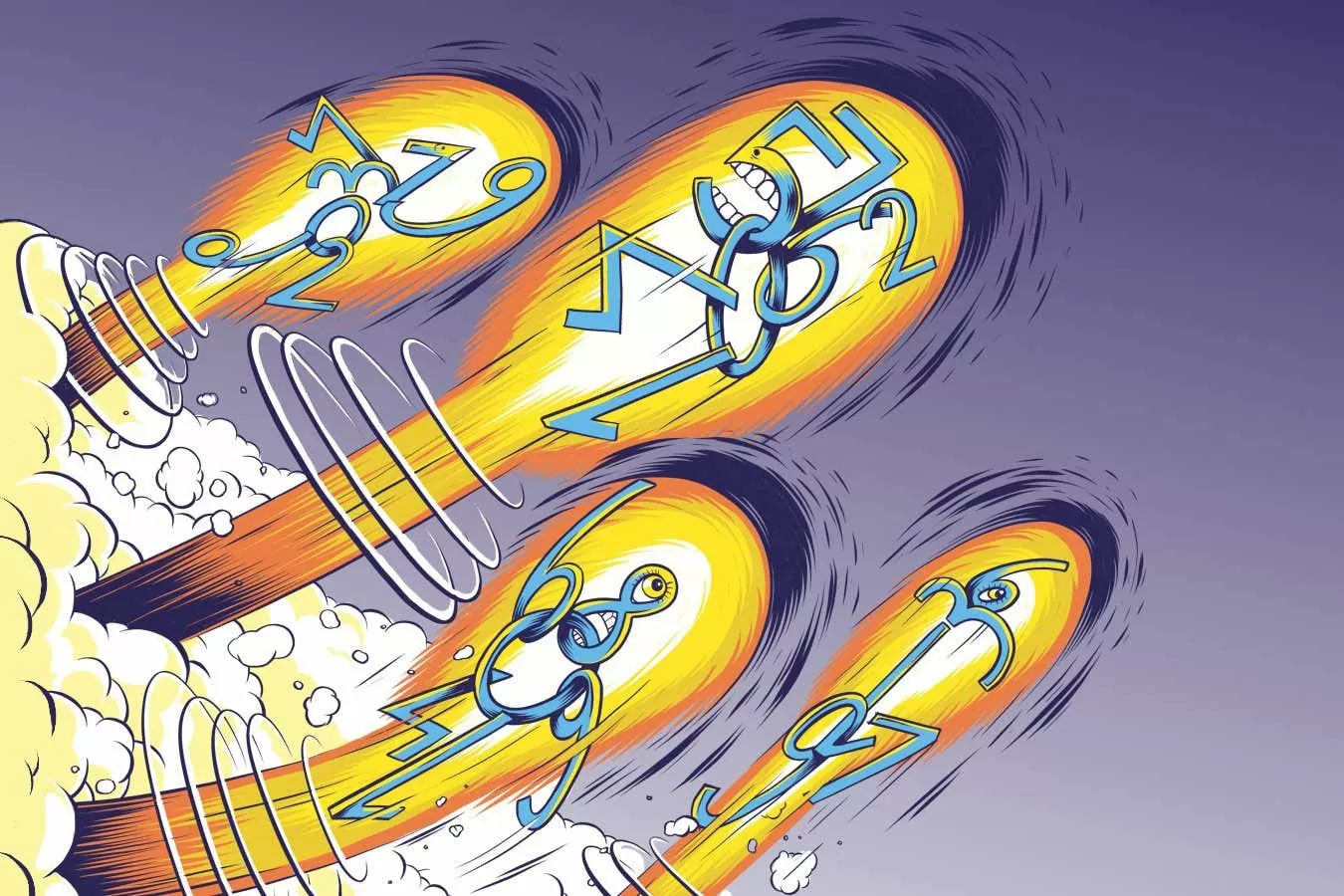
Mathematics, the universal language of numbers and patterns, has been the backbone of scientific and technological progress for centuries. It has allowed us to understand the mysteries of our world and even the universe. We rely on mathematics to solve problems, predict outcomes, and make sense of the world around us. However, there are certain seemingly simple sequences of multiplication and addition that challenge the very foundations of this discipline, pushing the boundaries of what we thought was possible. These infinite sequences grow at an astonishing rate and demand a whole new level of logic to unravel their mysteries.
At first glance, these sequences may seem like child’s play, involving nothing more than basic arithmetic. Take, for example, the sequence 2, 4, 8, 16, 32, and so on. It is a straightforward pattern of doubling the previous term to get the next one. However, as we continue this pattern, it quickly becomes apparent that the numbers are growing at a breathtaking pace. Just 15 terms into the sequence, we reach a staggering number of 32,768. And by the time we reach the 30th term, the number has grown to an unimaginable 1,073,741,824. This exponential growth is just the tip of the iceberg, making these seemingly simple sequences a mathematician’s nightmare.
One of the most famous sequences that challenges the foundations of mathematics is the Fibonacci sequence. It involves adding the two previous terms to get the next one, starting with 0 and 1. So, the sequence goes like this: 0, 1, 1, 2, 3, 5, 8, 13, 21, and so on. While this sequence may seem innocent enough, it has baffled mathematicians for centuries. It appears naturally in nature, from the arrangement of leaves on a stem to the spiral patterns of galaxies. But what makes it truly mind-boggling is its connection to the golden ratio, a mathematical constant that is found in numerous forms of art, architecture, and even the human body.
As if the Fibonacci sequence wasn’t perplexing enough, there are other similar sequences that leave mathematicians scratching their heads. Take the Lucas sequence, for example, which is almost identical to the Fibonacci sequence, but starts with 2 and 1 instead of 0 and 1. This tiny change may seem insignificant, but it leads to drastically different results. The numbers in this sequence grow even faster than the Fibonacci sequence, raising questions about the very nature of infinity.
These sequences, along with many others, are known as recursive sequences, as each term depends on the previous ones in a recursive manner. What makes them so fascinating is that the growth of these sequences is not linear, but exponential. This means that the numbers increase at an increasingly faster rate, and it becomes impossible to predict or even imagine the values of the terms after a certain point. It is as if these sequences have a life of their own, growing at an unfathomable speed, in defiance of our traditional understanding of mathematics.
The study of these sequences has led mathematicians to the field of number theory, which deals with the properties and behavior of numbers. It has also given rise to a whole new branch of mathematics called the theory of computation, which focuses on the limits of what can be computed and calculated using algorithms and machines. These seemingly simple sequences have opened up a whole new realm of mathematics, demanding a level of logic and reasoning beyond what we thought was possible.
But why are these sequences important, apart from their ability to amaze and challenge our understanding of mathematics? For one, they have practical applications in fields like cryptography and data compression, where the exponential growth of these sequences is utilized to secure and store large amounts of information effectively. They also play a crucial role in the study of chaos theory, where even the slightest change in initial conditions can lead to drastically different outcomes.
However, what these sequences truly signify is the limitless possibilities of mathematics. They show us that even the most basic and simple concepts can lead to mind-boggling results, and that our understanding of numbers and patterns is constantly evolving. They inspire us to push the boundaries and question the very foundations of mathematics, opening up new avenues for exploration and discovery.
So, the next time you come across a seemingly simple sequence of numbers, do not underestimate its power. It could be the key to unlocking a whole new world of mathematics, demanding a level of
