
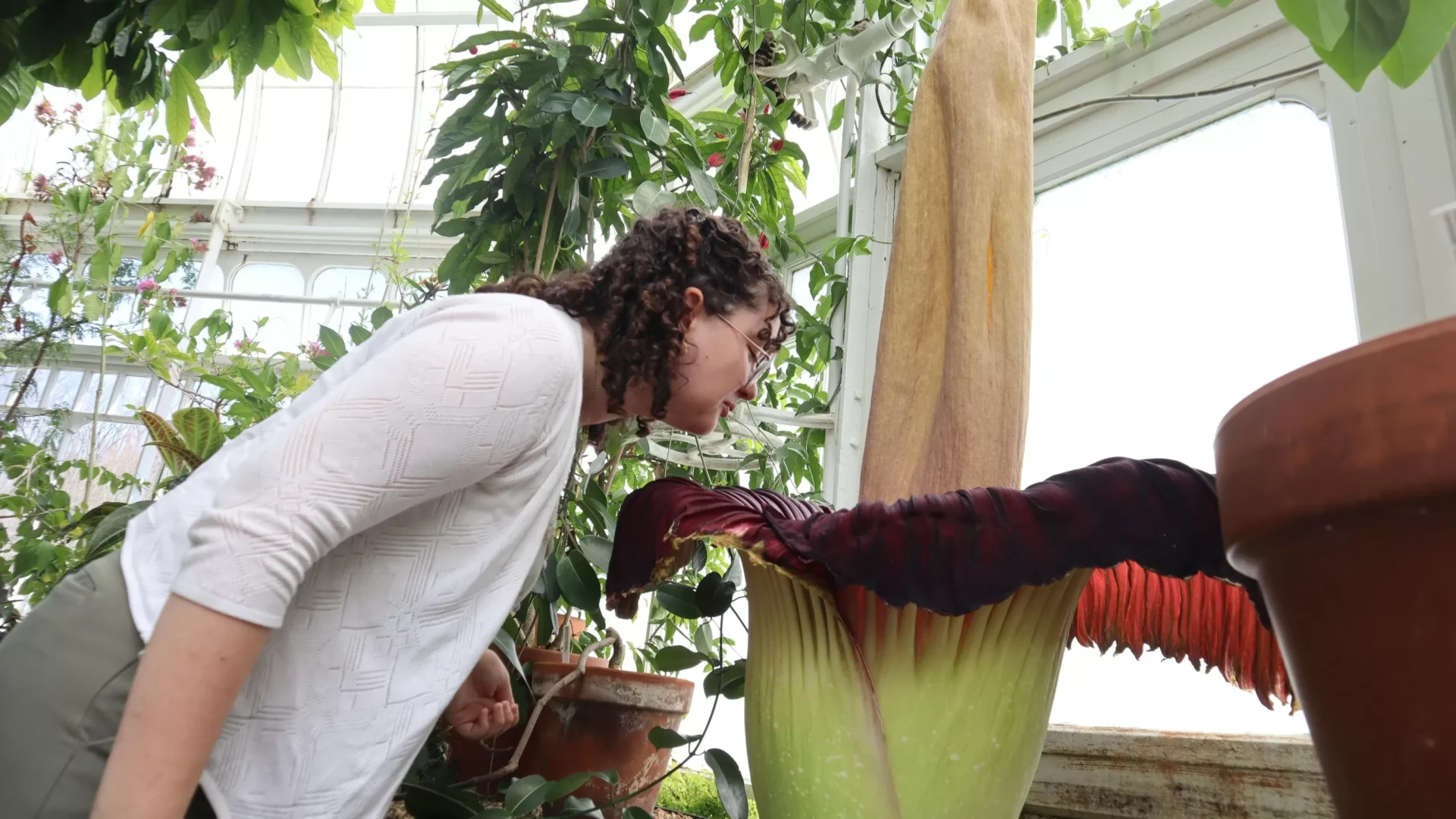
On a sunny afternoon at Mount Holyoke College, a group of curious onlookers gathered at the Talcott Greenhouse, eagerly awaiting the rare bloom of a corpse flower. The excitement was palpable as the crowd waited for the arrival of “Pangy,” the infamous flower known for its pungent odor resembling decaying flesh.
The Talcott Greenhouse, located on the picturesque campus of Mount Holyoke College in South Hadley, Massachusetts, is home to a diverse collection of plants from around the world. But on this particular day, all eyes were on Pangy, a corpse flower (Amorphophallus titanum) that was about to bloom for the first time in its 10-year existence.
The corpse flower, also known as the “titan arum,” is a rare and exotic plant native to the rainforests of Sumatra, Indonesia. It is known for its massive size, with some specimens reaching heights of over 10 feet, and its unique blooming cycle, which can take up to 10 years to occur.
As the crowd anxiously waited, the greenhouse staff prepared for the big moment, carefully monitoring the temperature and humidity levels to ensure the perfect conditions for Pangy’s bloom. And then, finally, it happened – the giant flower began to open, revealing its deep purple petals and a striking yellow spadix in the center.
The onlookers were in awe as they caught a glimpse of the rare flower, but what truly captivated their attention was the intense smell emanating from Pangy. The odor, described as a combination of rotting meat and garbage, is the plant’s way of attracting pollinators, such as beetles and flies, to help with its reproduction.
Despite the overpowering scent, the crowd couldn’t help but be drawn to Pangy, with many taking photos and videos to capture the moment. Some even braved the smell to get a closer look and experience the unique bloom firsthand.
“I’ve never seen anything like this before,” exclaimed one visitor, holding her nose but unable to tear her eyes away from the flower. “It’s incredible to witness such a rare event.”
The bloom of Pangy was not only a spectacle for the senses but also a reminder of the importance of conservation and preservation of these unique and endangered plants. The Talcott Greenhouse, along with other botanical gardens and institutions around the world, plays a crucial role in the conservation of these species, providing a safe haven for them to thrive and educate the public about their importance.
As the day came to an end, the crowd slowly dispersed, but the memory of Pangy’s bloom will remain etched in their minds forever. The rare and captivating event brought together people from all walks of life, united in their appreciation for the wonders of nature.
The Talcott Greenhouse and Mount Holyoke College are proud to have been a part of this momentous occasion and continue to welcome visitors to experience the beauty and diversity of the plant world. And who knows, perhaps in another 10 years, Pangy will grace us with its presence once again, reminding us of the power and resilience of nature.
