
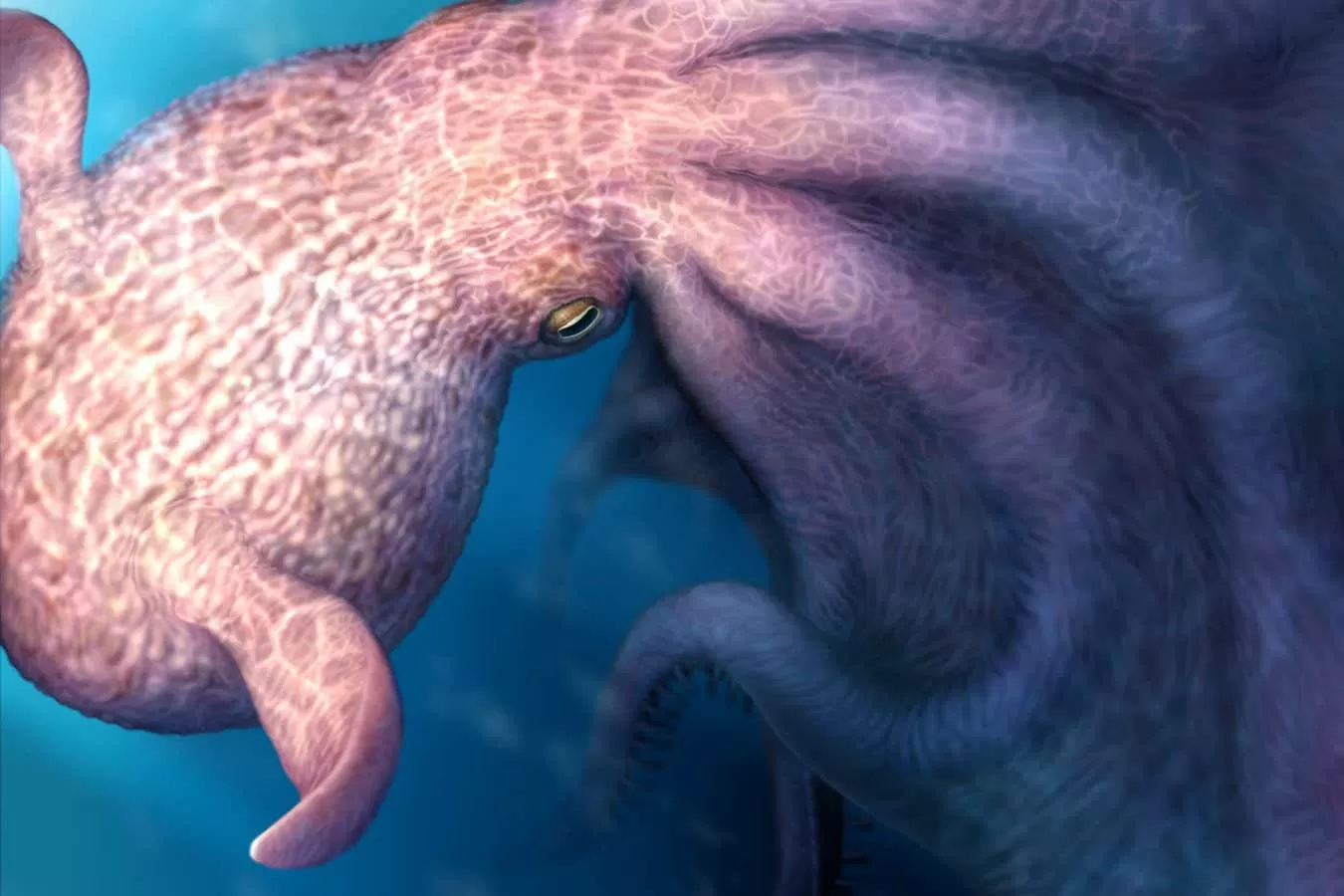
The Cretaceous period, approximately 145 to 66 million years ago, was a time of great diversity on Earth. Dinosaurs roamed the land, pterosaurs ruled the skies, and giant marine reptiles dominated the seas. But new evidence suggests that there may have been another formidable predator lurking in the depths of the ocean – the 19-metre-long predatory octopus.
Recent studies on fossilized remains of these ancient creatures have revealed that they may have been highly intelligent hunters. This discovery has challenged our understanding of the evolution of intelligence in the animal kingdom and sheds light on the fascinating world of these ancient cephalopods.
First discovered in the late 19th century, the fossilized remains of the predatory octopus have always been a source of curiosity for scientists. However, it was not until recently that researchers were able to piece together new information and paint a picture of what these massive creatures may have been like.
One of the most intriguing aspects of these ancient octopuses is their size. At 19 metres in length, they were significantly larger than the largest known species of octopus today, the Giant Pacific Octopus, which can reach up to 5 metres in length. This suggests that these prehistoric octopuses were apex predators, capable of taking down even the largest of prey.
But what sets them apart from other prehistoric sea creatures is the evidence of their intelligence. The fossilized remains show that these octopuses had large brains and complex nervous systems, similar to those of modern-day octopuses. This indicates that they were not only capable of complex behaviors, but they may have also possessed a level of intelligence comparable to that of modern-day cephalopods.
One of the most compelling pieces of evidence for the high level of intelligence in these ancient octopuses is the discovery of fossilized beaks. These beaks, which are used for feeding, show signs of wear and tear, suggesting that these creatures used them frequently. This means that they were not only skilled hunters, but they also had the ability to adapt and learn new hunting techniques.
Another interesting finding is the presence of sophisticated eyes in these ancient octopuses. Their eyes were similar to those of modern-day octopuses, with a complex structure that allowed for depth perception and the ability to see in low light conditions. This indicates that these octopuses may have been active hunters, using their keen eyesight to locate and capture prey.
But perhaps the most intriguing aspect of these ancient octopuses is the possibility that they may have been social creatures. Fossilized remains have been found in groups, suggesting that they may have lived and hunted together. This is a significant discovery, as it challenges the long-held belief that octopuses are solitary creatures.
The evolution of intelligence in the animal kingdom has always been a topic of great interest for scientists. It is believed that intelligence evolved in response to the challenges of survival, and the discovery of highly intelligent predatory octopuses during the Cretaceous period adds a new perspective to this theory. These creatures may have developed their intelligence as a means to outsmart their prey, and in turn, ensure their survival.
The discovery of these ancient octopuses also raises questions about the impact of their extinction. It is believed that these creatures became extinct around the same time as the dinosaurs, approximately 66 million years ago. Could their intelligence and adaptability have helped them survive the catastrophic event that wiped out the dinosaurs? This is a question that researchers are eager to explore further.
In conclusion, the discovery of 19-metre-long predatory octopuses during the Cretaceous period has opened up a whole new world of possibilities and insights into the evolution of intelligence in the animal kingdom. These ancient creatures were not only formidable predators, but they may have also possessed a level of intelligence that rivals that of modern-day cephalopods. As we continue to uncover more information about these mysterious creatures, we are reminded once again of the endless wonders and mysteries that lie within our planet’s past.
