
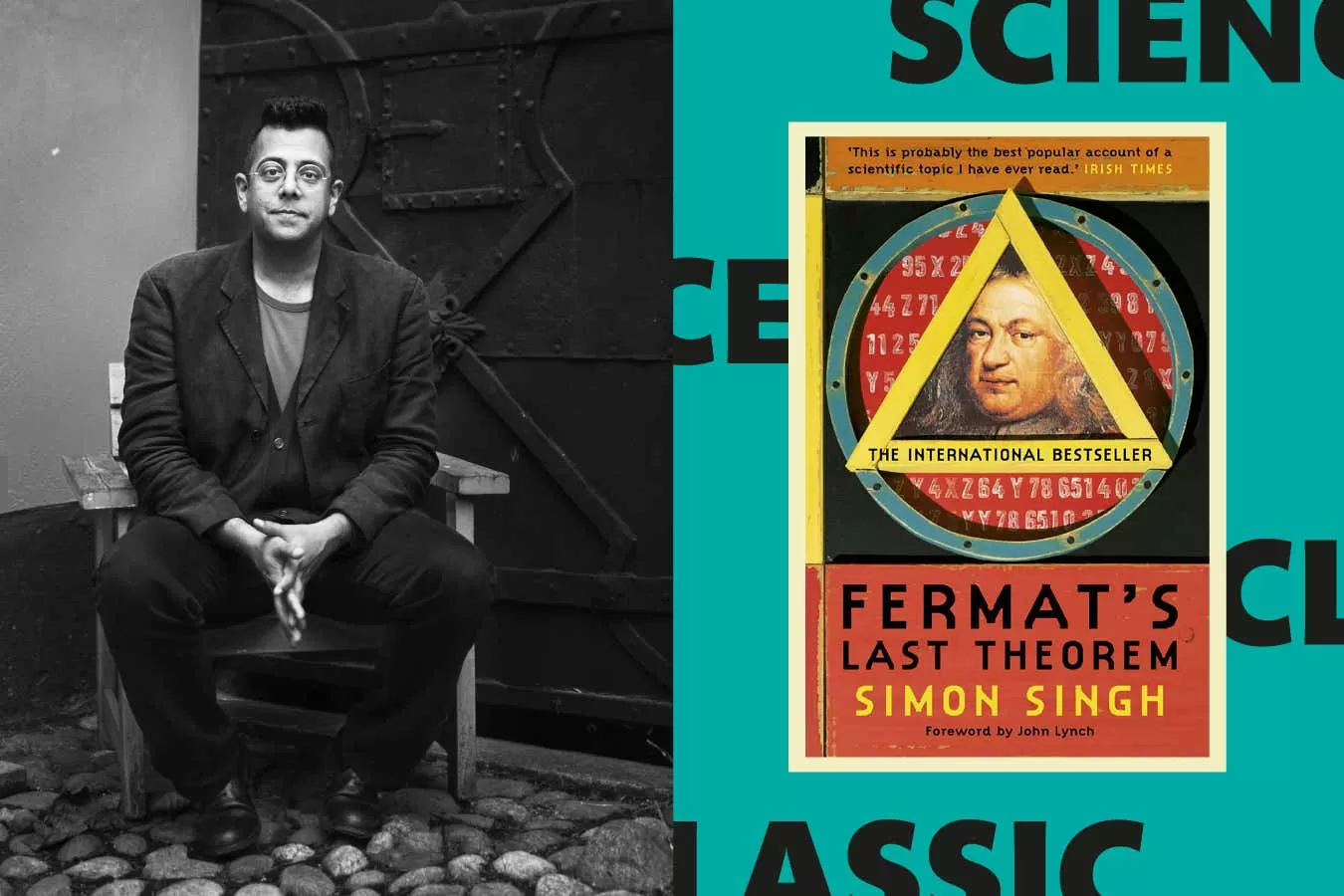
Simon Singh’s exploration of mathematical proof – in particular Pierre de Fermat’s last theorem – remains an absolute treasure, almost three decades after it was first published. This groundbreaking book, titled “Fermat’s Enigma: The Epic Quest to Solve the World’s Greatest Mathematical Problem,” not only captivated the minds of mathematicians and scientists, but also sparked a renewed interest in the world of mathematics among the general public.
Published in 1997, “Fermat’s Enigma” is a testament to Singh’s passion for mathematics and his ability to make complex concepts accessible to the masses. The book chronicles the centuries-long quest to prove Fermat’s last theorem, a problem that had baffled mathematicians for over 350 years. Singh’s meticulous research and engaging writing style take readers on a journey through the history of mathematics, from the ancient Greeks to the modern-day geniuses who finally cracked the code.
But what exactly is Fermat’s last theorem? In simple terms, it states that no three positive integers a, b, and c can satisfy the equation an + bn = cn for any integer value of n greater than 2. This may seem like a simple statement, but it has puzzled mathematicians since the 17th century when it was first proposed by French mathematician Pierre de Fermat. He famously wrote in the margin of a book that he had a “truly marvelous proof” for the theorem, but unfortunately, he did not have enough space to write it down. This sparked a centuries-long search for the proof, with many renowned mathematicians attempting to solve the enigma.
Singh’s book delves into the lives and work of these mathematicians, including the likes of Leonhard Euler, Carl Friedrich Gauss, and Andrew Wiles. He explains the various attempts and failed proofs, the controversies, and the breakthroughs that eventually led to the final proof in 1995 by Wiles. This momentous achievement not only solved one of the most challenging mathematical problems of all time but also solidified the importance of rigorous proof in mathematics.
One of the most remarkable aspects of “Fermat’s Enigma” is Singh’s ability to make the subject matter accessible to readers with varying levels of mathematical knowledge. He skillfully breaks down complex concepts and presents them in a way that is easy to understand, without losing the essence of the mathematical theories. This makes the book a must-read for anyone interested in mathematics, whether they are a professional mathematician or simply someone with a curious mind.
Moreover, Singh’s writing style is engaging and captivating, making the book a page-turner. He weaves together historical facts, personal anecdotes, and mathematical theories to create a compelling narrative that keeps readers hooked until the very end. The book is not just a dry account of mathematical proofs, but a thrilling story that captures the readers’ imagination and emotions.
Even after almost three decades since its publication, “Fermat’s Enigma” remains relevant and significant in the world of mathematics. The book has been translated into over 30 languages and has sold millions of copies worldwide, making it one of the most popular books on mathematics. It has also been adapted into a documentary and a BBC television series, further spreading the impact of Singh’s work.
But beyond the popularity and critical acclaim, “Fermat’s Enigma” has had a profound impact on the world of mathematics. It has inspired a new generation of mathematicians and sparked a renewed interest in the subject among the general public. Singh’s book has made mathematics more accessible and has shown that even the most complex problems can be solved with dedication, perseverance, and rigorous proof.
In conclusion, Simon Singh’s “Fermat’s Enigma” is a true treasure in the world of mathematics. It has stood the test of time and remains a must-read for anyone interested in the subject. Singh’s exploration of Fermat’s last theorem is not just a mathematical journey, but a testament to the power of human curiosity and the pursuit of knowledge. As we continue to push the boundaries of mathematics, “Fermat’s Enigma” will always serve as a reminder of the endless possibilities that lie within the realm of numbers and proofs.
