
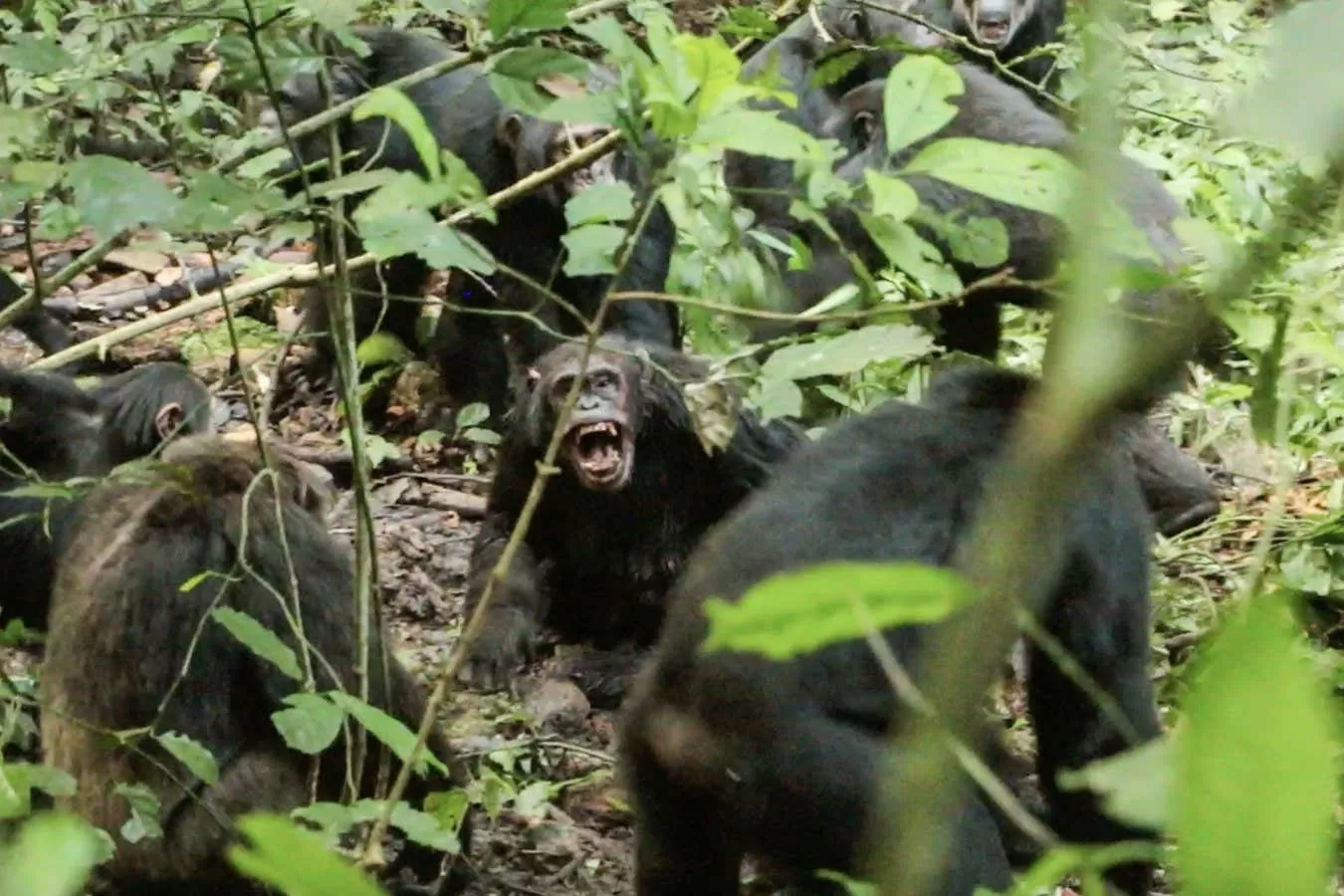
Researchers have recently made a shocking discovery while studying a group of wild chimpanzees in the African rainforest. They observed a once-unified group of chimpanzees engaging in a murderous conflict, with some individuals even resorting to cannibalism. This behavior, which is highly unusual for chimpanzees, has led researchers to draw parallels with civil wars in human societies.
The study, which was conducted by a team of primatologists from the Max Planck Institute for Evolutionary Anthropology, sheds light on the dark side of chimpanzee behavior. These primates, who are our closest living relatives, are known for their intelligence, social behavior, and ability to use tools. However, this new discovery has revealed a side of chimpanzees that is rarely seen and has raised important questions about the nature of violence in both humans and animals.
The researchers had been studying a group of chimpanzees in the Tai National Park in Ivory Coast for over 20 years. The group, which was once peaceful and cohesive, suddenly split into two factions in 2013. The two factions, led by two dominant males, began to engage in violent conflicts, resulting in the deaths of several individuals from both sides. The researchers were shocked to witness the brutality of these attacks, which included the use of rocks and branches as weapons, and even the consumption of the dead.
This behavior is not typical for chimpanzees, who are known to be highly social and cooperative animals. In fact, chimpanzees are known to form strong bonds with their group members and engage in grooming and other forms of social interaction. However, the researchers believe that the split in the group may have caused a breakdown in these social bonds, leading to the violent conflicts.
The parallels between this chimpanzee group and human societies are striking. Just like humans, chimpanzees also live in complex social groups and have a hierarchical structure. The two dominant males in the group were vying for power and control, much like leaders in human societies. The conflicts between the two factions also bear a resemblance to civil wars, where groups within a society engage in violent conflicts.
This discovery has important implications for our understanding of violence in both humans and animals. It challenges the long-held belief that violence is a uniquely human trait and suggests that it may have deeper evolutionary roots. The researchers believe that the behavior observed in these chimpanzees may be a result of competition for resources and reproductive success, which are also driving forces behind conflicts in human societies.
However, it is important to note that not all chimpanzee groups engage in such violent behavior. In fact, most chimpanzee groups are peaceful and cooperative, and conflicts are usually resolved through non-violent means. This suggests that while violence may be a part of our evolutionary history, it is not a defining characteristic of our species or our closest relatives.
The study also highlights the importance of conservation efforts for chimpanzees and their habitats. The Tai National Park, where the study was conducted, is home to one of the largest populations of chimpanzees in West Africa. However, the park is facing increasing threats from deforestation and human activities. The researchers believe that preserving the natural habitats of chimpanzees is crucial for their survival and for understanding their behavior.
In conclusion, the recent discovery of a murderous conflict in a group of wild chimpanzees has shed light on the dark side of their behavior and has drawn parallels with civil wars in human societies. While this behavior may have evolutionary roots, it is not a defining characteristic of chimpanzees or humans. This study highlights the importance of further research on violence in both animals and humans and the need for conservation efforts to protect our closest living relatives.
