
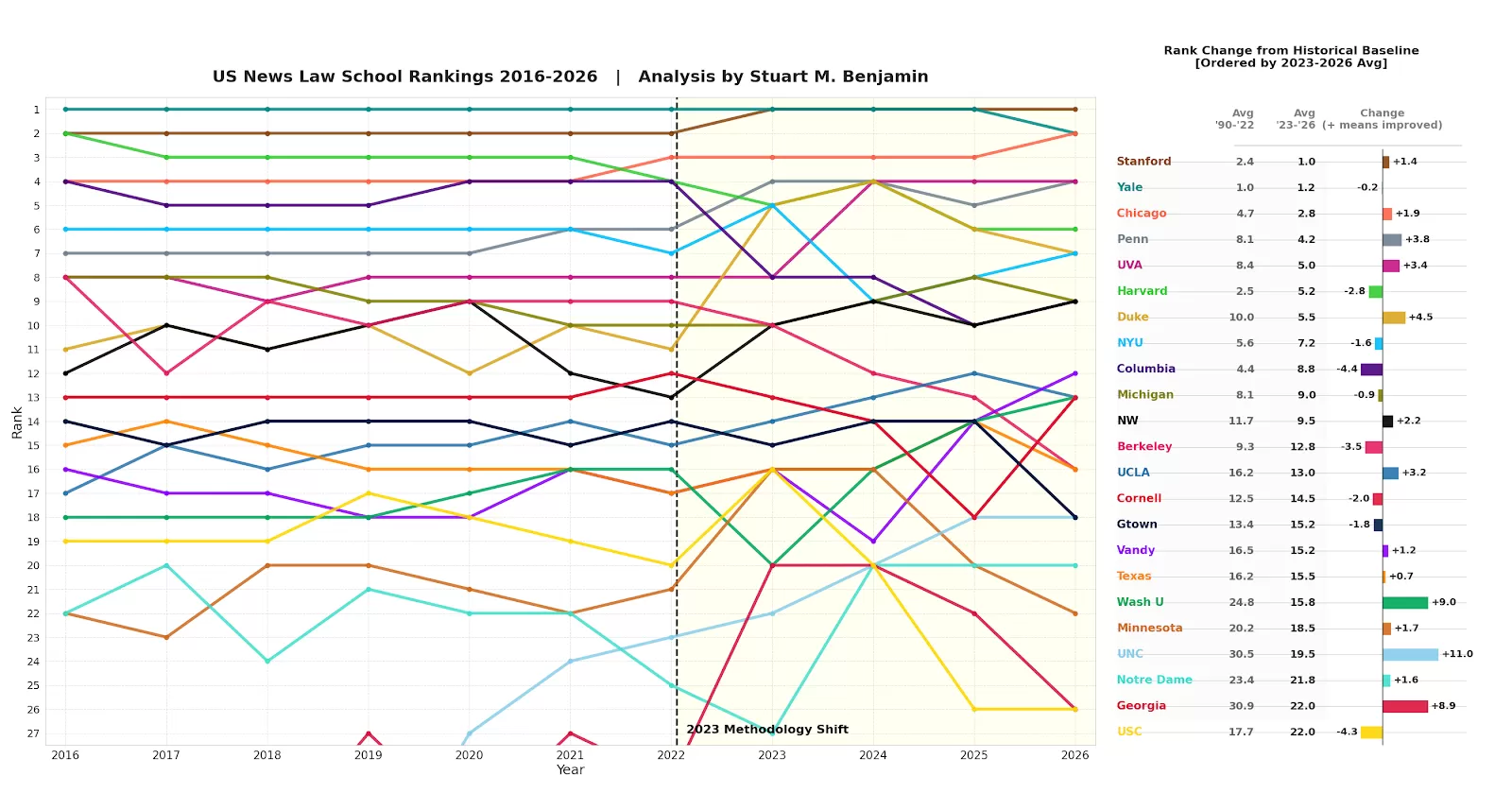
The legal world was abuzz with excitement as the US News released its revamped law school ranking methodology in 2023. This new methodology has not only killed an old grouping but has also created a successor, promising to revolutionize the way law schools are ranked in the United States.
For years, law schools have been ranked based on a set of criteria that included reputation, selectivity, and job placement rates. However, this method has been criticized for being too subjective and not accurately reflecting the true quality of a law school. In response to these criticisms, the US News has taken a bold step towards creating a more comprehensive and objective ranking system.
The new methodology focuses on three key factors – outcomes, resources, and engagement. Outcomes measure a law school’s success in preparing its students for the legal profession, while resources take into account the school’s faculty, student-to-faculty ratio, and financial resources. Engagement, on the other hand, evaluates a law school’s efforts in creating a diverse and inclusive environment for its students.
The most significant change in the new ranking methodology is the elimination of the old grouping system, which placed law schools into four tiers. This grouping was often criticized for creating an artificial hierarchy among law schools and not accurately reflecting the differences between them. With the new methodology, each law school will now receive a numerical rank, making it easier for students to compare and choose the right law school for them.
The successor to the old grouping system is the new “peer assessment score.” This score is calculated based on surveys sent to law school deans, faculty, and practicing lawyers, who are asked to rate the quality of law schools based on their academic programs. This new system allows for a more diverse and comprehensive evaluation of a law school’s reputation.
Another significant change in the new methodology is the emphasis on outcomes. This factor includes employment rates, bar passage rates, and student debt. By focusing on outcomes, the US News is providing a more accurate reflection of a law school’s success in preparing its students for the legal profession. This will not only benefit prospective students in choosing the right law school but will also encourage law schools to prioritize the success of their students.
The revamped ranking methodology has also placed a greater emphasis on diversity and inclusion. The engagement factor evaluates a law school’s efforts in creating a welcoming and inclusive environment for students from different backgrounds. This is a crucial step towards promoting diversity in the legal profession and ensuring that all students have equal opportunities to succeed.
The new methodology has been met with widespread praise from the legal community. Law school deans and faculty have lauded the US News for taking a more comprehensive and objective approach to ranking law schools. This new system not only provides a more accurate reflection of a law school’s quality but also encourages schools to focus on factors that truly matter in preparing their students for the legal profession.
Moreover, the new methodology has also been welcomed by students and prospective students. With the elimination of the old grouping system, students can now make more informed decisions about their legal education. The focus on outcomes and diversity also ensures that students are not only receiving a quality education but are also prepared to thrive in a diverse and inclusive legal environment.
In conclusion, the revamped US News law ranking methodology adopted in 2023 has been a game-changer for the legal community. By eliminating the old grouping system, placing a greater emphasis on outcomes and diversity, and creating a successor to the old system, the US News has taken a significant step towards creating a more comprehensive and objective ranking system. This new methodology not only benefits prospective students but also encourages law schools to prioritize the success and inclusivity of their students. The future of legal education in the United States is looking brighter than ever.
