
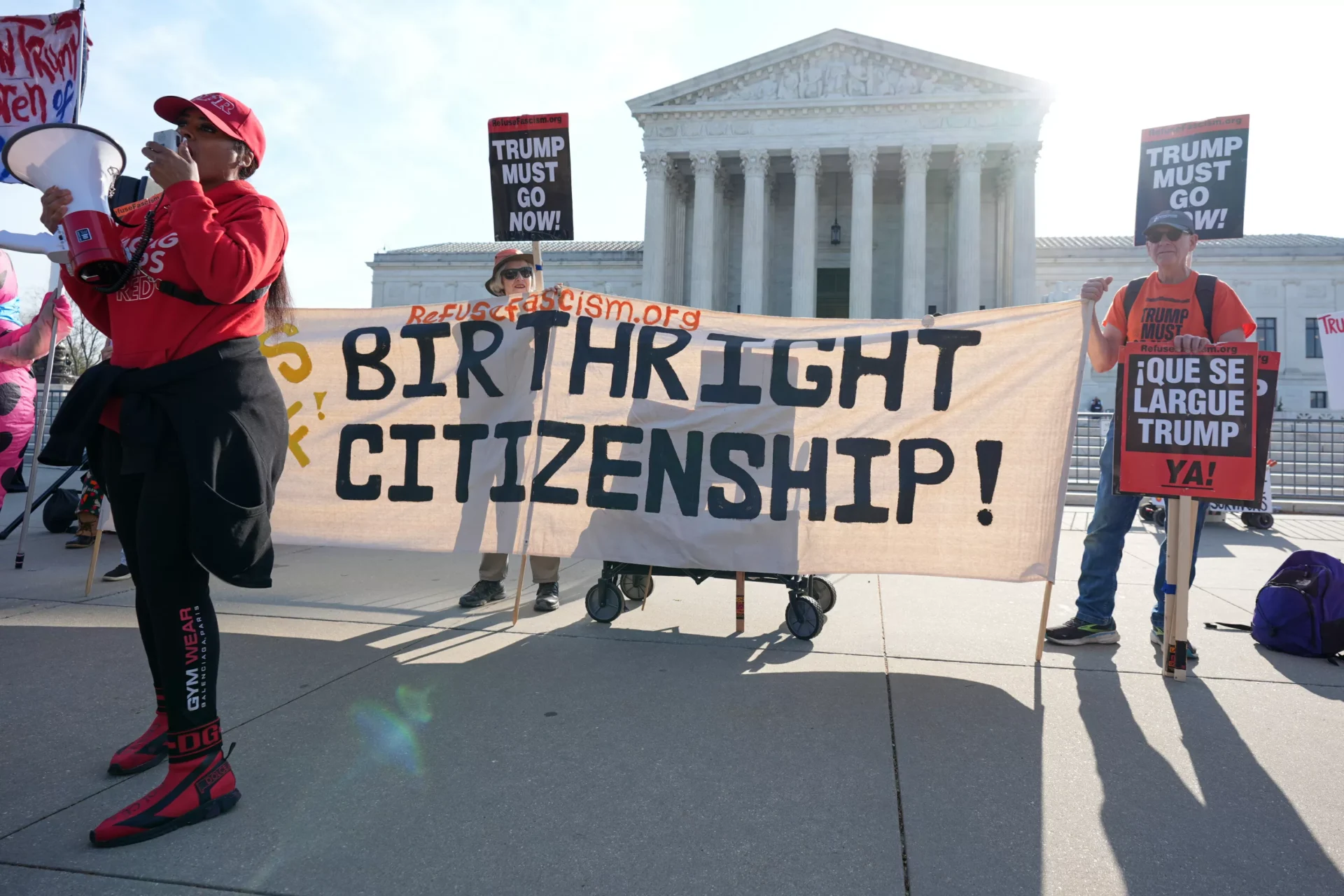
President Donald Trump has recently sparked a nationwide debate after expressing his desire for the Supreme Court to consider conservative radio host Mark Levin’s perspective on the issue of birthright citizenship. This controversial topic has been a hot button issue in the United States for decades, and now it seems that the highest court in the land may have to weigh in on the matter.
For those who may not be familiar, birthright citizenship is the principle that anyone born on American soil is automatically granted citizenship, regardless of their parents’ immigration status. This has been the law of the land since the enactment of the 14th Amendment to the Constitution in 1868. However, President Trump has stated his belief that this policy is being abused and has called for it to be re-examined by the Supreme Court.
Enter Mark Levin, a well-known conservative commentator and author, who has been a vocal critic of birthright citizenship. He argues that the 14th Amendment has been misinterpreted and that it was never intended to grant citizenship to children of illegal immigrants. Levin believes that the amendment was specifically meant to protect the rights of former slaves and their descendants, not to be used as a loophole for illegal immigration.
President Trump has publicly praised Levin’s perspective and has even gone as far as to say that he agrees with it. In an interview with Axios, the President stated, “We’re the only country in the world where a person comes in and has a baby, and the baby is essentially a citizen of the United States…with all of those benefits. It’s ridiculous. It’s ridiculous. And it has to end.”
This statement has caused an uproar among both Democrats and Republicans, with many arguing that this would be a direct violation of the 14th Amendment and would lead to a constitutional crisis. However, the President remains firm in his belief that birthright citizenship needs to be re-examined and has called on the Supreme Court to consider Levin’s perspective as they deliberate on this issue.
So, why is President Trump so adamant about this issue? The answer lies in his campaign promise to crack down on illegal immigration and secure the border. He believes that birthright citizenship is a major factor in attracting illegal immigrants to the United States, as they see it as a way to secure citizenship for their children. This, in turn, leads to an influx of illegal immigration and puts a strain on the country’s resources.
Supporters of the President’s stance argue that birthright citizenship is being abused and that it is time to address this issue. They believe that the 14th Amendment was never meant to be used in this way and that it is not fair to those who have gone through the proper channels to become American citizens. They also argue that the United States is one of the few countries in the world that grants birthright citizenship and that it is not a universal practice.
On the other hand, opponents of this viewpoint argue that birthright citizenship is a fundamental principle of the United States and that it should not be changed. They believe that it is a symbol of the country’s openness and inclusivity and that it is a cornerstone of the American Dream. They also argue that changing the interpretation of the 14th Amendment would be a slippery slope and could lead to other constitutional rights being questioned.
As this debate continues to rage on, it is clear that both sides have valid arguments. However, it is ultimately up to the Supreme Court to decide whether or not to consider Mark Levin’s perspective on birthright citizenship. This is a decision that will have far-reaching consequences and will shape the future of immigration in the United States.
In the end, what is most important is that this issue is being discussed and debated. It is a reminder that the United States is a country that values freedom of speech and that all voices should be heard. President Trump’s call for the Supreme Court to consider Mark Levin’s perspective is a testament to this and shows that he is willing to listen to all sides of the argument.
As we wait for the Supreme Court’s decision, it is important to remember that this is not just a political issue, but a human one. It is about the lives of millions of people who have come to the United States in search of a better life. It is a complex issue that requires careful consideration and thoughtful debate. Let us hope that the Supreme Court will make a decision that is fair and just for all.
