
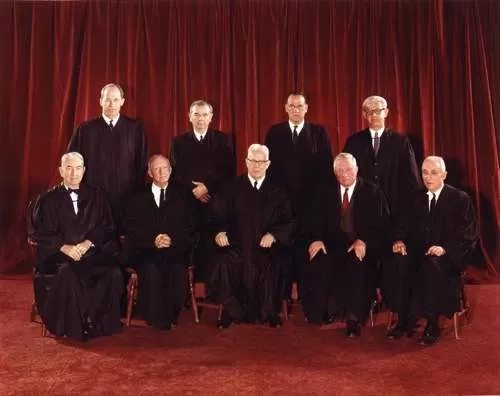
On April 3, 1962, the United States Supreme Court heard arguments in one of the most controversial cases in its history – Engel v. Vitale. This landmark case challenged the constitutionality of officially sanctioned prayer in public schools, and it would have a profound impact on the separation of church and state in America.
The case, which was filed by a group of parents in New Hyde Park, New York, centered around a simple prayer that was recited every morning in public schools across the state. The prayer, known as the “Regent’s Prayer” or the “Almighty God” prayer, read:
“Almighty God, we acknowledge our dependence upon Thee, and we beg Thy blessings upon us, our parents, our teachers and our country. Amen.”
The school district argued that the prayer was voluntary and non-denominational, and therefore did not violate the First Amendment’s Establishment Clause, which prohibits the government from establishing or endorsing a religion.
But the parents, represented by esteemed civil rights attorney Murray Gurfein, saw it differently. They argued that the prayer was a clear violation of their children’s rights to religious freedom and that it promoted a specific religious belief.
The case made its way to the Supreme Court, where it was argued on April 3, 1962. The Justices were tasked with deciding whether or not the prayer constituted a government endorsement of religion and, if so, whether it was constitutional.
The arguments presented in Engel v. Vitale were passionate and thought-provoking. The attorneys for the parents argued that the prayer was in direct violation of the Establishment Clause, as it clearly favored one religious belief over others. They also pointed out that the prayer was recited in a public school setting, making it a government-sanctioned religious activity.
On the other side, the school district’s attorney argued that the prayer was simply a voluntary and non-denominational way to start the school day, and that it did not infringe on anyone’s religious freedom.
After hearing the arguments, the Supreme Court deliberated for several months before rendering its decision on June 25, 1962. In a 6-1 decision, the Court ruled in favor of the parents, declaring that the prayer was indeed a violation of the Establishment Clause.
Justice Hugo Black, writing for the majority, stated that the prayer was “wholly inconsistent with the Establishment Clause.” He further explained that even though the prayer was voluntary, it still created a state-sponsored religious exercise.
This decision had a lasting impact on the separation of church and state in America. It established the principle that public schools, as agents of the government, cannot endorse or promote any specific religious belief. This decision has been cited in countless subsequent cases regarding the First Amendment’s Establishment Clause.
Engel v. Vitale remains a controversial case to this day, with some arguing that the decision has led to the removal of religion from public schools. However, many see it as a crucial step in upholding the First Amendment and protecting the religious freedom of all Americans.
Today, on the anniversary of this important Supreme Court argument, we are reminded of the significance of the separation of church and state in our country. The decision in Engel v. Vitale serves as a powerful reminder that the government must remain neutral when it comes to matters of religion and that no one religious belief should be favored over another.
As we continue to navigate the complex relationship between religion and public life, we must remember the lessons learned from Engel v. Vitale and the importance of upholding the principles of the First Amendment. Let us never forget the brave parents who stood up for their children’s rights and the Supreme Court Justices who made a historic decision in favor of religious freedom for all.
