
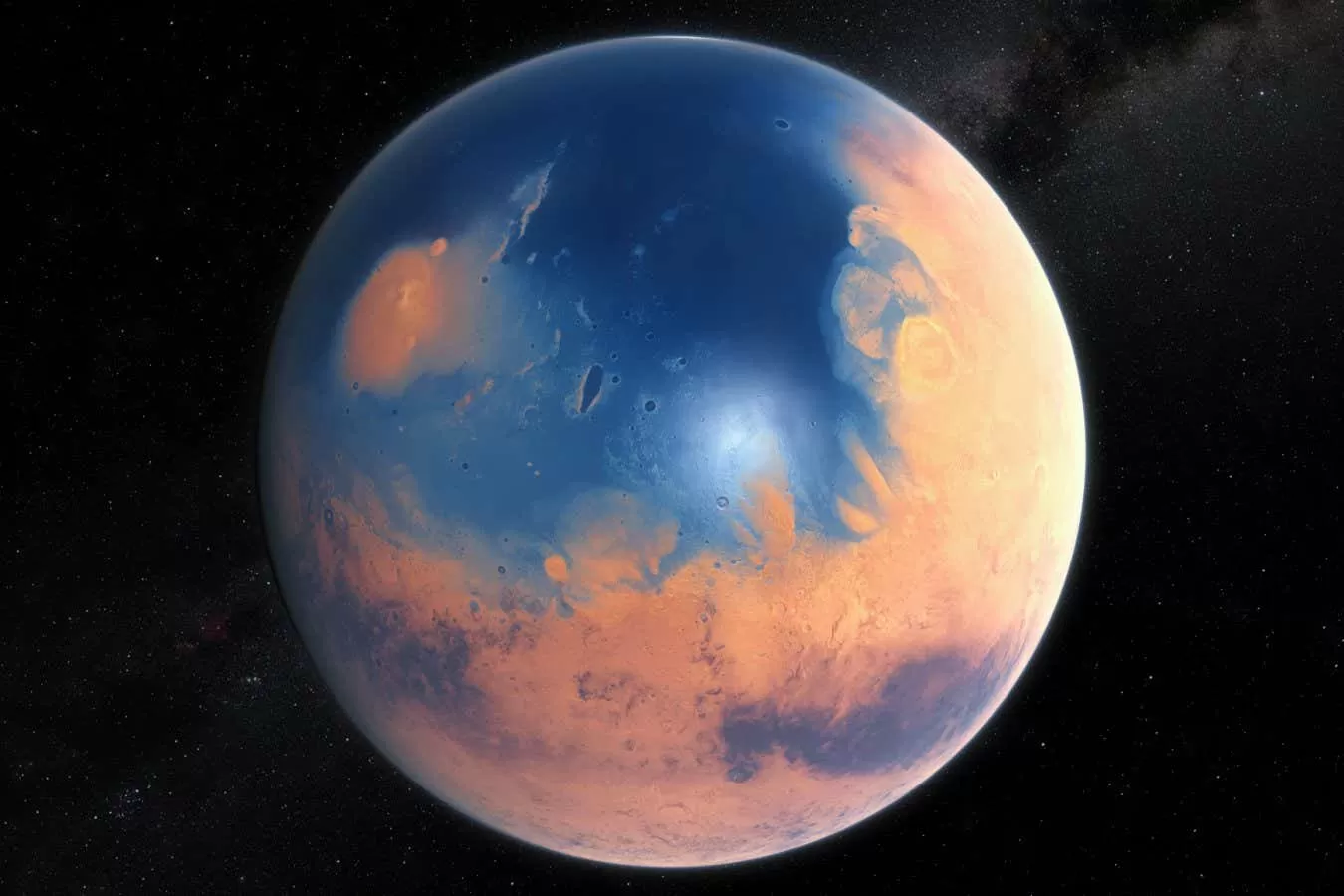
An Accounting of Mars’ Mysterious Water: Shedding Light on the Red Planet’s Hydrological History
Mars, the fourth planet from the Sun, has long been a source of fascination for scientists and space enthusiasts alike. With its striking red hue and similarities to Earth, it has been a subject of countless studies and research. One of the most intriguing aspects of Mars is its water, or lack thereof. For years, scientists have been trying to unravel the mystery of Mars’ hydrological history, and a recent study has shed new light on this enigma.
According to the study, an accounting of all the water that should have been and gone on Mars’s surface has revealed a significant discrepancy. This finding has highlighted just how little we understand about the Red Planet’s past and its water cycle. The study, published in the journal Science, was conducted by a team of researchers from the California Institute of Technology (Caltech) and the University of Arizona.
The researchers used data from NASA’s Mars Reconnaissance Orbiter (MRO) to analyze the planet’s water cycle. MRO, which has been orbiting Mars since 2006, has been instrumental in providing valuable information about the planet’s surface and atmosphere. The team focused on the planet’s polar regions, which are believed to have once been covered in water. They analyzed the amount of water that should have been present in the form of ice and compared it to the actual amount of water currently present.
The results were surprising. The team found that there is a significant amount of missing water from Mars’ polar regions. In fact, the amount of water that should have been present is almost double the amount that is currently there. This discrepancy has raised questions about the planet’s hydrological history and has left scientists scratching their heads.
One possible explanation for this missing water is that it may have escaped into space. Mars, unlike Earth, does not have a protective magnetic field, which makes it vulnerable to the solar wind. The solar wind, a stream of charged particles from the Sun, could have stripped away the planet’s atmosphere and water over time. Another theory suggests that the water may have seeped into the planet’s subsurface, where it remains trapped.
This new finding has significant implications for our understanding of Mars’ past and its potential for harboring life. Water is a crucial ingredient for life as we know it, and the presence of water on Mars has always been a key factor in the search for extraterrestrial life. The discovery of this missing water has raised questions about the planet’s habitability and whether it could have supported life in the past.
However, this study is just the beginning. The researchers are planning to continue their investigations and delve deeper into Mars’ hydrological history. They hope to gain a better understanding of how the planet’s water cycle has evolved over time and what factors may have contributed to the loss of water. This could provide valuable insights into the planet’s past and its potential for sustaining life.
Despite the discrepancy in the water accounting, this study is a significant step forward in our understanding of Mars. It highlights the need for further research and exploration of the Red Planet. With the advancements in technology and the increasing interest in space exploration, we are now in a better position than ever before to unravel the mysteries of Mars.
Moreover, this study serves as a reminder of the vastness and complexity of our universe. It shows that even with all our knowledge and advancements, there is still so much we have yet to discover and understand. The missing water on Mars is just one piece of the puzzle, and there are many more waiting to be solved.
In conclusion, the recent study on Mars’ water accounting has revealed a significant discrepancy, highlighting the gaps in our understanding of the planet’s hydrological history. It has raised questions about the fate of the missing water and its implications for the planet’s habitability. However, it also serves as a reminder of the endless possibilities and mysteries that await us in the vastness of space. With continued research and exploration, we are sure to uncover more secrets of the Red Planet and the universe beyond.
