
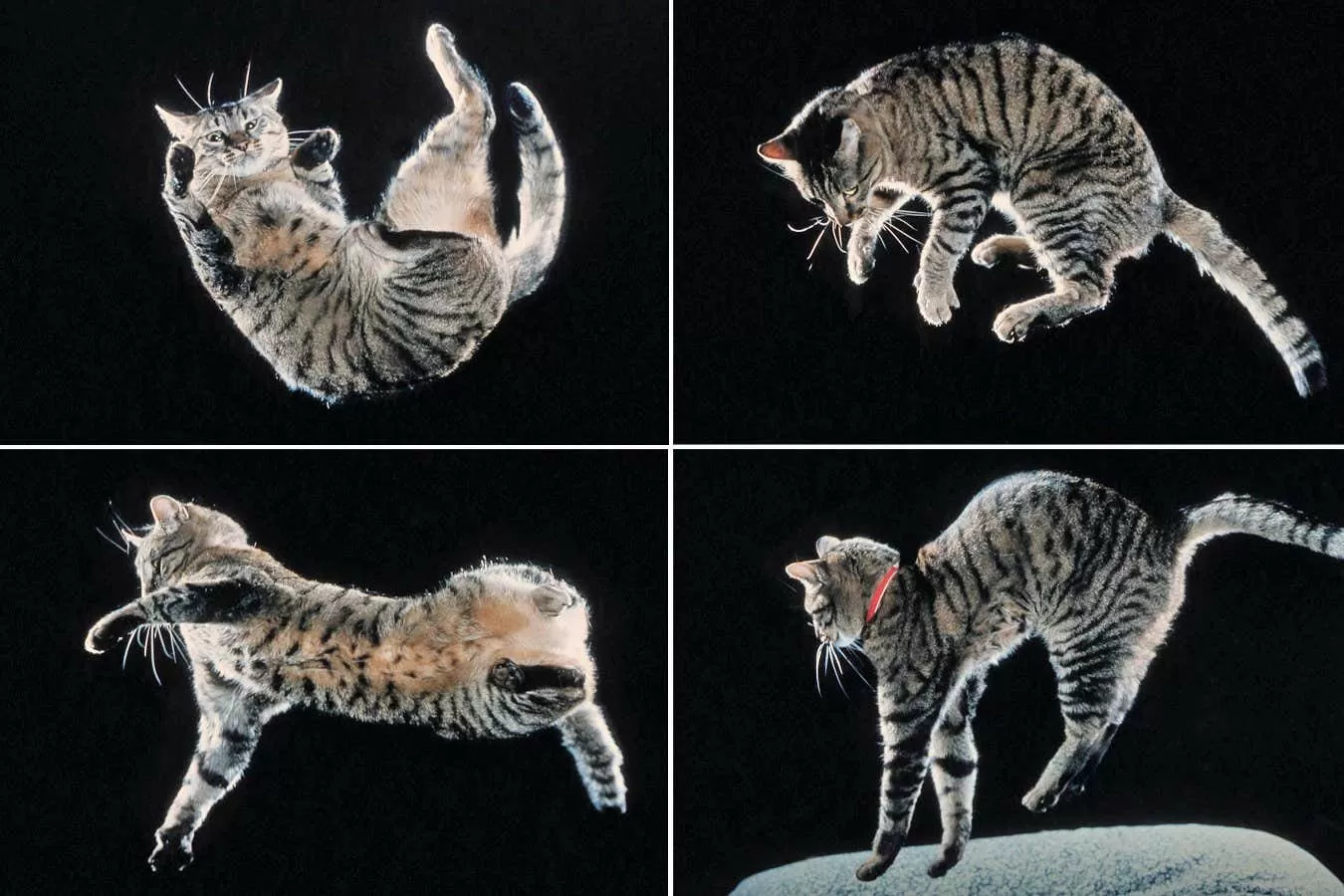
Cats have long been known for their grace, agility, and ability to land on their feet. But have you ever wondered how they manage to do it? The answer lies in an exceptional and often overlooked feature of their anatomy – the spine.
The spine, or vertebral column, is a crucial part of any animal’s body, serving as the main support for the entire structure. In cats, however, the spine is not only a support but also a key factor in their incredible acrobatic abilities. This is particularly evident in their famous ability to twist their bodies while falling, ensuring a safe and graceful landing.
So, what makes the feline spine so special? Let’s take a closer look.
First and foremost, cats have a highly flexible spine, consisting of 7 cervical, 13 thoracic, 7 lumbar, 3 sacral, and up to 23 caudal vertebrae. This adds up to a total of 53-60 vertebrae, depending on the length of the cat’s tail. This may seem like a lot compared to our measly 33 vertebrae, but the extra vertebrae are what give cats their incredible flexibility.
But it’s not just the number of vertebrae that makes the feline spine unique. It’s also the way they are connected. In humans, the vertebrae are connected by intervertebral discs, which are made of fibrous cartilage. These discs provide cushioning and flexibility but are limited in their range of motion. In cats, however, the vertebrae are connected by elastic ligaments, allowing for much greater flexibility and range of motion.
This flexibility is especially evident in the thoracic and lumbar regions of the spine. These areas are responsible for the cat’s twisting motion while falling, as they can rotate up to 180 degrees in either direction. This allows the cat to twist its front and back halves of the body sequentially, ensuring a safe and controlled landing.
But that’s not all – cats also have a unique feature called the ‘righting reflex.’ This reflex is activated when a cat falls, and it automatically adjusts the position of its body to ensure a safe landing. The cat’s flexible spine plays a crucial role in this reflex, allowing it to twist and contort its body in mid-air to land on its feet.
It’s not just falling that showcases the cat’s impressive spine. Their flexibility also comes into play during everyday activities such as grooming, hunting, and playing. Cats are notorious for their ability to contort their bodies into seemingly impossible positions, thanks to their flexible spine.
But why do cats have such a flexible spine? The answer lies in their evolutionary history. Cats are natural predators, and their ancestors needed a highly flexible spine to navigate through trees and catch prey. Over time, this trait has been passed down, making cats the agile and graceful creatures we know today.
In addition to their flexible spine, cats also have strong and powerful muscles that support their movements. These muscles work in conjunction with their spine, allowing them to twist, turn, and jump with ease. This combination of a flexible spine and strong muscles is what makes cats such incredible athletes.
In conclusion, a cat’s exceptional flexibility is made possible by its unique and highly adaptable spine. This feature not only allows them to twist and contort their bodies while falling but also plays a crucial role in their everyday activities. So, the next time you see a cat gracefully landing on its feet, take a moment to appreciate the wonders of its spine. Truly, it is a remarkable and essential part of what makes a cat a cat.
