
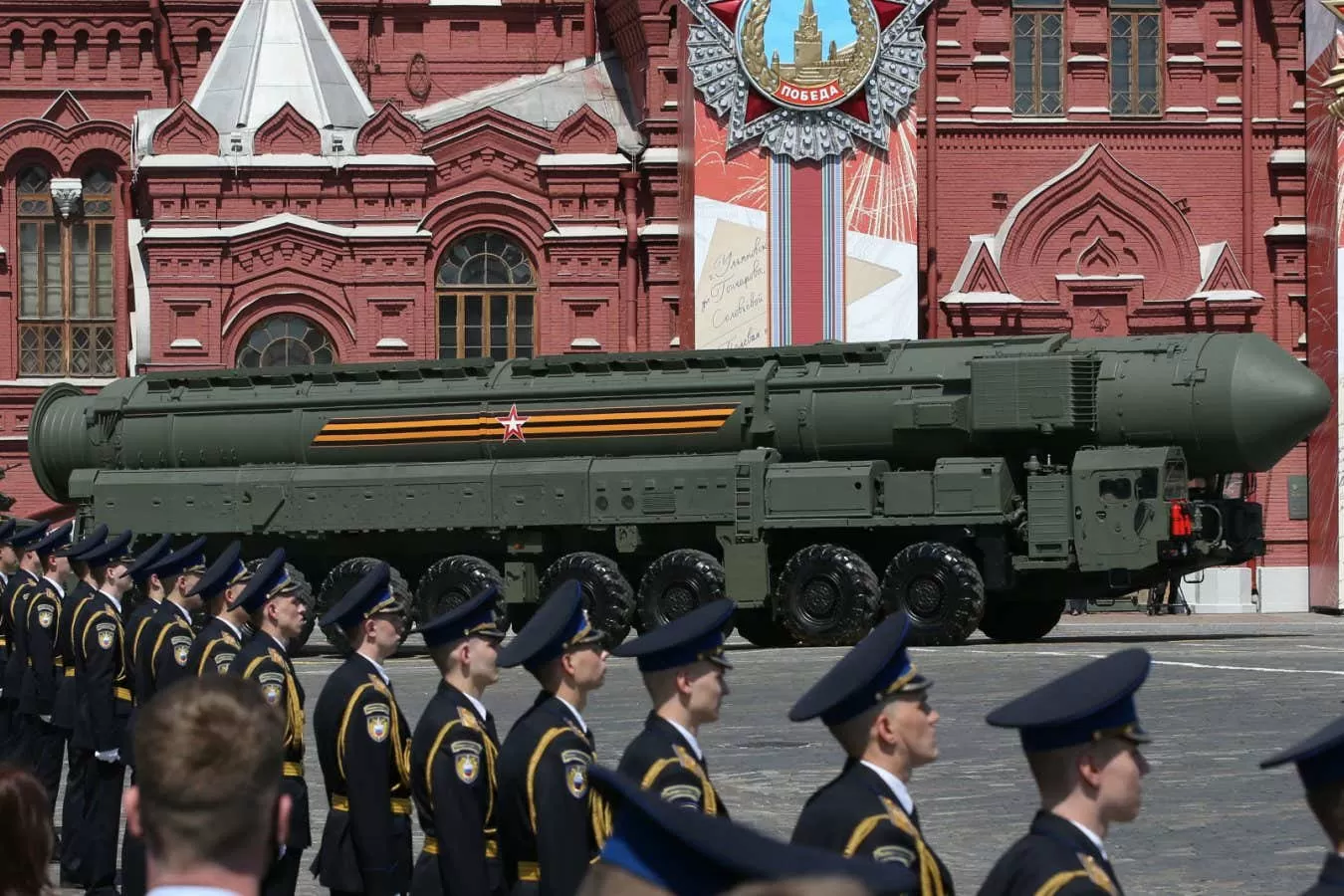
As the New START treaty’s February expiration looms on the horizon, many are concerned about the potential consequences of the world’s two largest nuclear powers having no cap on their arsenals. The treaty, which was signed in 2010, limited the number of deployed nuclear weapons held by the United States and Russia to 1,550 each. But with no extension in sight, some are questioning whether the end of this deal will truly make the world a safer place. Let’s take a closer look at the arguments and see if we can find any optimism in this situation.
First, let’s address the concerns. The New START treaty was a significant step towards nuclear disarmament, as it reduced both countries’ arsenals to their lowest levels since the 1950s. With no extension, there is a possibility that both sides could ramp up their production of nuclear weapons, leading to a renewed arms race. This, in turn, could create a more unstable and dangerous global environment.
Moreover, some argue that the treaty’s expiration will also lead to a lack of transparency between the two countries. The treaty required regular inspections and exchanges of data between the US and Russia, which helped in building trust and reducing the risk of potential misunderstandings or miscalculations. Without these measures in place, there may be an increase in suspicion and tension between the two superpowers.
However, despite these valid concerns, there are reasons to believe that the end of the New START treaty may not be as catastrophic as it seems. For starters, both the US and Russia already have significant stockpiles of nuclear weapons, which they can deploy at any moment. The treaty’s expiration will not change this fact; it will only remove a limitation that has been in place for the past decade.
Moreover, both countries have stated their commitment to nuclear arms control, and there have been discussions about extending the treaty or negotiating a new one. Both sides have also expressed a willingness to engage in talks with other nuclear powers, such as China, to reduce the global nuclear threat. This shows that the end of the New START treaty does not necessarily mean the end of nuclear disarmament efforts.
Another positive aspect to consider is the advancement of technology. Since the New START treaty was signed, there have been significant developments in missile defense systems, which have made nuclear weapons less effective as a deterrent. In today’s world, other factors such as cyber warfare and economic interdependence also play a crucial role in global security. This means that nuclear weapons are not the only tool in the arsenal to ensure peace and stability.
Additionally, the end of the New START treaty could also create an opportunity for a new approach to nuclear arms control. The treaty is a product of a different era, and as the global landscape changes, so should our strategies for dealing with nuclear weapons. It is possible that a new treaty, one that addresses the current geopolitical challenges, could be more effective in promoting global security.
It is also important to note that the treaty’s expiration does not mean that the US and Russia will engage in reckless behavior. Both countries have robust procedures in place to ensure the safety and security of their nuclear weapons. They also have a long history of managing their nuclear arsenals responsibly, even during times of heightened tension. It is unlikely that this will change just because the New START treaty has ended.
In the end, it is essential to remember that the New START treaty was never meant to be a solution to the world’s nuclear weapons problem; it was only a step in the right direction. While its expiration may create some uncertainty, it does not automatically mean that the world will become a more dangerous place. The treaty was just one tool in a much larger effort towards global peace and security. There are still many other measures in place, such as the Treaty on the Non-Proliferation of Nuclear Weapons, that serve as a roadmap towards a nuclear-free world.
In conclusion, the expiration of the New START treaty may be a cause for concern, but it is not a reason to despair. The world has come a long way from the height of the Cold War, and we must continue to build on that progress. Let us not forget that nuclear disarmament is a collective responsibility, and we must all play our part in ensuring a safer and more peaceful world for future generations. Instead of focusing on the end of one treaty, let us use this as an opportunity to push for stronger and more effective measures towards global nuclear disarmament.
