
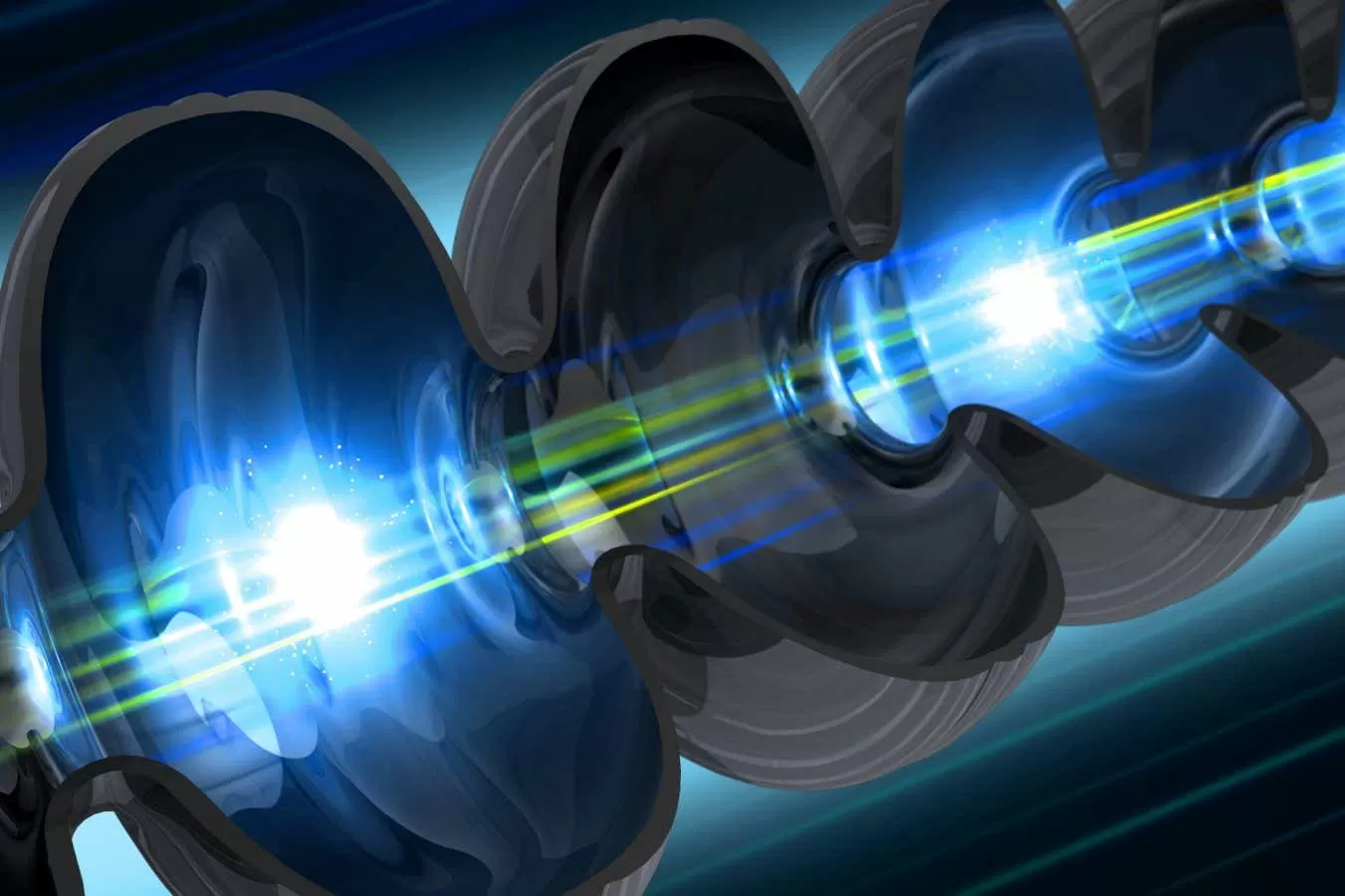
The Linac Coherent Light Source (LCLS) in California has been a pioneer in the field of X-ray science for years, producing record-breaking X-ray pulses that have revolutionized our understanding of the world around us. However, after years of continuous operation, the LCLS is now due for a shutdown and an upgrade. But fear not, when it is turned back on, it will be even more powerful than ever before.
The LCLS, located at the SLAC National Accelerator Laboratory, is a one-of-a-kind facility that uses a linear accelerator (or linac) to produce intense X-ray pulses. These pulses are a billion times brighter than any other X-ray source and are incredibly short, lasting only a few quadrillionths of a second. This unique combination of brightness and speed allows scientists to capture images of atoms and molecules in motion, providing unprecedented insights into the fundamental processes of nature.
Since its inception in 2009, the LCLS has been at the forefront of X-ray science, producing groundbreaking research in a wide range of fields, from chemistry and materials science to biology and energy research. Its capabilities have been continuously expanded and improved over the years, with the addition of new instruments and techniques, making it a vital resource for scientists from around the world.
However, like any cutting-edge technology, the LCLS requires regular maintenance and upgrades to ensure its optimal performance. And after almost a decade of non-stop operation, the time has come for a major shutdown and upgrade. This will be the first major shutdown since the facility opened, and it is expected to last for about a year.
During this time, the LCLS team will be working tirelessly to install new equipment and make improvements to the existing systems. One of the most significant upgrades will be the installation of a new X-ray laser, called LCLS-II, which will be even more powerful than the current one. This new laser will produce up to 1 million pulses per second, a hundred times more than the current LCLS, making it the world’s first high-repetition-rate X-ray laser.
The LCLS-II will also have the ability to produce X-rays with shorter wavelengths, allowing scientists to study even smaller and faster processes. This will open up new frontiers in research, enabling scientists to explore the inner workings of atoms and molecules in unprecedented detail.
But the upgrades don’t stop there. The LCLS team will also be installing new instruments and detectors, as well as upgrading the existing ones, to further enhance the capabilities of the facility. These improvements will enable scientists to conduct a wider range of experiments and gather more precise data, leading to groundbreaking discoveries in various fields of science.
The shutdown and upgrade of the LCLS may seem like a temporary setback, but it is a necessary step towards a brighter and more powerful future. The new and improved LCLS will not only continue to push the boundaries of X-ray science but also pave the way for new discoveries and advancements in various fields of research.
The LCLS team is excited about the upgrades and the potential they hold for the future of X-ray science. They are confident that the new and improved LCLS will attract even more scientists from around the world, who will use its capabilities to unravel the mysteries of the universe.
In conclusion, the LCLS has been a game-changer in the world of X-ray science, and with its upcoming upgrades, it is set to become even more powerful and groundbreaking. The shutdown may be a temporary pause, but the advancements and discoveries that will come out of it will have a lasting impact on our understanding of the world. So let us eagerly await the return of the LCLS, and the exciting new discoveries it will bring.
