
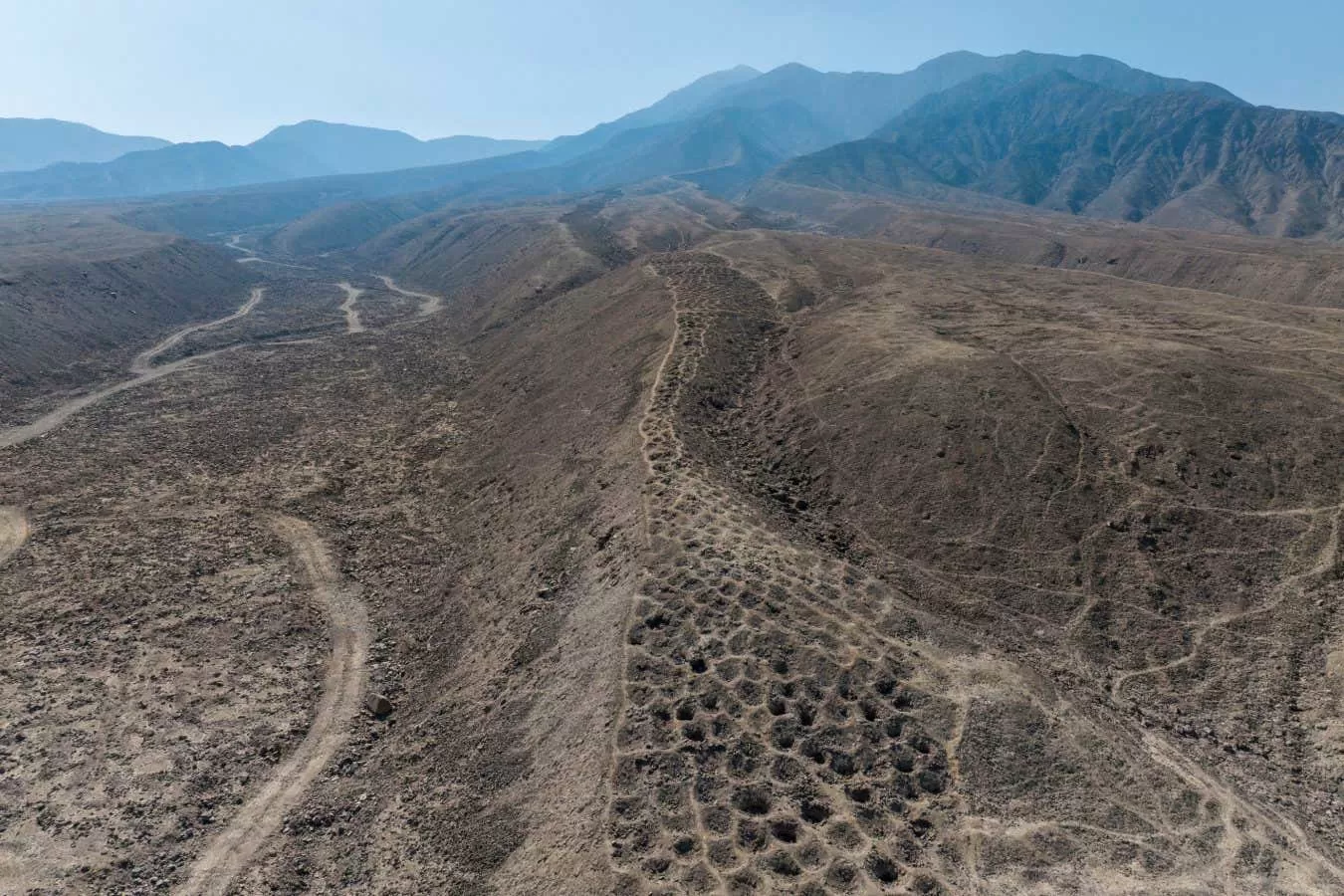
Monte Sierpe, a remote mountain in Peru, has long been shrouded in mystery and intrigue. But recent discoveries have shed new light on this enigmatic place, revealing that it may have been home to an ancient accounting system unlike anything seen before.
Thousands of holes, arranged in a snake-like pattern, cover the surface of Monte Sierpe. The holes, known as “chullpas” in the local language, are believed to have been used as a monumental accounting device for trade and tax purposes. This remarkable find has captured the attention of archaeologists and historians alike, and has provided valuable insight into the economic and social systems of the people who once inhabited this area.
The chullpas of Monte Sierpe date back to the pre-Columbian era, with some estimates dating them as far back as 500 BC. The sheer number of holes present on the mountain is staggering – over 5,000 in total. The chullpas vary in size, ranging from small pockets to larger pits that can hold up to 200 liters of material. They are arranged in a winding pattern that resembles a serpent, which is where the mountain gets its name – Sierpe means “snake” in Spanish.
The purpose of these holes has long been a subject of debate among scholars. Some believed that they were used as tombs, while others speculated that they were part of a religious ritual. But recent investigations have uncovered evidence that suggests a more practical and utilitarian function – an ancient accounting system.
One of the most compelling pieces of evidence is the strategic placement of the chullpas. They are located along ancient trade routes, indicating that they were used to keep track of goods and commodities that were being transported between different regions. This theory is further supported by the fact that the holes are found in clusters, with larger pits surrounded by smaller ones. This suggests a hierarchical system, with the larger holes representing a higher value or quantity of goods.
Furthermore, the chullpas are not evenly distributed on the mountain, but rather concentrated in certain areas. This points to the possibility that they were used to monitor and collect taxes. As trade and commerce flourished in this region, it is likely that a system of taxation was put in place, and the chullpas served as a physical record of the goods that were being taxed.
The intricate design of the chullpas also adds weight to the theory that they were used for accounting purposes. The winding pattern of the holes is not random, but follows a strategic and organized layout. This would have made it easier for the people to keep track of and record their trade and tax transactions.
This groundbreaking discovery has opened up a whole new understanding of the economic and social systems of the ancient people of Peru. It shows that they were not only highly advanced in their knowledge of mathematics and accounting, but also in their ability to develop complex systems of trade and commerce.
The chullpas of Monte Sierpe are a testament to the ingenuity and innovation of these ancient civilizations. Despite not having access to modern technology and tools, they were able to create a sophisticated accounting system using nothing but the natural resources around them. This is a testament to their resourcefulness and their deep connection with the land.
What makes this discovery even more remarkable is that it was made in a remote and often overlooked area of Peru. Monte Sierpe may not have the grandeur of Machu Picchu or the Nazca lines, but it holds a wealth of knowledge and history that is just waiting to be uncovered.
As more research is conducted on the chullpas of Monte Sierpe, we can expect to learn even more about the people who built them and the society they lived in. This discovery has opened up a new chapter in the history of Peru and has given us a glimpse into the rich and fascinating past of this beautiful country.
In conclusion, the chullpas of Monte Sierpe are not just a series of holes on a mountain, but a testament to the ingenuity and intelligence of the ancient Peruvian people. They serve as a reminder that history is always waiting to be discovered, and it is up to us to uncover its secrets and learn from them. Let us continue to explore and appreciate the wonders that the world has to offer.
