
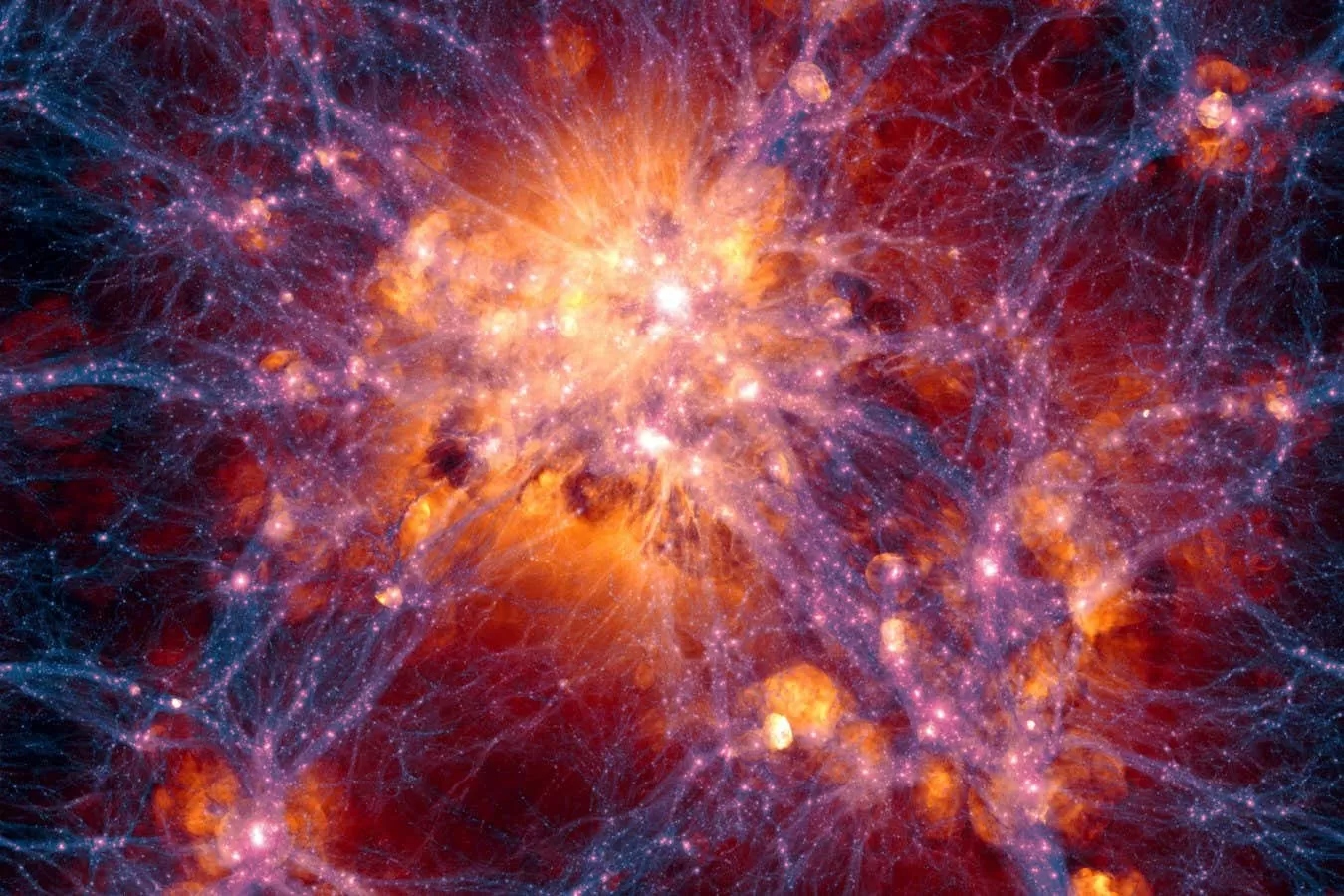
Astronomers have made a groundbreaking discovery that sheds new light on the complex interactions between galaxies and the vast cosmic web that connects them. A dwarf galaxy, located 100 million light years away, is being stripped of its crucial star-forming gas as it passes through the cosmic web.
This fascinating phenomenon was observed by a team of researchers using the Atacama Large Millimeter/submillimeter Array (ALMA) telescope in Chile. The galaxy in question, known as ID2299, is a relatively small and young galaxy that is still in the process of forming stars. However, the recent observations have revealed that the galaxy is losing its star-forming gas at an alarming rate.
The cosmic web, also known as the large-scale structure of the universe, is a vast network of filaments and voids that connect galaxies together. These filaments are made up of dark matter and gas, and they act as highways for galaxies to travel through. As galaxies move through the cosmic web, they can interact with these filaments, causing a variety of effects.
In the case of ID2299, the galaxy is passing through a particularly dense filament of the cosmic web. As it does so, the gas within the galaxy is being stripped away by the intense gravitational forces of the filament. This process, known as ram pressure stripping, is a common occurrence in galaxy clusters, where the gravitational pull of the cluster can strip galaxies of their gas.
However, this is the first time that such a phenomenon has been observed in a smaller, isolated galaxy like ID2299. This discovery has significant implications for our understanding of galaxy evolution and the role of the cosmic web in shaping the universe we see today.
The gas being stripped from ID2299 is crucial for the formation of new stars. Without it, the galaxy will eventually run out of fuel and cease to form new stars. This process is known as quenching, and it is a natural part of a galaxy’s lifecycle. However, the fact that this is happening in such a young galaxy is surprising and highlights the powerful influence of the cosmic web.
The observations also revealed that the gas being stripped from ID2299 is being funneled into the cosmic web itself. This gas will eventually be recycled and used to fuel the formation of new stars in other galaxies. This process is essential for the growth and evolution of galaxies, and it is fascinating to see it in action.
One of the lead researchers, Dr. Annagrazia Puglisi, described the discovery as “a unique opportunity to witness the complex interplay between galaxies and the cosmic web.” She also expressed excitement about the potential for further research in this area, stating that “this finding opens up new avenues for studying the evolution of galaxies and the role of the cosmic web in shaping the universe.”
The observations of ID2299 also have implications for our understanding of the evolution of dwarf galaxies. These small galaxies are thought to be the building blocks of larger galaxies, and understanding their formation and evolution is crucial for understanding the universe as a whole.
The team of researchers also noted that this discovery would not have been possible without the advanced capabilities of the ALMA telescope. ALMA’s high-resolution and sensitivity allowed the team to observe the gas being stripped from ID2299 in unprecedented detail.
In conclusion, the recent discovery of a dwarf galaxy being stripped of its star-forming gas by the cosmic web is a significant breakthrough in our understanding of the universe. This observation highlights the complex interactions between galaxies and the cosmic web and provides valuable insights into the evolution of galaxies. With further research, we can continue to unravel the mysteries of the universe and gain a deeper understanding of our place within it.
