
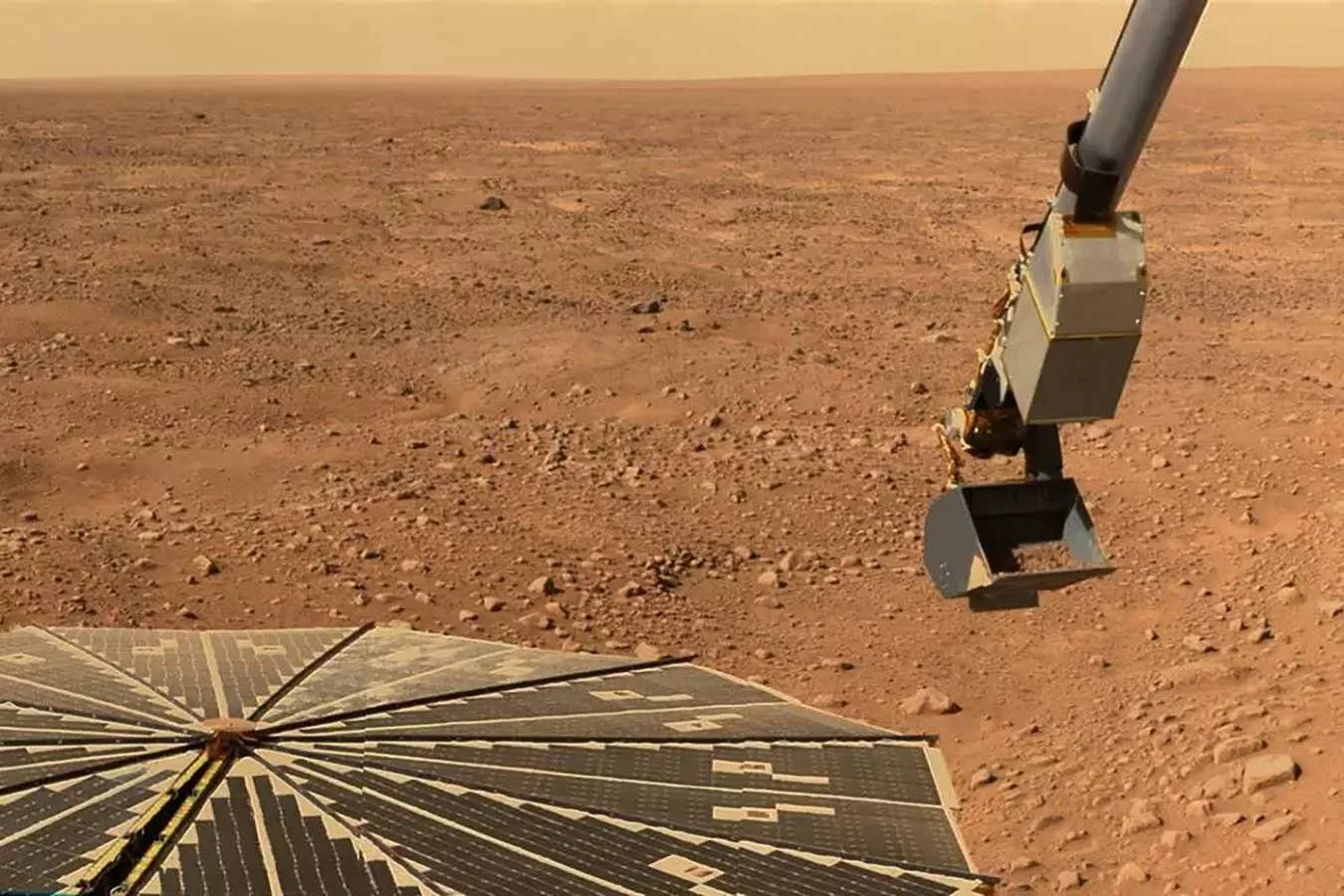
Mars has always been a source of fascination for scientists and space enthusiasts alike. Its barren and desolate landscape has long been a subject of study and exploration, with the ultimate goal of finding signs of life on the Red Planet. And now, a recent discovery has brought us one step closer to this goal.
Buried deep underground, near the surface of Mars, lies a frozen region that could potentially hold the key to unlocking the mysteries of the planet. Scientists have found evidence of tiny hidden channels that are full of liquid water, creating a habitable environment for microscopic organisms. This groundbreaking discovery has opened up a whole new realm of possibilities in our search for extraterrestrial life.
The discovery was made by a team of researchers from the Italian National Institute for Astrophysics (INAF) and the University of Bologna, who used data from the Mars Advanced Radar for Subsurface and Ionosphere Sounding (MARSIS) instrument on board the European Space Agency’s Mars Express spacecraft. The MARSIS instrument is designed to penetrate beneath the surface of Mars and map its subsurface structures.
The team found evidence of these hidden channels in the Planum Australe region of Mars, which is located near the planet’s south pole. This region is known to have a thick layer of ice, but the MARSIS data revealed the presence of liquid water in the form of brine (a mixture of water and salt) in these channels. The brine has a lower freezing point than pure water, which allows it to remain in a liquid state despite the freezing temperatures on Mars.
This discovery is significant because it suggests that Mars may have a more hospitable environment than previously thought. The presence of liquid water is a crucial factor for the existence of life, as we know it. And while the surface of Mars is too harsh for life to survive, these hidden channels provide a protected and stable environment for microscopic organisms to thrive.
But how did these channels form in the first place? The researchers believe that they were created by the melting of ice due to the heat generated by the planet’s geothermal activity. This process is similar to what happens on Earth, where hydrothermal vents on the ocean floor provide a habitat for a diverse range of organisms. The same could be true for Mars, with these hidden channels acting as a potential oasis for life.
The discovery of these hidden channels also has implications for future human exploration of Mars. The presence of liquid water could potentially provide a source of water for future missions, making it easier for humans to sustain themselves on the planet. It also opens up the possibility of using these channels as a shelter for future human settlements.
However, it is important to note that this discovery does not confirm the existence of life on Mars. It simply suggests that the conditions for life to exist may be present in these hidden channels. Further research and exploration will be needed to determine if any form of life exists in these regions.
The discovery of these hidden channels on Mars is a testament to the advancements in technology and our understanding of the Red Planet. It is a reminder that there is still so much to learn and discover about our neighboring planet. And with each new discovery, we are one step closer to unraveling the mysteries of Mars and potentially finding evidence of extraterrestrial life.
This groundbreaking discovery has reignited our curiosity and excitement for Mars and its potential to harbor life. It is a reminder that the universe is vast and full of wonders, waiting to be explored. Who knows what other secrets Mars may hold, and what other discoveries await us in the depths of its frozen regions.
In conclusion, the discovery of hidden channels full of liquid water on Mars is a significant step forward in our search for life beyond Earth. It opens up a whole new realm of possibilities and brings us closer to answering the age-old question of whether we are alone in the universe. As we continue to explore and study Mars, we can only hope that more groundbreaking discoveries like this will be made, bringing us one step closer to unlocking the mysteries of our neighboring planet.
