
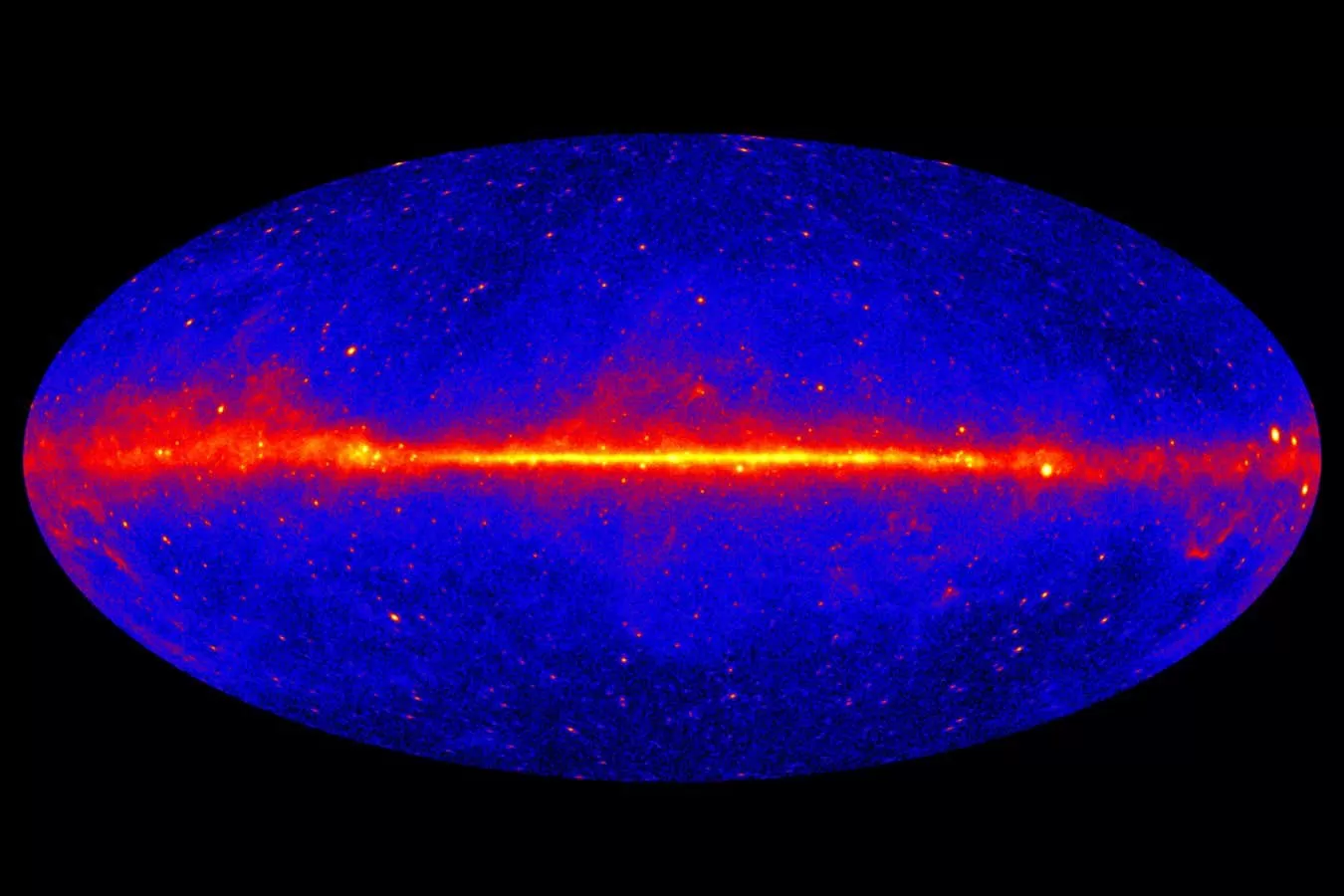
The Milky Way, our home galaxy, has always been a source of fascination for astronomers and space enthusiasts. It is a vast and mysterious place, filled with billions of stars, planets, and other celestial bodies. However, recent observations by NASA’s Fermi Gamma-ray Space Telescope have revealed a puzzling phenomenon at the heart of our galaxy – a mysterious excess of gamma rays.
Gamma rays are the most energetic form of light, and they are produced by some of the most violent and energetic events in the universe. These include supernovae, black holes, and even the Big Bang itself. So, when scientists noticed an unusually high concentration of these high-energy photons in the middle of the Milky Way, they were intrigued.
After analyzing the data from the Fermi telescope, scientists have put forth a new theory to explain this mysterious excess of gamma rays – dark matter annihilation. Dark matter is a mysterious and elusive substance that is thought to make up about 85% of the total matter in the universe. It does not interact with light or other forms of electromagnetic radiation, making it invisible and difficult to detect.
According to the new theory, dark matter particles may be colliding with each other in the dense center of our galaxy, releasing a burst of gamma rays in the process. These collisions would be extremely rare, but due to the sheer amount of dark matter in the galactic center, they could still create a detectable amount of gamma rays.
This idea is not entirely new. In fact, scientists have been searching for signs of dark matter annihilation for decades, but this is the first time that a distinct source of gamma rays has been pinpointed in our own galaxy. The data from the Fermi telescope shows that the excess of gamma rays is coming from an area of about 5,000 light-years in diameter, and it has a distinct shape that matches the distribution of dark matter in the galactic center.
Of course, as with any new scientific theory, not all experts are convinced. Some have suggested that other astrophysical phenomena, such as pulsars or even a population of undetected black holes, could be the source of the excess gamma rays. However, so far, the dark matter annihilation theory is the most plausible explanation, and it opens up a whole new avenue of research into the nature of dark matter.
If dark matter particles are indeed smashing into each other and releasing gamma rays, it could mean that we are one step closer to understanding the elusive substance. Scientists have long been trying to unravel the mysteries of dark matter, and this new discovery could provide valuable clues about its properties and behavior.
But why is this discovery important? For one, it confirms the existence of dark matter. While its presence has been inferred through its gravitational effects on visible matter, this is the first direct evidence of its existence. It also sheds light on the nature of dark matter and how it may interact with itself and with other forms of matter.
Moreover, this new finding has the potential to change our understanding of the entire universe. Dark matter is the key to understanding the structure and evolution of the cosmos, and any new insight into its properties could have far-reaching implications for our understanding of the universe.
However, there is still much more research to be done. Scientists will continue to analyze the data from the Fermi telescope and conduct further observations to confirm this new theory. In the meantime, this discovery has opened up a whole new field of research and has reignited the excitement and curiosity of scientists and space enthusiasts alike.
In conclusion, the mysterious excess of gamma rays in the middle of the Milky Way could be a result of dark matter particles colliding and annihilating. This groundbreaking discovery has the potential to revolutionize our understanding of dark matter and the universe as a whole. And while there may still be unanswered questions, one thing is for sure – the study of our universe will never cease to amaze and inspire us.
