
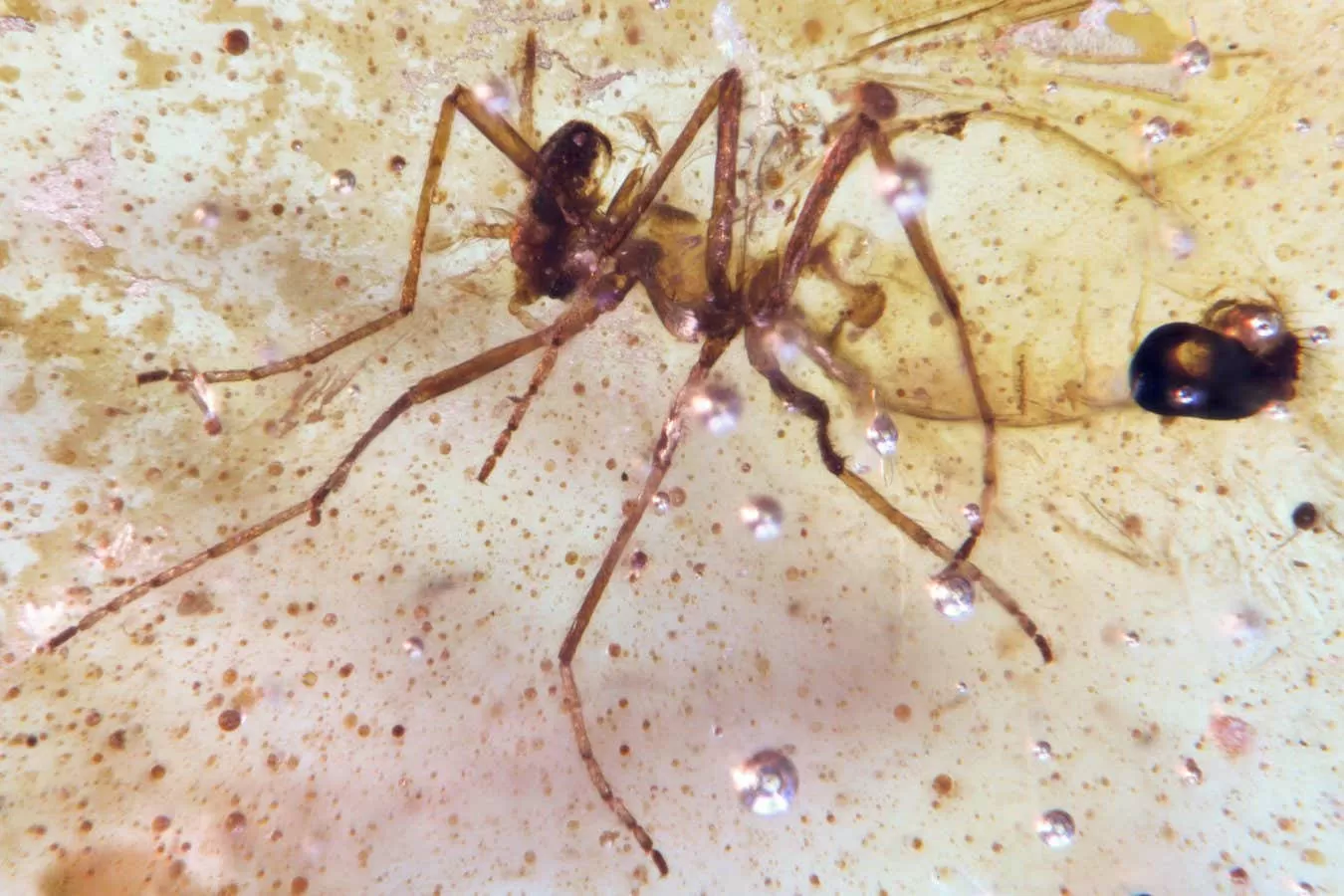
A remarkable discovery has been made in Ecuador, as a sand quarry has yielded South America’s first amber with bio-inclusions. This amber contains a treasure trove of ancient insects and a spider’s web, providing a glimpse into the diverse ecosystem that existed 112 million years ago.
The amber, a fossilized tree resin, was found in the province of Sucumbíos in northern Ecuador. It was discovered by a team of researchers from the National Polytechnic School (EPN) and the Central University of Ecuador (UCE). This discovery has been hailed as a major breakthrough in the field of paleontology, as it is the first time that amber with such well-preserved bio-inclusions has been found in South America.
The amber, which is about the size of a small egg, contains a spider’s web measuring 2.5 centimeters in diameter. This web is believed to have been woven by a primitive spider, making it the oldest known spider web in South America. Along with the web, the amber also contains a collection of insects such as mosquitoes, beetles, flies, wasps, and biting midges. These insects are perfectly preserved in the amber, giving researchers a rare opportunity to study them in detail.
Dr. Santiago Ortega, a researcher from EPN and the lead author of the study, described the amber as a “time capsule” that provides a unique window into the past. He explained that the amber was formed during the Early Cretaceous period, a time when dinosaurs still roamed the Earth. This makes the discovery even more significant, as it provides a glimpse into the ancient world that existed before the mass extinction of dinosaurs.
The insects found in the amber are believed to have lived during a time when South America was still part of the supercontinent Gondwana, which included present-day Africa, South America, Antarctica, India, and Australia. This discovery sheds light on the evolution and distribution of insects during this period, as well as the geological history of South America.
The team of researchers has been working tirelessly to study the amber and its contents. They have used advanced imaging techniques to analyze the insects and their surroundings, providing valuable insights into their behavior and ecology. Dr. Ortega and his team have also been collaborating with international experts to determine the age of the amber and its geological significance.
The discovery of this amber has opened up new avenues for research and has the potential to contribute to our understanding of the Earth’s past. It also highlights the importance of preserving our natural resources, as they hold valuable information about our planet’s history. The researchers have stressed the need for further exploration in the area to uncover more amber deposits and expand our knowledge of the ancient world.
This discovery has also sparked excitement among the local community, as it has put Ecuador on the map for paleontology and scientific research. It has also brought attention to the importance of protecting and conserving Ecuador’s natural resources, as they continue to provide valuable insights into our planet’s past.
The findings of this study have been published in the journal Scientific Reports, and the team is planning to continue their research and share their findings with the scientific community. This discovery serves as a reminder of the wonders that can be found in our own backyard and the importance of preserving our natural heritage for future generations.
In conclusion, the discovery of South America’s first amber with bio-inclusions in Ecuador is a significant milestone in the field of paleontology. This amber, with its well-preserved insects and spider web, provides a rare glimpse into the ancient world and has the potential to contribute to our understanding of the Earth’s history. It also highlights the need for continued research and conservation efforts to uncover more of nature’s hidden treasures.
