
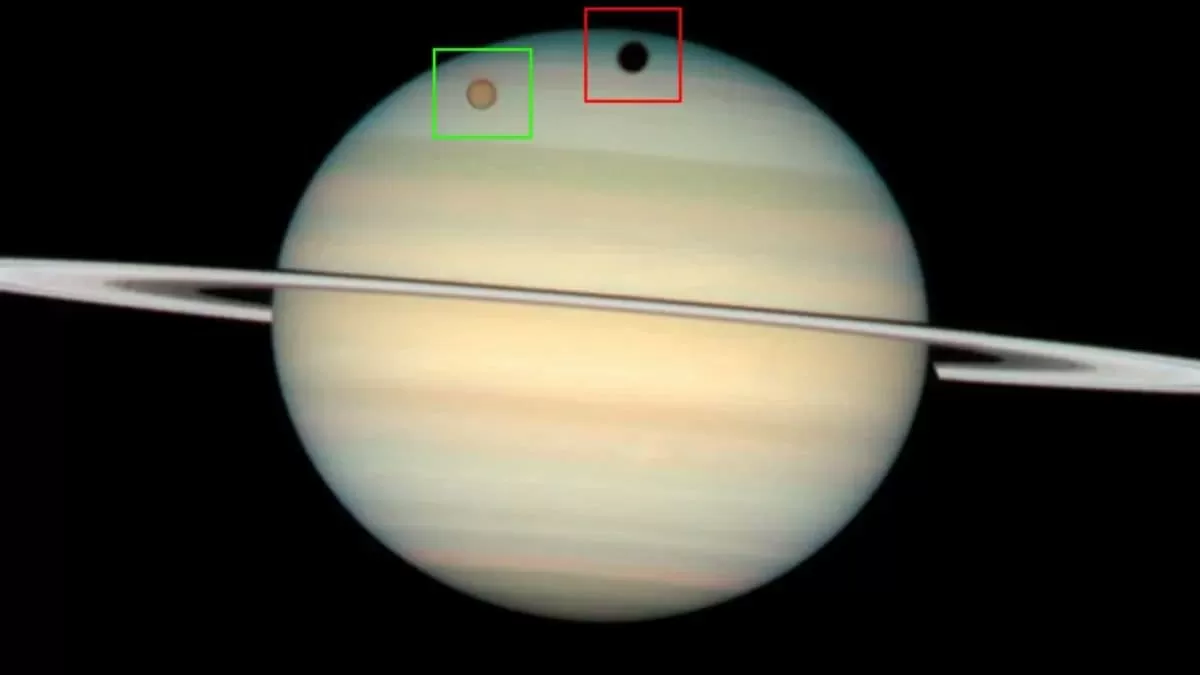
Get ready to witness a rare celestial event that will awe and inspire stargazers around the world. In the summer and early fall of 2025, Saturn’s largest moon Titan will cast its shadow across the planet in a series of stunning transits. These transits, visible through telescopes, will appear as dark “holes” drifting across Saturn’s face as Titan eclipses the planet.
Such events occur only near Saturn’s equinox, which happens every 15 years. This means that this is a once-in-a-lifetime opportunity to witness this incredible phenomenon. So mark your calendars and get ready to be mesmerized by the cosmic dance of Saturn and its moon Titan.
The first transit is set to occur on July 24th, 2025, followed by three more transits on August 10th, August 27th, and September 12th. The final event will take place on September 28th, 2025. Each transit will last for several minutes, giving plenty of time for observers to marvel at the spectacle.
But what exactly is a transit and why is this event so rare? A transit is when one celestial body passes in front of another from the perspective of an observer. In this case, Titan will pass in front of Saturn, casting its shadow on the planet. This alignment occurs only near Saturn’s equinox, as the angle between the sun, Saturn, and Titan is just right for this phenomenon to take place.
This celestial alignment is not only a visual treat but also a scientific opportunity. By studying Titan’s shadow as it obscures parts of Saturn’s atmosphere, scientists can gain valuable insights into the composition and dynamics of both bodies.
Titan is a unique moon, with its dense atmosphere and hydrocarbon seas making it an intriguing object of research. During the transits, scientists will be able to measure the temperature, composition, and behavior of Titan’s atmosphere as it blocks out sunlight from Saturn.
Not only that, but these transits are also a great opportunity for amateur astronomers to contribute their observations and data to ongoing research projects. With the advancement of technology, anyone with a telescope and a passion for astronomy can make meaningful contributions to the scientific community.
The 2025 transits of Titan over Saturn also hold a special place in history. The last time such a celestial alignment occurred was in 2009, and the next time won’t be until 2040. Therefore, we encourage everyone to make the most of this rare event and witness it with awe and wonder.
For those who have never witnessed a transit before, this will be an unforgettable experience. Imagine seeing a dark “hole” moving across the face of a planet, blocking out its light. It’s a surreal and humbling experience, reminding us of the vastness and mysteries of our universe.
So mark your calendars and start preparing for this unique event. Set up your telescopes, gather your friends, and get ready for an evening of celestial magic. And for those who are unable to observe it in person, there are live streams and online events planned for everyone to be a part of this grand event.
The transits of Titan over Saturn is a reminder of the beauty and complexity of our solar system and the wonders that await us in the universe. It’s a reminder to keep looking upwards and to keep exploring and learning about the mysteries of our cosmos.
In conclusion, the summer and early fall of 2025 will be an exciting time for astronomy enthusiasts and scientists alike. The rare celestial alignment of Titan and Saturn is a once-in-a-lifetime event that offers both visual and scientific insights. So let’s come together to witness this spectacular phenomenon and marvel at the wonders of our universe.
