
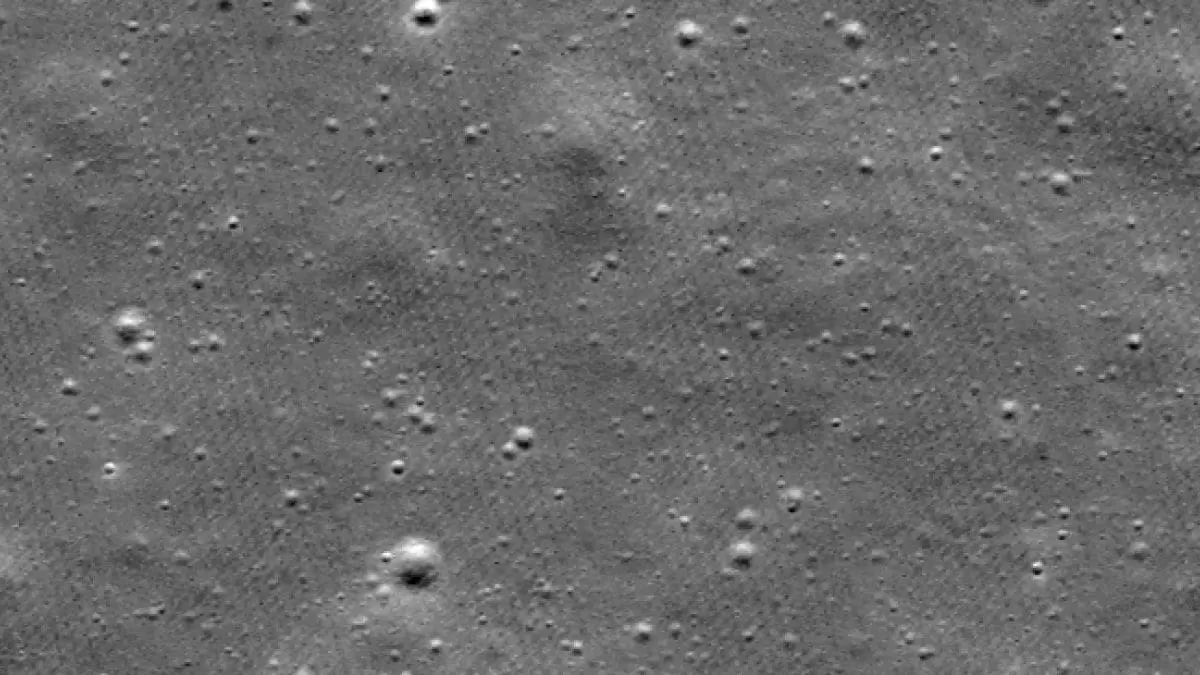
NASA’s Lunar Reconnaissance Orbiter and India’s Chandrayaan-2 have once again proven their capabilities by capturing images that confirm the crash of Japan’s Resilience lander on the Moon’s Mare Frigoris. This unfortunate event occurred on June 5, when contact with the lander was lost just 100 seconds before its scheduled touchdown. However, the new photos reveal a dark impact mark and scattered debris, providing valuable information for future missions.
The Resilience lander, developed by Japanese startup ispace, was a part of the company’s HAKUTO-R program, which aimed to explore the lunar surface and conduct experiments in collaboration with NASA. The lander was carrying a rover and was set to touch down on the Moon’s Mare Frigoris, also known as the Sea of Cold, which is located in the northern hemisphere of the Moon.
The mission was closely monitored by NASA’s Lunar Reconnaissance Orbiter (LRO) and India’s Chandrayaan-2, both of which have been orbiting the Moon and capturing high-resolution images of its surface. The LRO, which has been in orbit since 2009, has been instrumental in providing valuable data and images for various lunar missions. Similarly, Chandrayaan-2, India’s second lunar mission, has been a major success, with its orbiter still functioning and sending back valuable data.
On June 5, as the Resilience lander was making its descent towards the lunar surface, contact was lost just 100 seconds before its scheduled touchdown. This was a major setback for the HAKUTO-R program and the Japanese space industry as a whole. However, the LRO and Chandrayaan-2 were able to capture images of the crash site, providing valuable insights into what went wrong.
The images reveal a dark impact mark and scattered debris, indicating a high-velocity impact. This suggests that the lander may have experienced a hard landing, which could have caused damage to its systems and resulted in the loss of communication. The images also show that the lander was able to reach the surface, but was unable to make a soft landing.
While this is a setback for the HAKUTO-R program, it is important to note that space exploration is a challenging and risky endeavor. The fact that the lander was able to reach the lunar surface is a testament to the hard work and dedication of the team behind the mission. It also highlights the importance of collaboration in the space industry, as NASA and JAXA (Japan Aerospace Exploration Agency) were working together on this mission.
The crash of the Resilience lander also serves as a reminder of the need for continuous improvement and learning in the field of space exploration. The data and images captured by the LRO and Chandrayaan-2 will be crucial in understanding what went wrong and how future missions can be improved. This is the essence of scientific exploration – to learn from our mistakes and use that knowledge to push the boundaries of what is possible.
The images captured by the LRO and Chandrayaan-2 also showcase the incredible capabilities of these spacecraft. The LRO, which has been orbiting the Moon for over a decade, continues to provide valuable data and images, while Chandrayaan-2, which was launched in 2019, has already made significant contributions to our understanding of the lunar surface.
The crash of the Resilience lander may be a setback, but it should not discourage us from pursuing our dreams of exploring the Moon and beyond. It is a reminder that space exploration is a challenging and risky endeavor, but one that is worth pursuing for the sake of scientific advancement and human curiosity.
In conclusion, the images captured by NASA’s Lunar Reconnaissance Orbiter and India’s Chandrayaan-2 confirming the crash of Japan’s Resilience lander on the Moon’s Mare Frigoris are a testament to the capabilities of these spacecraft and the importance of collaboration in the space industry. While the crash may be a setback, it is also an opportunity to learn and improve for future missions. Let us continue to push the boundaries of space exploration and unlock the mysteries of our universe.
