
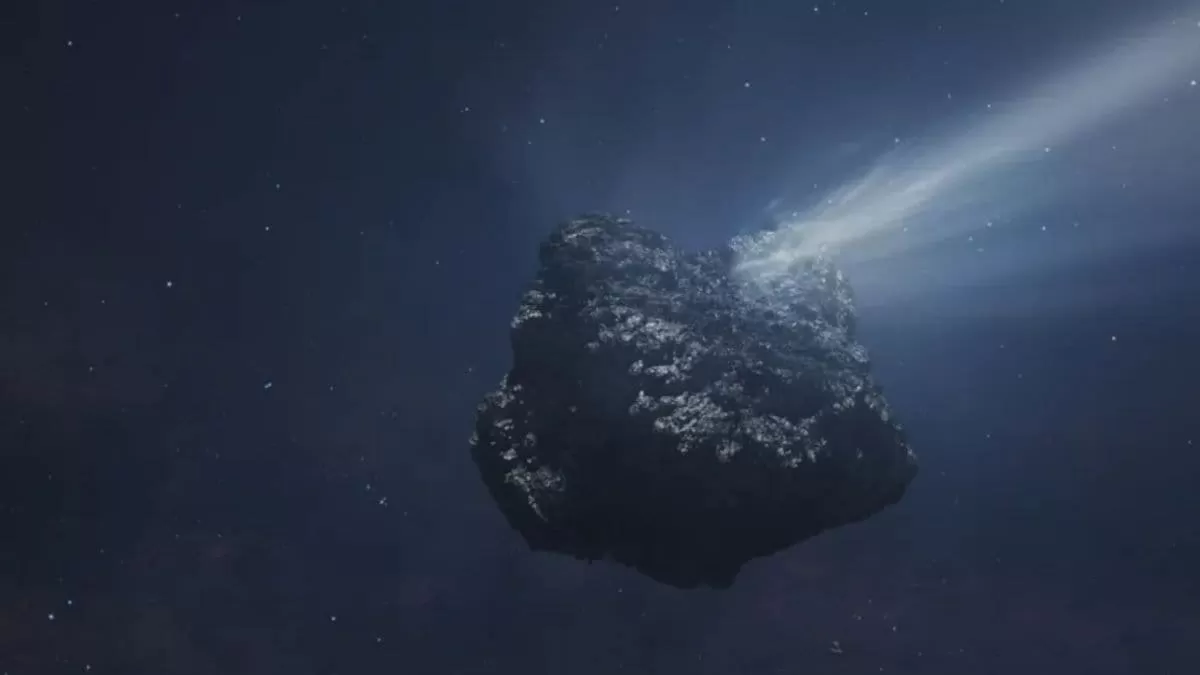
NASA, the world-renowned space agency, has made yet another groundbreaking discovery that has left the scientific community in awe. In a recent announcement, NASA has confirmed the existence of comet C/2014 UN271, the largest known comet from the Oort Cloud, which is chemically active. Detected by the Atacama Large Millimeter/submillimeter Array (ALMA) from far beyond Neptune, this comet’s carbon monoxide jets offer rare insights into icy body chemistry and early solar system conditions.
The Oort Cloud, a vast and largely unexplored region of our solar system, is believed to be the birthplace of comets. It is a spherical cloud of icy objects that extends up to 100,000 times the distance between the Earth and the Sun. These icy bodies are thought to be remnants from the early formation of our solar system, dating back over 4.6 billion years. And now, NASA’s discovery of comet C/2014 UN271 has given us a glimpse into the chemical composition of these ancient objects.
The comet, which is estimated to be between 100 and 370 kilometers in diameter, was first detected by the Dark Energy Survey in 2014. However, it wasn’t until the recent observations by ALMA that its true size and chemical activity were revealed. ALMA, a powerful array of 66 antennas located in the Chilean Andes, is specifically designed to study the cold and distant regions of our universe. Its high-resolution images have provided us with a closer look at this massive comet as it makes its way towards the Sun.
The most significant discovery from ALMA’s observations is the presence of carbon monoxide jets on the comet’s surface. These jets, which were detected using ALMA’s sensitive radio telescopes, are believed to be spewing out from the comet’s icy interior. This is the first time that such jets have been observed in a comet from the Oort Cloud, providing researchers with valuable insights into the chemical processes that take place within these ancient objects.
The detection of carbon monoxide jets on comet C/2014 UN271 has also shed light on the early conditions of our solar system. Carbon monoxide is considered to be one of the building blocks of life, and its presence in the comet’s jets suggests that it was present in the early stages of our solar system’s formation. This discovery supports the theory that comets played a crucial role in delivering essential elements for life to Earth.
Dr. Anthony Remijan, a scientist at the National Radio Astronomy Observatory, stated, “ALMA’s high sensitivity and resolution have allowed us to observe this comet in unprecedented detail, providing us with incredible insights into its chemical composition and early solar system conditions.” He further added, “This discovery opens up a whole new avenue for studying the chemical evolution of comets and the role they played in the formation of our solar system.”
NASA’s discovery of comet C/2014 UN271 has not only provided us with a better understanding of comets from the Oort Cloud, but it has also emphasized the importance of continued exploration of our solar system. The data collected from ALMA’s observations will be studied further by scientists around the world, and we can expect to gain more insights into the chemical processes that shaped our solar system.
This discovery also highlights the incredible capabilities of ALMA, which has been instrumental in many groundbreaking discoveries since its launch in 2011. Its high-resolution images and sensitive radio telescopes have allowed us to study distant and cold regions of our universe that were previously out of reach. And with the recent confirmation of its extension until 2032, we can expect many more remarkable discoveries to come.
In conclusion, NASA’s confirmation of comet C/2014 UN271’s chemical activity is a significant milestone in our understanding of comets and the early formation of our solar system. ALMA’s observations have provided us with rare insights into the chemical composition of these ancient objects and have opened up new avenues for further research. This discovery serves as a reminder of the endless possibilities that await us in the vast and mysterious universe, and it motivates us to continue exploring and unraveling its secrets.
