
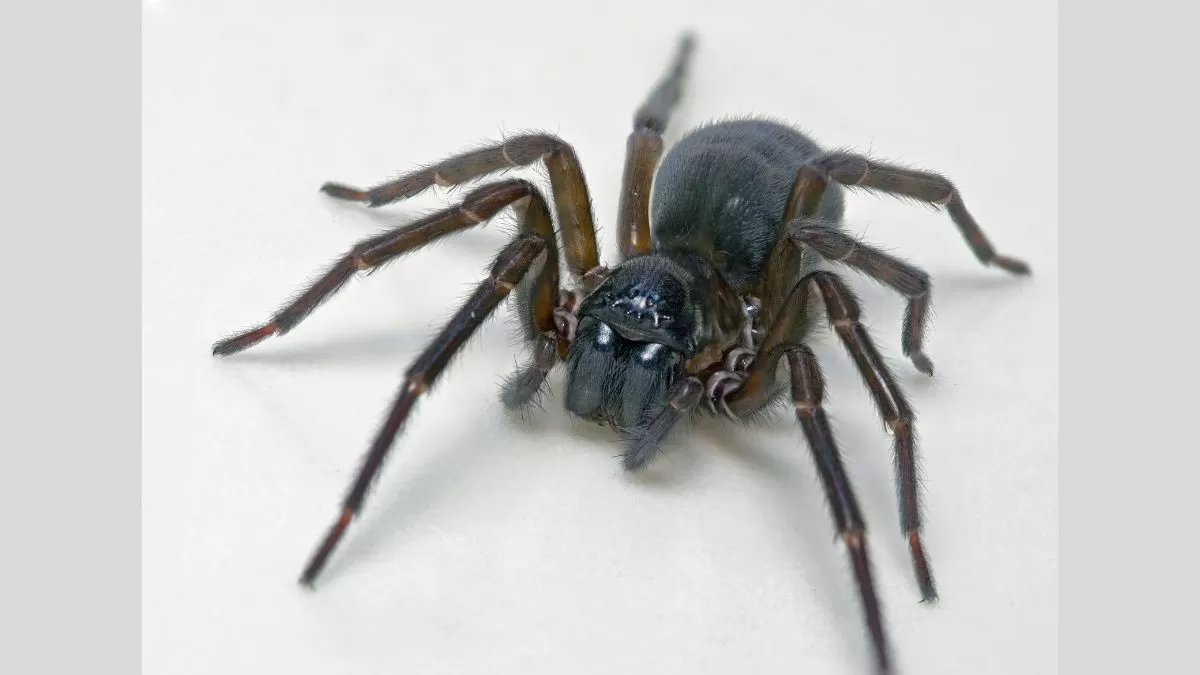
A recent study published in BMC Biology has revealed a fascinating discovery about the feather-legged lace weaver spider. Contrary to popular belief, this spider does not inject venom into its prey, but instead uses a unique method of coating its victims with regurgitated toxins on silk. This groundbreaking finding challenges traditional notions of spider evolution and prey capture strategies, and could potentially lead to a better understanding of these fascinating creatures.
The feather-legged lace weaver spider, also known as the Uloborus plumipes, is a small spider found in Europe, Asia, and North America. It is known for its distinctive feather-like legs and intricate web-building abilities. However, until now, little was known about its hunting methods.
The study, conducted by researchers from the University of Basel in Switzerland, focused on the spider’s venom glands and ducts. Surprisingly, they found that the spider does not possess these structures, which are commonly found in other venomous spiders. This led the researchers to question how the spider was able to subdue its prey.
Through a series of experiments, the researchers discovered that the feather-legged lace weaver spider uses a unique method of immobilizing its prey. After capturing its victim in its web, the spider covers it with a layer of regurgitated digestive enzymes and toxins. This coating effectively paralyzes the prey, allowing the spider to easily consume it.
This method of prey capture is not only effective but also efficient. By coating its prey with toxins, the spider does not have to expend energy on injecting venom. This could be a significant advantage for the spider, especially when hunting larger prey.
The researchers also found that the toxins used by the spider are similar to those found in venomous spiders. This suggests that the feather-legged lace weaver spider may have evolved from a venomous ancestor, but lost its venom glands and ducts over time. This is a significant finding that challenges traditional beliefs about spider evolution.
Dr. Peter Michalik, the lead author of the study, explains, “Our findings suggest that the feather-legged lace weaver spider has developed a unique and highly effective method of prey capture. This could potentially change the way we understand spider evolution and the diversity of prey capture strategies in spiders.”
The study also has implications for the field of spider venom research. By studying the toxins used by the feather-legged lace weaver spider, scientists may be able to identify new compounds that could be used for medical purposes. Spider venom has been found to have potential in treating various diseases, including chronic pain and neurological disorders.
The discovery of this unique prey capture strategy in the feather-legged lace weaver spider is a testament to the incredible diversity and adaptability of these creatures. It also highlights the importance of continued research and exploration in the field of spider biology.
As Dr. Michalik puts it, “Spiders are fascinating creatures that have been around for millions of years. This study shows that there is still so much we have yet to discover about them. We hope that our findings will inspire further research and shed light on the incredible world of spiders.”
In conclusion, the recent study on the feather-legged lace weaver spider has revealed a remarkable and unexpected method of prey capture. This discovery challenges traditional beliefs about spider evolution and could potentially lead to new medical breakthroughs. It is a testament to the endless wonders of the natural world and the importance of continued scientific exploration.
