
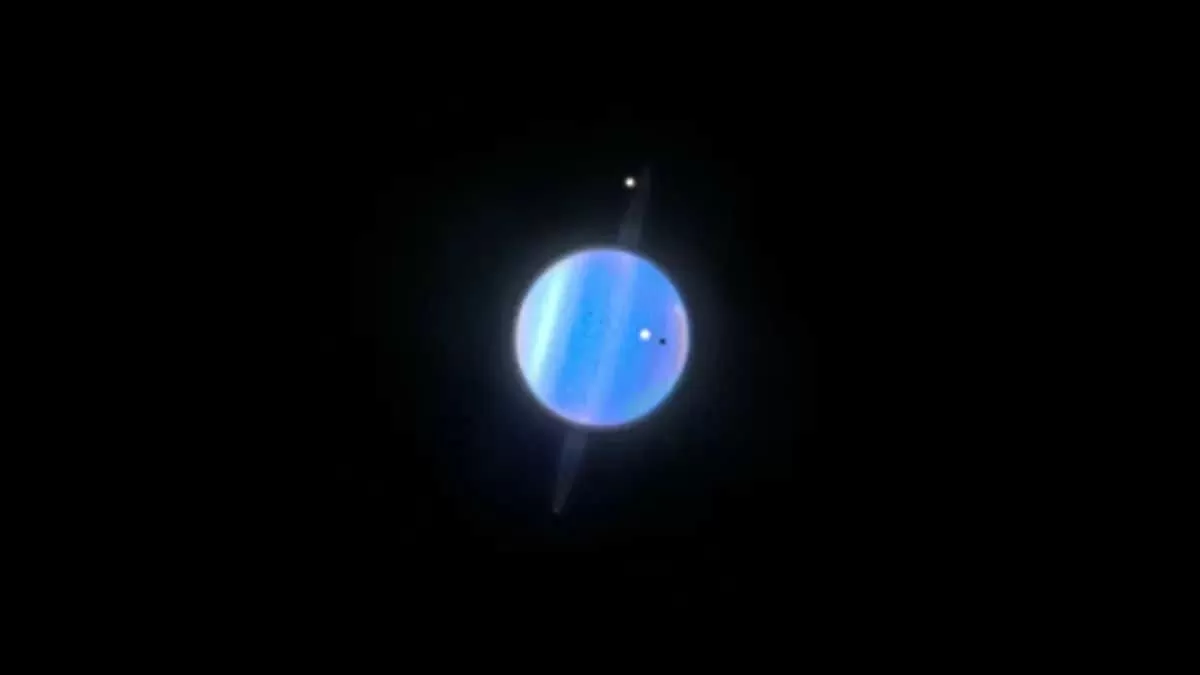
New Hubble Space Telescope observations have revealed surprising new information about the moons of Uranus. For decades, scientists believed that the planet’s magnetic field was responsible for darkening the backsides of its two largest moons, Titania and Oberon, with radiation. However, the latest data has shown that something entirely different is happening.
According to the new findings, Titania and Oberon are actually collecting space dust on their leading sides. This phenomenon, dubbed the “cosmic bug splatter” effect, has completely upended scientists’ expectations and theories about these two moons.
The Hubble Space Telescope, launched in 1990, has been instrumental in our understanding of the universe and has provided us with stunning images and groundbreaking discoveries. Its latest observations of Uranus’ moons have once again pushed the boundaries of our knowledge and challenged our understanding of the solar system.
For years, scientists believed that the darkening of Titania and Oberon’s backsides was due to the planet’s strong magnetic field. This field is created by the planet’s rotation and is known to trap charged particles, which can cause darkening of surfaces. However, the new data from Hubble has shown that this is not the case.
Instead, the leading sides of these two moons are collecting space dust from Uranus’ outer rings. This dust, which is made up of tiny particles of ice and rock, is being bombarded by high-speed particles from the planet’s magnetosphere, causing it to accumulate on the moons’ surfaces. This is similar to how bugs collect on the windshield of a car while driving through a swarm.
This discovery has been met with great excitement and has opened up a whole new avenue of research for scientists. It has also raised questions about the composition and behavior of Uranus’ outer rings. These rings, which were discovered in 1977, are made up of dark particles and are thought to be remnants of a collision between Uranus and a large object in its past.
The “cosmic bug splatter” effect has also shed light on the complex interactions between a planet’s magnetosphere and its moons. This phenomenon is not unique to Uranus, as other moons in our solar system, such as Jupiter’s Europa and Saturn’s Enceladus, have also been found to collect space dust on their leading sides.
The new data from Hubble has once again proven the importance of continued exploration and research in our solar system. It has shown that even after decades of study, there is still so much we have yet to discover and understand.
This discovery has also highlighted the incredible capabilities of the Hubble Space Telescope, which has been in operation for over 30 years. Its ability to provide us with such detailed and accurate observations from millions of miles away is a testament to the advancements in technology and our understanding of the universe.
The “cosmic bug splatter” effect on Uranus’ moons has not only challenged our previous theories but has also sparked new questions and avenues of research. It has shown that our solar system is a dynamic and ever-changing place, and there is still much to be explored and understood.
As we continue to push the boundaries of space exploration, we can only imagine what other surprises and discoveries await us in the vastness of our universe. The Hubble Space Telescope and other space missions will continue to play a crucial role in unraveling the mysteries of our solar system and beyond.
