
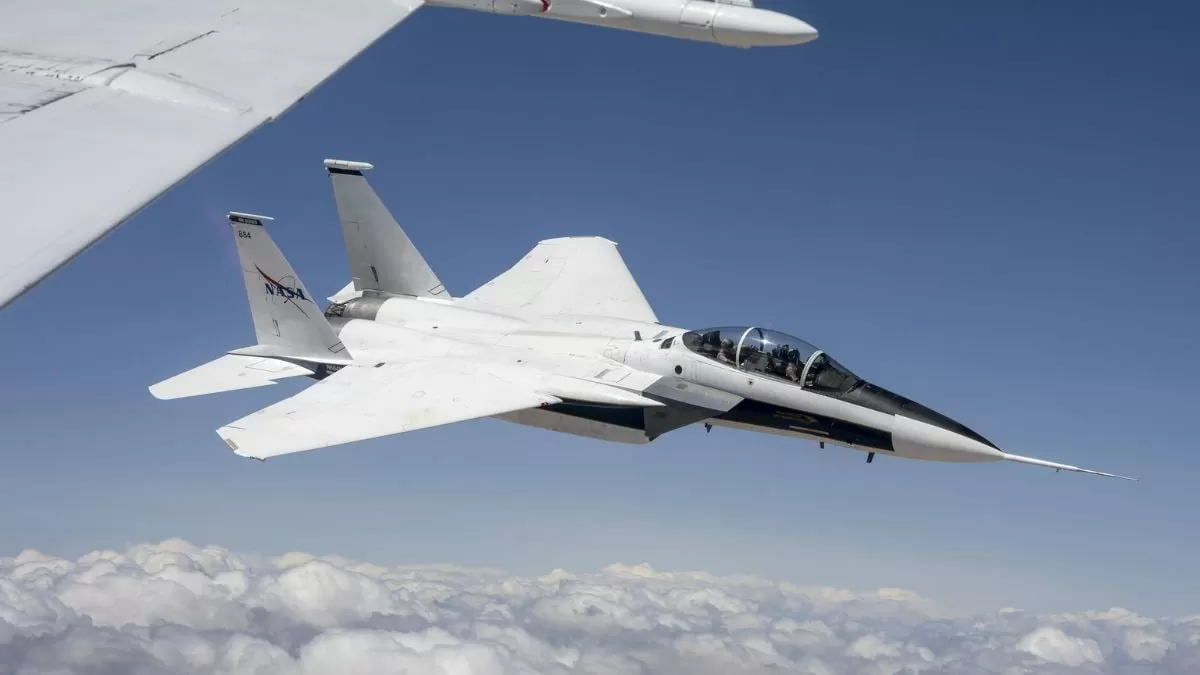
NASA, the renowned space agency, recently achieved a major milestone in its Quesst mission, which aims to revolutionize commercial air travel over land. During May flights over the Mojave Desert, NASA’s twin F-15 jets successfully validated critical tools for the X-59 quiet supersonic aircraft, bringing us one step closer to a future of faster, quieter, and more efficient air travel.
The X-59 quiet supersonic aircraft is a groundbreaking project that aims to address one of the biggest challenges in aviation – sonic booms. When an aircraft travels faster than the speed of sound, it creates a loud and disruptive noise known as a sonic boom. This has restricted supersonic flights over land, limiting them to only over-water routes. However, with the development of the X-59, NASA hopes to reduce the intensity of these sonic booms to a level that is barely noticeable on the ground, making it possible for supersonic flights to be conducted over land.
To achieve this ambitious goal, NASA has been rigorously testing and validating various critical tools and technologies for the X-59 aircraft. And the recent flights of the twin F-15 jets have proved to be a major success, validating precision systems such as shock-sensing probes, schlieren imaging, and ALIGNS navigation.
Shock-sensing probes are essential in measuring the strength of shock waves produced by supersonic aircraft. These probes are placed on the F-15 jets and are used to collect real-time data on the strength and location of shock waves, allowing scientists to fine-tune the design of the X-59 to minimize sonic booms.
Schlieren imaging is another crucial tool used in the development of the X-59. It uses high-speed cameras to capture images of shock waves, allowing researchers to visualize and analyze the impact of different design modifications on the intensity of sonic booms.
ALIGNS (Airborne Location Integrated Navigation System) is a cutting-edge navigation system that uses a combination of satellite signals and onboard sensors to provide precise navigation information to the aircraft. This technology is crucial for the X-59 as it will enable the aircraft to fly at supersonic speeds over land without disrupting the ground with loud sonic booms.
The successful validation of these critical tools and technologies during the May flights over the Mojave Desert is a significant achievement for NASA’s Quesst mission. It not only demonstrates the agency’s commitment to pushing the boundaries of aeronautical innovation but also brings us one step closer to a future where supersonic air travel over land is a reality.
The development of the X-59 aircraft has been a long and challenging journey, with many hurdles to overcome. But NASA’s perseverance and dedication have paid off, and the recent validation of critical tools is a testament to that. With this success, NASA is now one step closer to achieving its ultimate goal of enabling quieter, faster, and more efficient commercial air travel over land.
The implications of this achievement are enormous. It opens up a whole new world of possibilities for the aviation industry, making it possible for people to travel faster and more conveniently than ever before. With supersonic flights over land, the time it takes to travel from one place to another will be significantly reduced, and long-distance trips will become more accessible and feasible. This will not only benefit individuals but also have a positive impact on business and the economy.
But the benefits of this achievement go beyond just faster air travel. By reducing the intensity of sonic booms, the X-59 will also have a positive impact on the environment. The loud noise produced by traditional supersonic aircraft has been a major concern for environmentalists. With the development of the X-59, NASA is taking a significant step towards addressing this issue and creating a more sustainable future for air travel.
As we look towards the future, it is evident that NASA’s Quesst mission is crucial for the advancement of commercial air travel. The successful validation of critical tools for the X-59 aircraft during the May flights over the Mojave Desert marks a significant milestone and brings us one step closer to a world where we can travel faster, quieter, and more sustainably. This achievement is a testament to NASA’s commitment to pushing the limits of technology and shaping the future of aviation. And with the continued efforts of the agency, we can look forward to a future of efficient and convenient air travel.
