
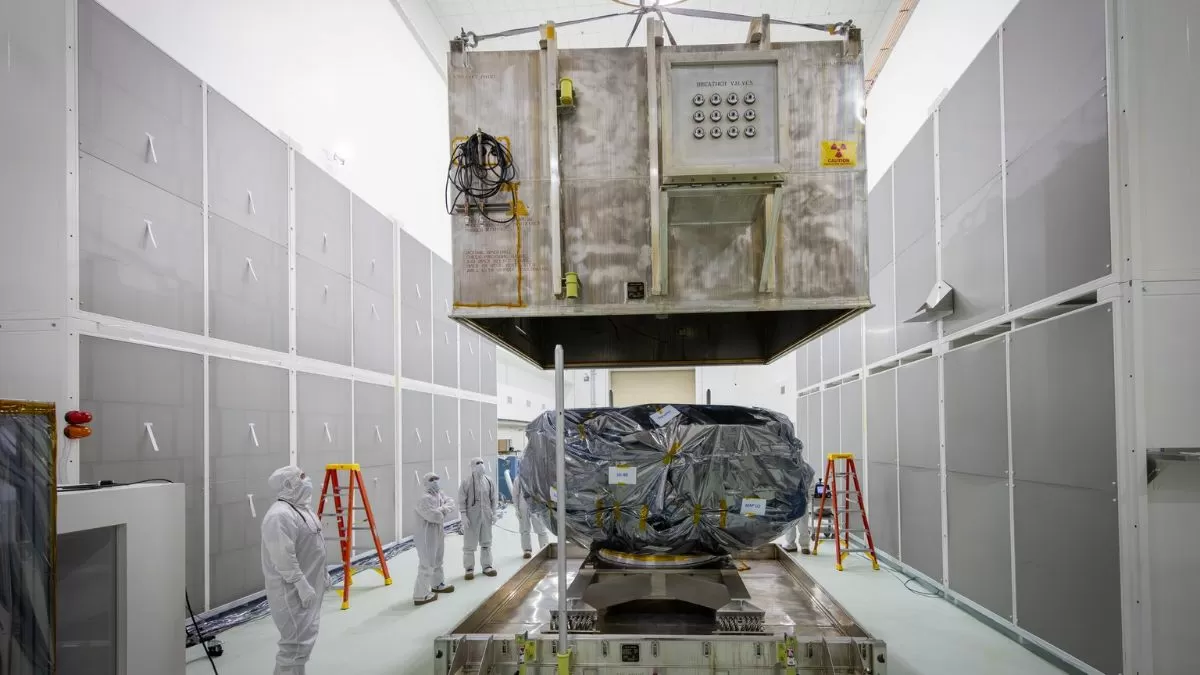
NASA’s Interstellar Mapping and Acceleration Probe (IMAP) is gearing up for its highly anticipated launch, set to take place no earlier than September 2025. The spacecraft, built by Johns Hopkins Applied Physics Laboratory (APL), will embark on a groundbreaking mission to study the solar wind and the edge of the heliosphere from a vantage point a million miles away from Earth.
The IMAP mission is a part of NASA’s Heliophysics Explorer Program, which aims to understand the fundamental processes that drive our solar system. The spacecraft will be positioned at Lagrange Point 1, a gravitationally stable point between the Earth and the Sun, where it will have an unobstructed view of the solar wind and its interactions with the interstellar medium.
The solar wind is a constant stream of charged particles that emanate from the Sun and extend far beyond the orbit of Pluto. It is responsible for shaping the heliosphere, a bubble-like region that surrounds our solar system and protects it from the harsh cosmic rays of interstellar space. By studying the solar wind and the heliosphere, scientists hope to gain a better understanding of the Sun’s influence on our local space environment and its potential effects on Earth.
IMAP will carry a suite of 10 state-of-the-art instruments, including a dust detector, a magnetometer, and a solar wind analyzer, to collect data on the solar wind and its interactions with the interstellar medium. The spacecraft will also fly alongside two other satellites, the European Space Agency’s Solar Orbiter and NASA’s Solar Probe Plus, to provide a comprehensive view of the Sun and its surroundings.
The mission’s primary goal is to map the heliosphere in three dimensions, providing the most detailed and comprehensive view of this region to date. This will help scientists understand the dynamics of the solar wind and its interactions with the interstellar medium, as well as the structure and evolution of the heliosphere.
But that’s not all. IMAP will also investigate the origins of cosmic rays, high-energy particles that originate from outside our solar system and can pose a threat to astronauts and spacecraft. By studying the solar wind and its interactions with the interstellar medium, scientists hope to uncover the mechanisms that accelerate these particles to such high energies.
The spacecraft’s journey to Lagrange Point 1 will take approximately six months, after which it will begin its two-year primary mission. During this time, IMAP will make multiple passes through the solar wind, collecting data and sending it back to Earth for analysis. The spacecraft will also make observations of the Sun and its surroundings during its journey to and from Lagrange Point 1.
The IMAP mission is a testament to NASA’s commitment to pushing the boundaries of space exploration and expanding our understanding of the universe. It is a culmination of years of hard work and dedication by the team at Johns Hopkins APL, who have designed and built the spacecraft to withstand the harsh conditions of space and deliver groundbreaking scientific discoveries.
The launch of IMAP in 2025 will mark a significant milestone in our quest to unravel the mysteries of the solar wind and the heliosphere. The data collected by the spacecraft will not only advance our understanding of our own solar system but also provide valuable insights into the workings of other star systems and the universe as a whole.
As we eagerly await the launch of IMAP, we can only imagine the groundbreaking discoveries that await us. The mission is a testament to the power of human curiosity and our relentless pursuit of knowledge. With IMAP, we are taking another giant leap towards unlocking the secrets of our universe and expanding the boundaries of human understanding.
