
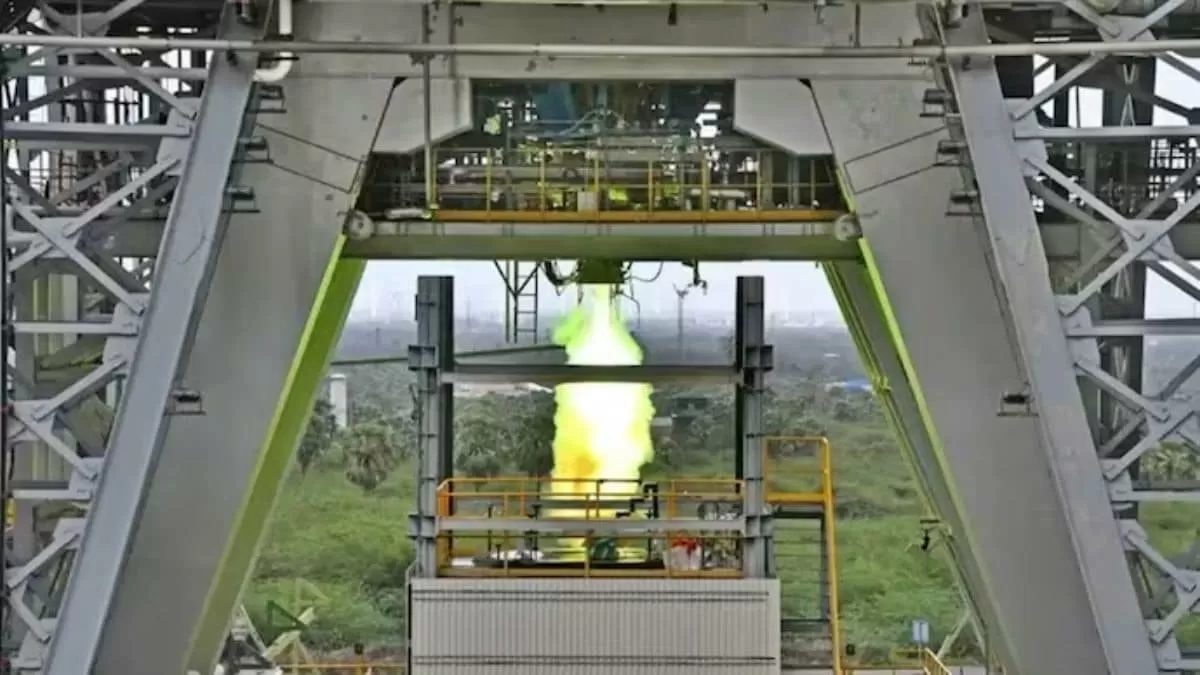
ISRO Conducts Successful Third Hot Test of SE2000 Semi-Cryogenic Engine
In a momentous achievement for the Indian Space Research Organization (ISRO), the SE2000 semi-cryogenic engine successfully completed its third hot test on May 28, 2025, at the ISRO Propulsion Complex in Mahendragiri. This final test, which was part of a three-phase series, validated the start-up sequence of the SE2000 engine. This breakthrough technology uses liquid oxygen and kerosene in a staged combustion cycle, and it will play a pivotal role in powering the upcoming SC120 stage of the LVM3, further enhancing India’s capabilities in the space sector.
The SE2000 is a result of relentless efforts by the talented scientists and engineers at ISRO who have been working tirelessly to create an indigenous semi-cryogenic engine. The engine is designed to generate a thrust of 2000 kilo Newtons (kN) with a specific impulse (a measure of efficiency) of 340 seconds. This is a significant improvement compared to the existing liquid stage engines that have a thrust of 800 kN and a specific impulse of 300 seconds.
The successful hot test has once again demonstrated ISRO’s prowess in mastering complex technologies. The SE2000 engine uses a new propellant combination of liquid oxygen and highly refined kerosene, which makes it more efficient and cost-effective. The engine operates on a staged combustion cycle, which means that the propellants are burned in sequential stages to maximize the thrust and efficiency of the engine. This technology has been successfully used in the GSLV Mk III launch vehicle, and now it will be further improved upon with the SE2000 engine.
The hot test, which lasted for 1,000 seconds, was a critical milestone in the development of the SE2000 engine. It subjected the engine to extreme temperatures and high-pressure conditions, replicating the harsh environment it would experience during an actual mission. The engine performed flawlessly, proving that it is ready to power the SC120 stage of the LVM3. This is a significant step towards the launch of India’s heaviest rocket, the LVM3, which can carry payloads of up to 10 tonnes to the Geosynchronous Transfer Orbit (GTO).
The development of the semi-cryogenic engine will not only reduce India’s dependence on foreign countries for critical technologies but also significantly reduce the cost of launching satellites into space. Currently, India has to rely on foreign launch service providers to launch heavy satellites into space, which is a costly affair. The SE2000 engine, combined with the LVM3 launch vehicle, will make India self-sufficient in this crucial aspect, bringing down the cost and making it more competitive in the global space market.
The SE2000 engine is a testament to ISRO’s commitment towards creating indigenous technologies and pushing the boundaries of space exploration. The semi-cryogenic technology is not an easy feat to achieve, and only a handful of countries possess this capability. With this successful hot test, ISRO has joined the elite group of countries with the expertise to build and operate a semi-cryogenic engine.
The SE2000 engine is set to play a crucial role in India’s future space missions. It will be used to power the SC120 stage of the LVM3, which will be the backbone of India’s future heavy launch capabilities. This will allow India to launch heavier satellites into space, paving the way for more advanced scientific missions and communication services. The engine will also be used in the development of the new generation GSLV Mk IV launch vehicle, which is designed to carry heavier payloads to the GTO and beyond.
The successful hot test of the SE2000 engine has once again proven ISRO’s technical excellence and its tireless efforts to make India a leader in the space sector. With this achievement, ISRO has taken another giant leap towards realizing its vision of making India self-reliant in critical space technologies. The Government of India has also expressed its appreciation for ISRO’s achievements and has pledged its continued support towards ISRO’s endeavors.
In conclusion, the success of the third hot test of the SE2000 semi-cryogenic engine is a moment of great pride and joy for the entire nation. It is a testament to ISRO’s dedication and hard work in developing indigenous technologies and puts India in a league of its own in the global space race. The
