
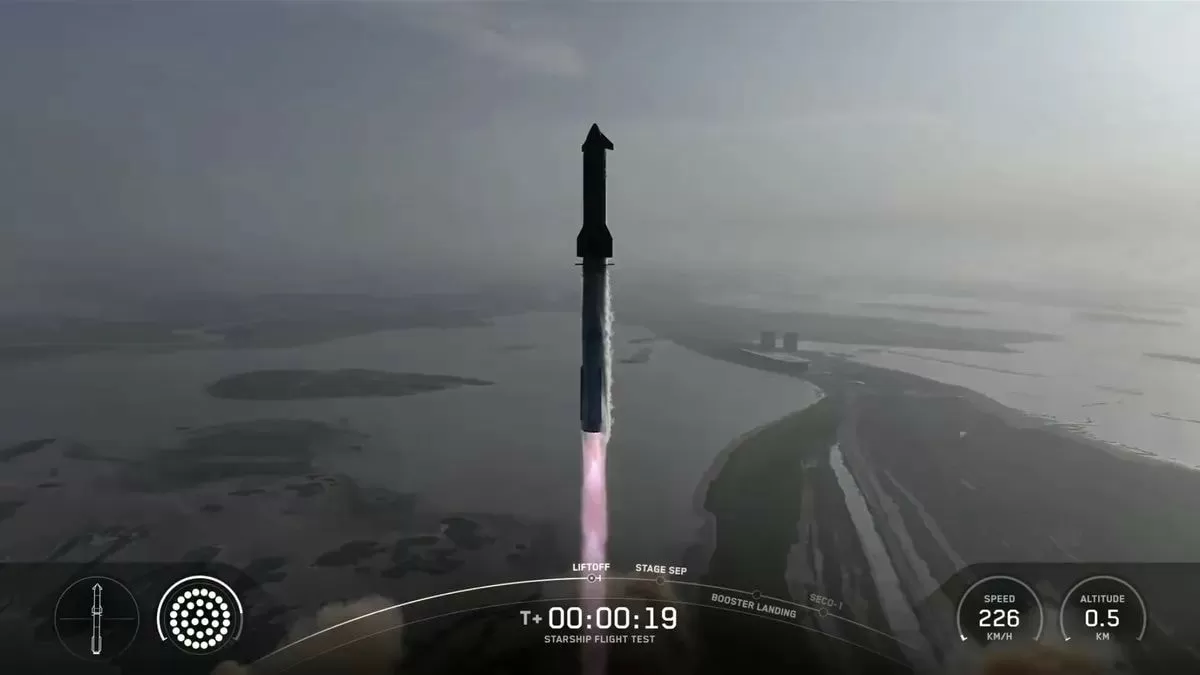
SpaceX, the aerospace company founded by visionary entrepreneur Elon Musk, has once again made headlines with its latest Starship test flight. On May 27, 2021, SpaceX launched its ninth Starship test flight, marking another step forward in its mission to revolutionize space travel.
This particular test flight was especially remarkable as it showcased bold advancements, including the first reuse of a Super Heavy booster. Despite not achieving all of its mission goals, the test provided valuable data on reusability, aerodynamic control, and thermal protection, bringing us one step closer to making space travel more accessible and sustainable.
The Starship test flight consisted of two stages – the Super Heavy booster and the upper stage. Both stages were equipped with advanced technologies and innovative designs, pushing the boundaries of what is possible in space exploration.
The Super Heavy booster, which is the largest rocket ever built, was the first to take flight. This was a historic moment as it was the first time a Super Heavy booster had been reused. This achievement is a game-changer for the industry as it significantly reduces the cost of space travel and makes it more economically feasible.
Although the Super Heavy booster did not complete all of its mission goals, it still provided crucial data on reusability. This data will be used to further improve the technology and pave the way for future successful launches.
The upper stage of the Starship, which is designed to carry humans and cargo to space, also made significant strides in its test flight. It successfully reached space and attempted satellite deployment, showcasing its potential for future space missions.
One of the key advancements demonstrated by the upper stage was its aerodynamic control. This technology allows the Starship to maneuver and land precisely, making it possible to land on other planets and moons in the future. This is a crucial step towards Musk’s vision of establishing a human settlement on Mars.
The test flight also provided valuable data on thermal protection, which is essential for the safety of astronauts and equipment during reentry into the Earth’s atmosphere. The upper stage was equipped with advanced heat shield technology, which successfully withstood the extreme temperatures during its descent, proving its effectiveness.
Despite not achieving all of its mission goals, the Starship test flight was a resounding success. It demonstrated the incredible progress that SpaceX has made in developing reusable rockets and pushing the boundaries of space exploration.
This success would not have been possible without the dedicated team at SpaceX, who have worked tirelessly to make this dream a reality. Their hard work and determination have brought us one step closer to making space travel more accessible and sustainable for future generations.
The advancements showcased in this test flight are a testament to SpaceX’s commitment to innovation and its mission to make humanity a multi-planetary species. With each successful launch, SpaceX is getting closer to realizing its ultimate goal of colonizing Mars and making interplanetary travel a reality.
In conclusion, SpaceX’s ninth Starship test flight was a remarkable achievement, showcasing bold advancements in reusability, aerodynamic control, and thermal protection. Despite not achieving all its mission goals, the test provided valuable data and brought us one step closer to making space travel more accessible and sustainable. With each successful launch, SpaceX is proving that the impossible is possible, and the future of space exploration looks brighter than ever before.
