
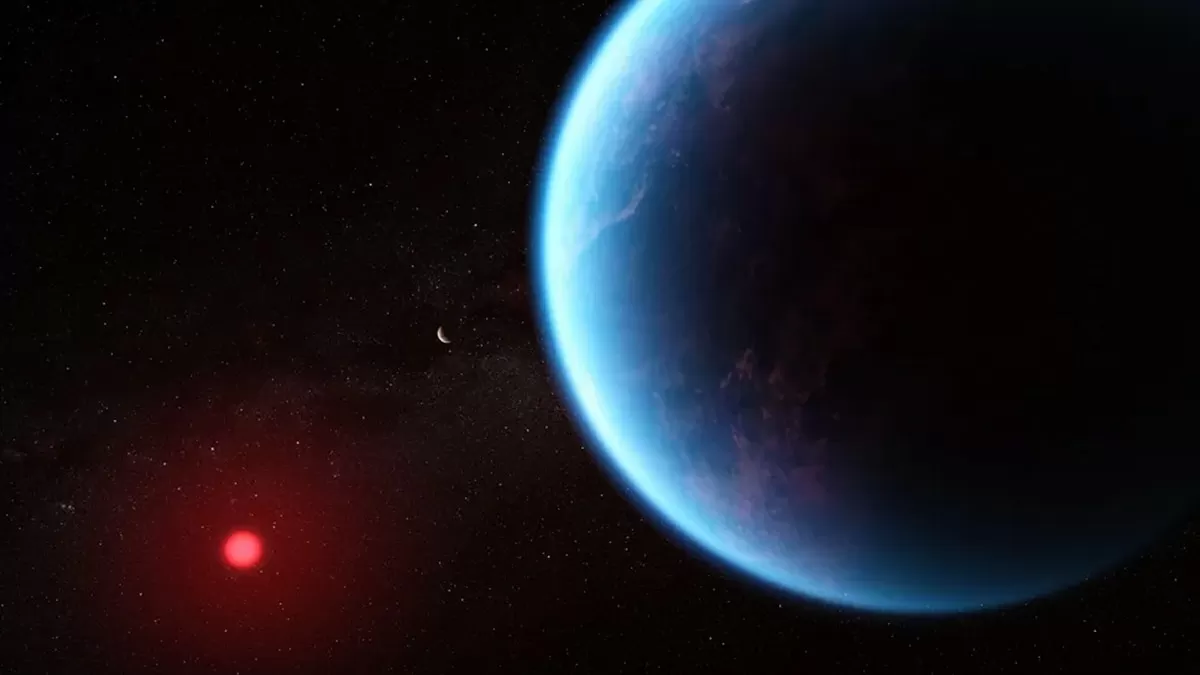
A new study, led by researchers from the University of Chicago, has reanalyzed data from the James Webb Space Telescope and discovered weaker evidence for potential biosignatures on exoplanet K2-18b. This groundbreaking research challenges earlier reports that suggested the presence of dimethyl sulfide (DMS), a chemical often associated with marine life on Earth. The latest analysis reveals that the signals found on K2-18b are inconsistent, leaving scientists with more questions than answers.
Exoplanets, or planets outside of our solar system, have long fascinated scientists and astronomers. The possibility of life beyond Earth has driven extensive research in the field, and the discovery of K2-18b in 2015 sparked a lot of excitement. Located 111 light-years away, this super-Earth planet is known to orbit within the habitable zone of its star, making it a prime candidate for the potential presence of life.
Previous studies had suggested the presence of DMS in the atmosphere of K2-18b, a chemical that is known to be produced by marine life on Earth. The excitement around this discovery was due to the fact that DMS could potentially serve as a biosignature, or a chemical indicator of life, on other planets. However, the latest research led by Jacob Bean, an associate professor at the University of Chicago, has found that the signals of DMS are not strong enough to be considered solid evidence for the presence of life on K2-18b.
The team of researchers reanalyzed data from the James Webb Space Telescope, a highly advanced spacecraft designed to study the universe in infrared light. They used a new method to extract the signals and filter out any noise, which led to different results from the previous analysis. The signals identified as DMS were found to be inconsistent and could possibly be attributed to other chemicals in the atmosphere of the planet.
This discovery has sparked a lot of debate and discussion within the scientific community. While some experts believe that this is a significant setback in the search for extraterrestrial life, others see it as an exciting opportunity to further investigate the planet and its atmosphere.
Bean and his team are optimistic about the new findings and the impact they could have on future research. He stated, “We should always be skeptical of our own findings and constantly strive to further examine and analyze our data. This new research opens up new possibilities for understanding the composition of exoplanets and their potential for hosting life.”
The latest study highlights the importance of constantly reevaluating and challenging our findings in the scientific world. While the initial excitement around the potential biosignatures on K2-18b may have been premature, the new research provides a better understanding of the complexities of studying exoplanets and the challenges that come with it.
This discovery also highlights the significance of advancements in technology and the importance of investing in cutting-edge research tools like the James Webb Space Telescope. With its powerful capabilities, the spacecraft has already provided us with a wealth of information about distant planets, and there is no doubt that it will continue to do so in the years to come.
The search for extraterrestrial life is a complex and ongoing process, and this latest study serves as a reminder that we still have a lot to learn and discover. The possibility of finding life beyond Earth is an exciting prospect, and while the latest findings may have dampened some of that excitement, it has also opened up new avenues for further research and exploration.
In conclusion, the University of Chicago-led study has challenged previous reports of potential biosignatures on K2-18b. While the presence of DMS is not as strong as initially thought, it does not rule out the possibility of life on the exoplanet. The new findings have opened up new opportunities for studying distant worlds and have sparked important discussions within the scientific community. This only goes to show that the search for extraterrestrial life is a continuous journey, and with advancements in technology and constant reevaluation, one day we may finally find the answer to the age-old question – are we alone in the universe?
