
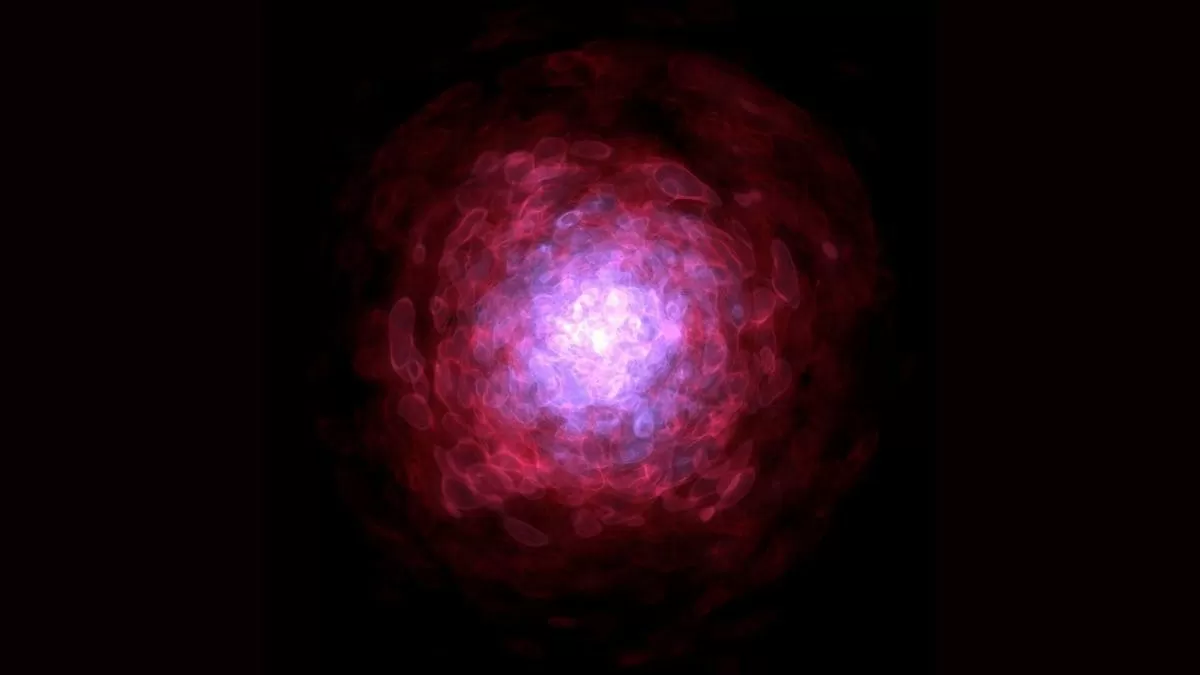
A groundbreaking study has made significant strides in unraveling the mysteries of dark matter, a substance that makes up approximately 85% of the universe’s mass. Led by a team of scientists at the University of California, Irvine, the study has set a new lower bound on the mass of ultralight bosonic dark matter particles, at an incredibly small 2.2 × 10⁻²¹ electron volts (eV). This groundbreaking discovery, published in the journal Physical Review Letters, has the potential to challenge existing theories and shed light on the elusive nature of dark matter.
For decades, scientists have been fascinated by dark matter, which cannot be seen or detected by traditional methods. Its existence has only been inferred through its gravitational effects on visible matter. The most prevalent theory about dark matter is that it is made up of a type of particle known as weakly interacting massive particles (WIMPs). However, despite decades of research, WIMPs have yet to be observed, leading scientists to consider other possibilities, including ultralight bosonic particles.
To explore this possibility, the team of researchers turned their attention to the dwarf galaxy Leo II, located approximately 690,000 light-years away from Earth. Using advanced computational models, they analyzed the motion of stars within this galaxy and were able to determine that the lower bound for the mass of ultralight bosonic dark matter particles is 2.2 × 10⁻²¹ eV. This means that any particles with a mass less than this would not be able to form the observed structures within the galaxy, ruling them out as candidates for dark matter.
This discovery is a major breakthrough as it challenges the popular fuzzy dark matter theory, which proposes that dark matter is made up of ultralight bosonic particles with masses ranging from 10⁻²² to 10⁻²⁴ eV. The new lower bound set by the study effectively rules out this mass range, meaning that scientists will need to explore other theories and possibilities to explain the existence of dark matter.
The implications of this study go beyond just ruling out a specific mass range for dark matter particles. It also paves the way for future research and exploration into other potential candidates. One of the co-authors of the study, Dr. Manoj Kaplinghat, explains, “More importantly, we now have a new approach to constraining dark matter models. This study opens up a whole new path for research in this field.”
Furthermore, the study also provides crucial evidence to support the existence of dark matter, adding to the mounting data collection that supports its presence in the universe. As the lead author, Kevork Abazajian, notes, “The fact that we can rule out some of the possibilities for dark matter in this way helps to solidify the case for dark matter as a real and significant component of our universe.”
The team’s discovery is not just a significant milestone for the study of dark matter, but it also has the potential to open doors for further exploration and understanding of the universe. As Dr. Kaplinghat states, “We’re on the brink of a new era in our understanding of dark matter, and this study has laid the foundation for future research in this field.”
The study’s findings have also been met with excitement and praise from the scientific community. Dr. Joel Primack, a physicist at UC Santa Cruz, commented, “It’s a tour de force of 20th-century computational physics and 21st-century astronomical observation.” He also added, “The implications are that a wide range of possible models for dark matter is now ruled out. This is a really big deal.”
In conclusion, the groundbreaking study led by the team at UC Irvine has made a significant contribution to our understanding of dark matter. By setting a new lower bound on the mass of ultralight bosonic dark matter particles, they have challenged existing theories and opened the door for further research into this elusive substance. With the potential to unlock the mysteries of the universe, this study marks an exciting step forward in the field of dark matter research.
