
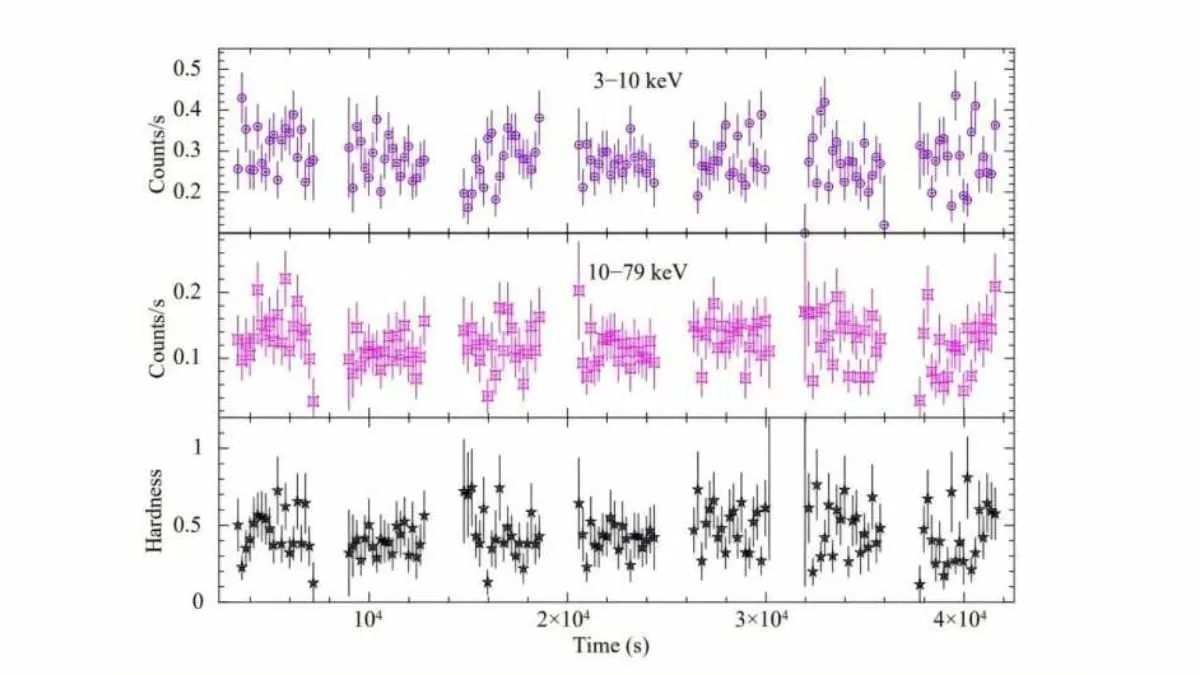
NASA’s NuSTAR and NICER telescopes have once again made a groundbreaking discovery in the outer reaches of our universe. In a joint study, these advanced telescopes have shed new light on RX J0032.9-7348, an X-ray pulsar located in the Small Magellanic Cloud (SMC), first detected 30 years ago. This latest study has revealed fascinating insights into this mysterious object, including a double-peaked pulse profile and a significant X-ray brightening event in October 2024.
RX J0032.9-7348 is a highly energetic neutron star located in the SMC, a dwarf galaxy about 200,000 light-years away from Earth. Discovered in 1990 by NASA’s Einstein Observatory, it has continued to capture the attention of scientists due to its unique characteristics and the challenging environment it resides in.
In this most recent study, researchers combined the capabilities of NuSTAR and NICER to observe RX J0032.9-7348 over a period of several years. NuSTAR, or Nuclear Spectroscopic Telescope Array, is a high-energy X-ray telescope designed to detect and observe the most energetic phenomena in the universe. It has the capability to capture X-rays with energies up to 79,000 electron volts (eV), making it ideal for studying objects like RX J0032.9-7348. On the other hand, NICER, or Neutron star Interior Composition Explorer, is a NASA instrument specifically designed for studying neutron stars and their interiors. It is capable of measuring the X-ray brightness and pulse characteristics of these objects with incredible precision.
The observations made by these two telescopes have revealed new and important information about RX J0032.9-7348. Researchers have measured a spin-up rate of -0.08 microseconds per year, indicating that the pulsar is gradually spinning faster. This is a common phenomenon in X-ray pulsars and is caused by the transfer of material and angular momentum from its companion star. This finding will help scientists better understand the evolution of this pulsar and its role in the SMC.
Additionally, the team has also discovered an interesting double-peak in the pulsar’s pulse profile, which could provide insight into its magnetic field structure. This feature was not visible in previous observations and indicates that the pulsar may be undergoing changes in its magnetic field. These findings have been published in The Astrophysical Journal.
One of the most intriguing discoveries of this study was the significant X-ray brightening event observed in October 2024. This event lasted for over a week and resulted in the pulsar becoming 25 times brighter than its typical X-ray emission. This type of phenomenon is known as an outburst and is caused by sudden changes in the accretion rate, where the pulsar pulls in material from its companion star.
The combined observations from NuSTAR and NICER have provided unprecedented details about the behavior of RX J0032.9-7348. Professor Deepto Chakrabarty, a member of the research team and the principal investigator for NICER, stated, “It’s really exciting to see these two powerful NASA telescopes working together to uncover the secrets of this X-ray pulsar, located in one of our neighboring galaxies.” This study is a perfect example of how collaboration between different telescopes can lead to significant discoveries and open new avenues for research.
The results from this study have further cemented the importance of X-ray pulsars in unraveling the mysteries of our universe. These highly energetic objects, with their extreme environments and unique characteristics, provide a wealth of information about the inner workings of our universe. Understanding their behavior can also help us develop a better understanding of other cosmic phenomena, such as black holes and quasars.
With technological advancements and the work of dedicated scientists, we can expect more exciting discoveries in the future. The success of this joint study using NuSTAR and NICER has once again demonstrated the crucial role of NASA in advancing our knowledge of the universe. It is no doubt that the continued efforts of NASA and its groundbreaking telescopes will continue to amaze and fascinate us for years to come.
