
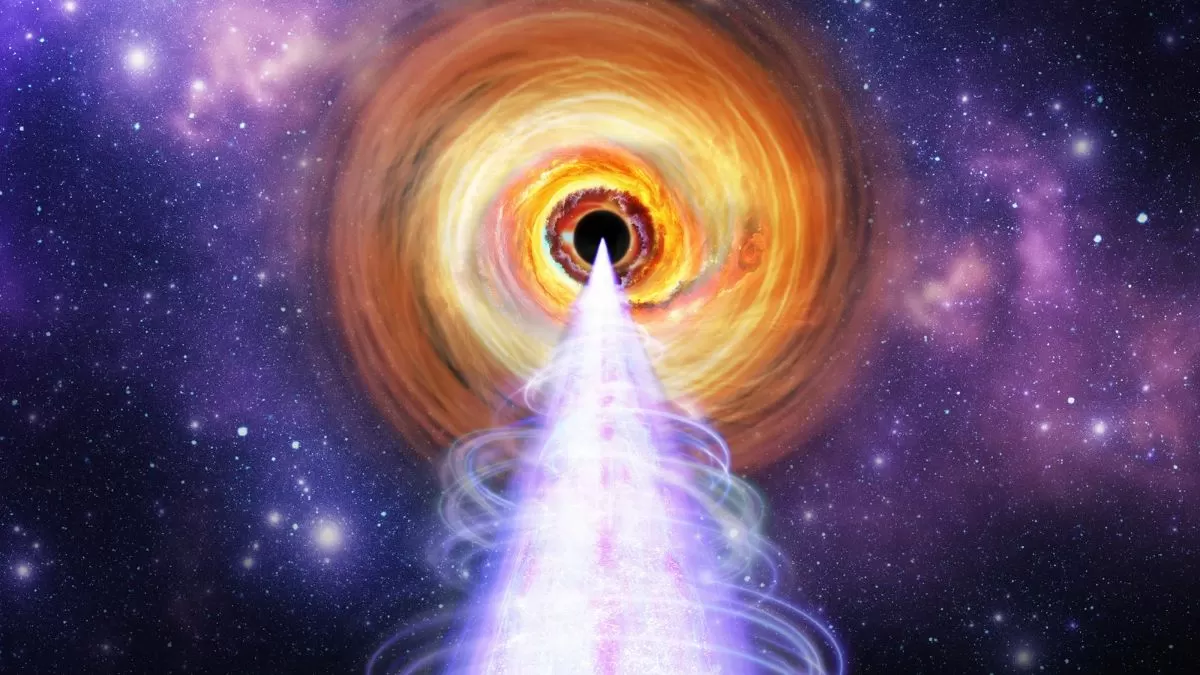
NASA’s IXPE Satellite Solves Mystery of X-Ray Production in Supermassive Black Hole Jets
For years, scientists have been puzzled by the production of X-rays in the extreme jets of supermassive black holes. These powerful jets, which can extend for thousands of light years, are known to emit high-energy radiation, including X-rays. However, the exact mechanism behind this phenomenon has remained a mystery.
But now, thanks to NASA’s Imaging X-ray Polarimetry Explorer (IXPE) satellite, we may finally have an answer. In a recent study, IXPE observed the blazar BL Lacertae and recorded low X-ray polarization versus very high optical polarization. This groundbreaking discovery confirms Compton scattering as the likely mechanism for X-ray production in these extreme jets.
This breakthrough, published in the journal Nature Astronomy, is a major step forward in our understanding of the universe and the role of supermassive black holes in shaping it.
The blazar BL Lacertae is a type of active galactic nucleus, where a supermassive black hole at the center of a galaxy is actively feeding on surrounding matter. As the black hole consumes this matter, it emits powerful jets of particles and radiation, including X-rays.
But until now, scientists were unsure of how these X-rays were produced. One theory suggested that they were created through synchrotron radiation, where electrons spiral around magnetic field lines and emit radiation. However, this theory did not fully explain the observed X-ray emission in blazars.
The IXPE satellite, launched in 2019, was specifically designed to measure the polarization of X-rays. This is a crucial aspect of understanding the production mechanism of these high-energy particles. By measuring the polarization of X-rays, scientists can determine the direction of the electric field and the orientation of the magnetic field in the emitting region.
In the case of BL Lacertae, IXPE’s observations showed that the X-rays were not polarized, while the optical light from the same region was highly polarized. This stark difference in polarization between the two types of radiation strongly suggests that Compton scattering is the main mechanism for X-ray production in these jets.
Compton scattering is a process where high-energy photons, in this case, X-rays, collide with low-energy electrons and transfer some of their energy to the electrons. This results in the emission of lower-energy photons, which are then observed as X-rays.
This process is similar to the way a billiard ball transfers its energy to another ball when they collide. In this analogy, the billiard ball represents the X-ray photon, and the other ball represents the electron.
The confirmation of Compton scattering as the main mechanism for X-ray production in blazars is a significant achievement for astrophysics. It not only helps us understand the extreme environments around supermassive black holes but also has implications for other high-energy phenomena in the universe.
For example, Compton scattering is also thought to be responsible for the production of gamma rays in pulsars, another type of high-energy object in our universe. By studying the X-ray polarization in blazars, we can gain a better understanding of this process and its role in shaping our universe.
Moreover, this breakthrough also supports the electron-photon interaction theory, which suggests that the interaction between electrons and photons is responsible for the production of high-energy radiation in various astrophysical objects.
The IXPE satellite’s observations of BL Lacertae are just the beginning. The satellite is expected to observe many more blazars and other high-energy objects in the coming years, providing us with a wealth of data to further our understanding of the universe.
In addition to its scientific significance, this discovery also highlights the importance of space exploration and the role of satellites in advancing our knowledge of the universe. IXPE is just one of many satellites and space missions that are helping us unravel the mysteries of our universe and push the boundaries of human knowledge.
In conclusion, NASA’s IXPE satellite has made a groundbreaking discovery that may finally solve the mystery of X-ray production in the extreme jets of supermassive black holes. By confirming Compton scattering as the likely mechanism, this breakthrough has opened up new avenues for research and deepened our understanding of the universe. With more observations and data from IXPE, we can expect even more exciting discoveries in the future.
