
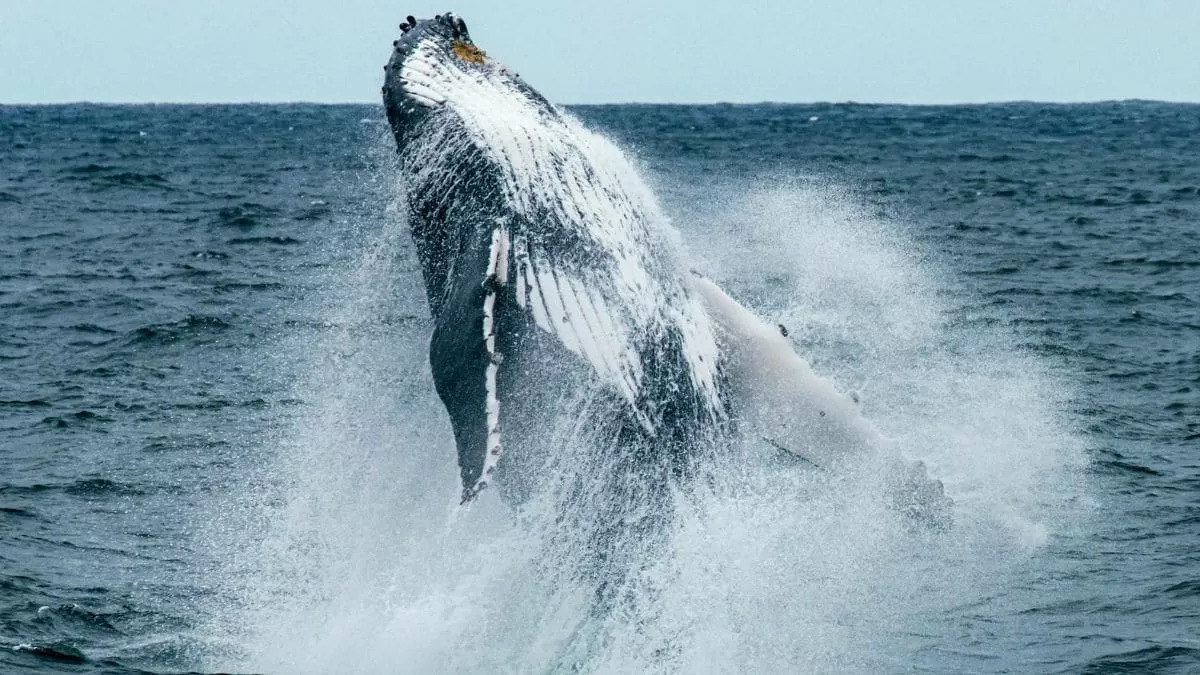
North Atlantic Right Whales are one of the most majestic creatures in the world. These gentle giants can grow up to 50 feet in length and weigh up to 70,000 pounds. However, despite their impressive size, these whales are facing a serious threat of extinction. With only around 400 individuals left in the world, North Atlantic Right Whales are one of the most endangered mammals on the planet.
The main reason for the decline in their population is the increasing number of fishing gear entanglements and ship collisions. These whales often get caught in fishing gear, which can lead to serious injuries or even death. Ship collisions are also a major concern, as these whales are slow-moving and can easily get hit by large vessels.
In order to protect these magnificent creatures, scientists are constantly looking for ways to track their movements and understand their behavior. And now, they have found a new tool to help them in their efforts – NASA satellite data.
NASA’s satellite data is being used to track the key food source of North Atlantic Right Whales – the red coloured plankton, Calanus finmarchicus. This tiny copepod is a vital part of the whales’ diet and its availability directly affects the health and survival of these whales.
The Gulf of Maine, located off the coast of New England, is a critical feeding ground for these whales. However, the distribution of Calanus finmarchicus in this area is highly variable and difficult to track. This is where NASA’s satellite data comes in.
Scientists are using the Moderate Resolution Imaging Spectroradiometer (MODIS) instrument on NASA’s Aqua satellite to identify swarms of Calanus finmarchicus in the Gulf of Maine. This instrument can detect the natural pigment of the copepod, making it easier for scientists to track its movements and distribution.
By monitoring the distribution of Calanus finmarchicus, scientists can predict the availability of this vital food source for North Atlantic Right Whales. This information can then be used to inform fisheries management and shipping routes, reducing the risk of entanglement and collisions for these whales.
The use of NASA’s satellite data has already shown promising results. In a recent study, scientists were able to accurately predict the distribution of Calanus finmarchicus in the Gulf of Maine, which was later confirmed by field observations. This is a significant step towards better understanding the feeding patterns of North Atlantic Right Whales and ultimately, protecting their population.
But the use of satellite data doesn’t stop there. Scientists are also using this technology to study the impact of climate change on the distribution of Calanus finmarchicus. As the ocean temperatures rise, the distribution of this copepod is expected to shift, which could have a major impact on the survival of North Atlantic Right Whales.
The collaboration between NASA and scientists studying North Atlantic Right Whales is a perfect example of how technology can be used for the greater good. By combining satellite data with traditional research methods, scientists are able to gather more accurate and comprehensive data, which can then be used to inform conservation efforts.
But the responsibility to protect these magnificent creatures doesn’t lie solely on the shoulders of scientists. As individuals, we can also play a crucial role in the conservation of North Atlantic Right Whales. By supporting sustainable fishing practices and being mindful of our impact on the ocean, we can help reduce the threats faced by these whales.
It is our duty to ensure that future generations get to witness the beauty of North Atlantic Right Whales. And with the help of NASA’s satellite data, we are one step closer to achieving that goal. Let us continue to work together to protect these gentle giants and preserve the biodiversity of our planet.
