
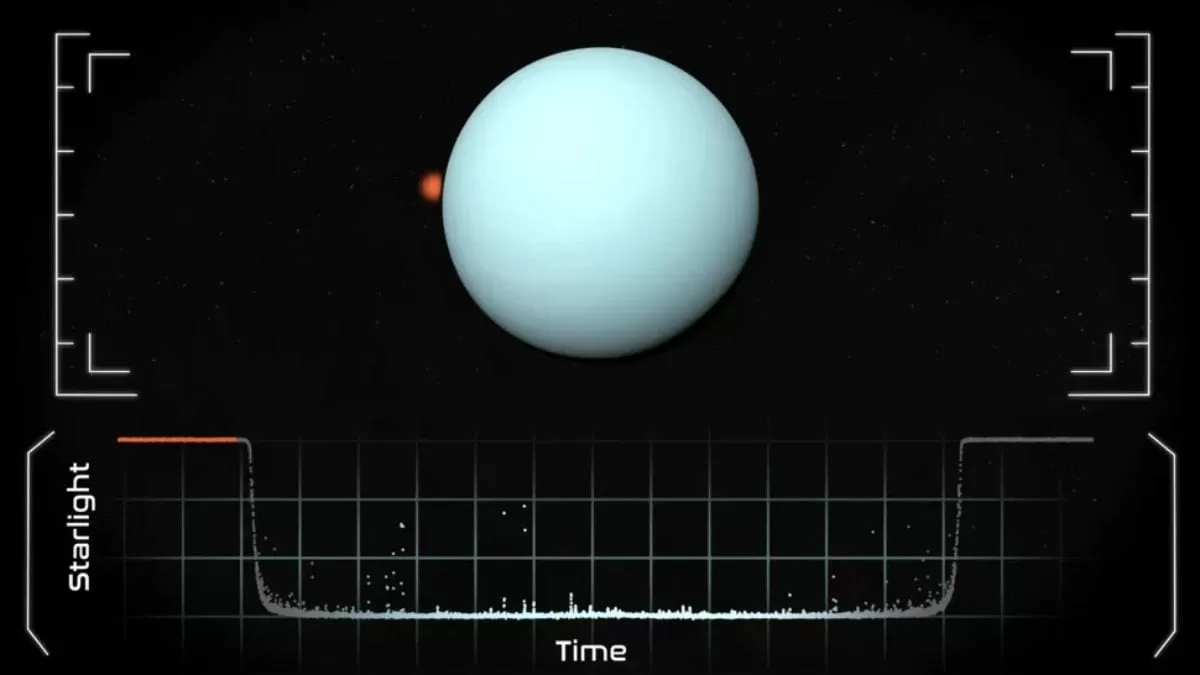
NASA, the renowned space agency, has once again captured the attention of the scientific community with its latest discovery. This month, NASA captured a rare stellar occultation of Uranus, providing fresh data about the ice giant’s atmosphere and rings. This remarkable event has offered new insights into the mysterious planet, which has not been explored as extensively as its neighboring planets.
The last major occultation of Uranus was recorded in 1996, making this recent event a significant milestone in the study of the planet. During the occultation, scientists were able to measure temperature changes and atmospheric composition, providing valuable information about Uranus’ complex environment. This data could potentially guide future exploration missions and deepen our understanding of this enigmatic planet.
One of the most fascinating aspects of this occultation was the measurement of temperature changes in Uranus’ atmosphere. The data collected by NASA’s telescopes showed a significant increase in temperature in the upper atmosphere of the planet. This finding has puzzled scientists as it contradicts their previous understanding of Uranus’ atmosphere, which was believed to be uniformly cold. The sudden temperature increase could be attributed to the planet’s unique tilt, which causes one pole to face the sun for 42 years, resulting in extreme seasonal changes.
Moreover, the occultation also provided new insights into the composition of Uranus’ atmosphere. Scientists were able to detect the presence of hydrogen sulfide, a toxic gas, in the planet’s upper atmosphere. This discovery is significant as it differs from the previous observations of ammonia and methane in Uranus’ atmosphere. The presence of hydrogen sulfide indicates that the planet’s atmosphere is more complex and dynamic than previously thought.
The occultation also shed light on Uranus’ intricate ring system. The data collected by NASA’s telescopes revealed that the planet’s rings are much more extensive and complicated than previously believed. The rings were found to be composed of dust and debris, which is constantly being replenished by the planet’s moons. This new information about Uranus’ rings could help scientists better understand the formation and evolution of planetary rings in our solar system.
The findings from this occultation have far-reaching implications for future missions to Uranus. With the data collected, scientists can now plan and design more targeted and effective missions to explore the planet further. The newfound knowledge about Uranus’ atmosphere and rings could also help in developing new technologies and instruments for future space exploration.
The study of Uranus has always been challenging due to its distance from Earth and its unique characteristics. However, with the recent occultation, scientists have been able to gather a wealth of new information about this mysterious planet. This data has not only deepened our understanding of Uranus but also raised new questions that will continue to drive scientific research in the years to come.
The success of this occultation is a testament to NASA’s unwavering commitment to advancing our knowledge of the universe. The agency’s state-of-the-art telescopes and instruments have once again proven their capabilities in capturing rare and valuable data. The findings from this occultation will undoubtedly pave the way for future discoveries and advancements in our understanding of the solar system.
In conclusion, the recent stellar occultation of Uranus by NASA has provided fresh data and insights into the planet’s atmosphere and rings. The temperature changes and atmospheric composition measured during the event have challenged our previous understanding of the planet and opened new avenues for exploration. With this new knowledge, scientists can now plan and execute more targeted missions to unravel the mysteries of Uranus. This remarkable achievement by NASA is a testament to the agency’s dedication to pushing the boundaries of space exploration and expanding our understanding of the universe.
