
Measuring the Strength of Gravity: A Step Towards Understanding Nature’s Most Enigmatic Force
Gravity, the force that holds us to the ground and keeps our planet in orbit around the sun, is one of the most fundamental and mysterious forces of nature. Yet, despite its importance, accurately measuring the strength of gravity has proven to be an extraordinarily difficult task. For centuries, scientists have been trying to unlock the secrets of gravity, but different experiments have always yielded conflicting results. However, a new test has emerged, offering hope for finally understanding this enigmatic force.
The concept of gravity was first introduced by Sir Isaac Newton in the 17th century, who described it as a force of attraction between two objects with mass. According to his theory, the strength of gravity depends on the mass of the objects and the distance between them. However, as scientists delved deeper into the mysteries of gravity, they realized that Newton’s theory was not the complete picture.
In the early 20th century, Albert Einstein revolutionized our understanding of gravity with his theory of general relativity. He proposed that gravity is not a force, but rather a result of the curvature of space and time caused by massive objects. This theory was able to explain some of the anomalies observed in Newton’s theory, but it also opened up new questions and challenges for scientists.
One of the biggest challenges in understanding gravity is accurately measuring its strength. This is not an easy task as gravity is an extremely weak force, especially when compared to other fundamental forces like electromagnetism. To put it into perspective, the gravitational force between two objects with the mass of a human is approximately 10^-34 times weaker than the electromagnetic force between two electrons. This makes it incredibly difficult to measure and requires highly sensitive equipment and precise techniques.
For centuries, scientists have been using different methods to measure the strength of gravity, but the results have always been inconsistent. Some experiments have shown a slight deviation from Newton’s theory, while others have shown a significant difference from Einstein’s theory. This has led to a long-standing debate and confusion among scientists about the true nature of gravity.
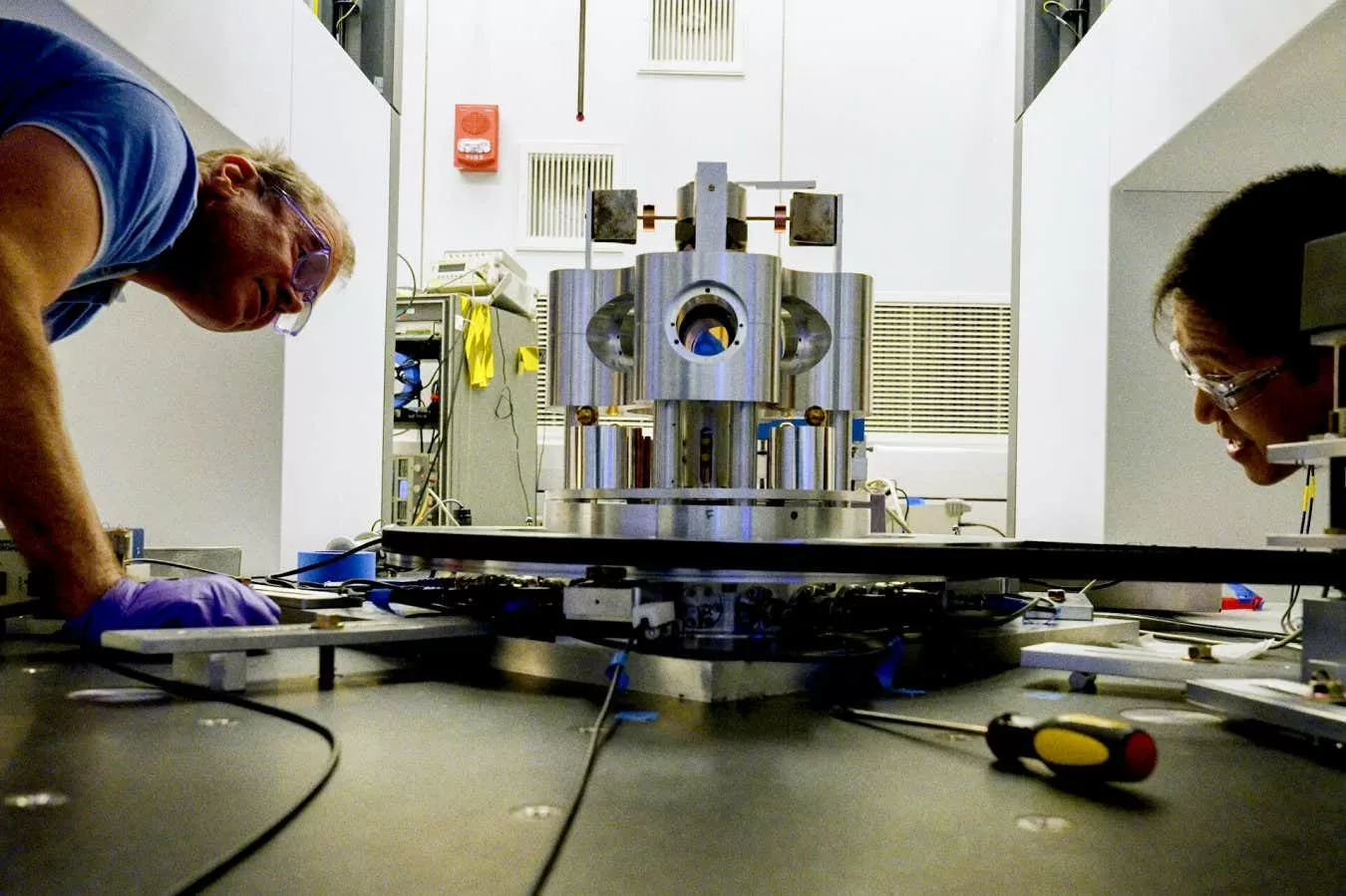
However, a recent experiment conducted by a team of scientists from the University of Washington and the University of California, Berkeley, has shown promising results in measuring the strength of gravity. They used a technique called atom interferometry, which involves measuring the interference patterns of atoms to determine the strength of gravity. This method is highly sensitive and has the potential to detect even the smallest deviations from the predicted values.
The experiment involved dropping ultracold rubidium atoms in a vacuum chamber and measuring the interference patterns as they fell. The results showed a deviation of only 1% from the predicted value, which is a significant improvement compared to previous experiments. This not only confirms Einstein’s theory of general relativity but also opens up new possibilities for further research in this field.
The success of this experiment has paved the way for more accurate and precise measurements of the strength of gravity. It has also provided a new tool for scientists to test the limits of our current understanding of gravity and potentially uncover new insights into its true nature. This is a major step towards finally understanding one of the most elusive and mysterious forces of nature.
The implications of this breakthrough are immense, as it can have a significant impact on our understanding of the universe. Gravity plays a crucial role in the formation and evolution of galaxies, stars, and planets. It also governs the motion of celestial bodies and the structure of the universe. Therefore, understanding the true nature of gravity is crucial in unlocking the secrets of the cosmos.
In addition, the accurate measurement of gravity can also have practical applications in various fields such as geology, navigation, and space exploration. It can help us better understand the dynamics of Earth’s interior, improve the accuracy of GPS systems, and even aid in the design of spacecraft for future missions.
In conclusion, the measurement of the strength of gravity has always been a challenging and elusive task for scientists. But with the recent breakthrough in atom interferometry, we are one step closer to understanding this enigmatic force. The new test has not only confirmed Einstein’s theory of general relativity but also opened up new avenues for further research. It is a significant achievement that has the potential to revolutionize our understanding of gravity and the universe. With continued advancements and breakthroughs, we may finally unravel the mysteries of this fundamental force and unlock the secrets of our universe.
