
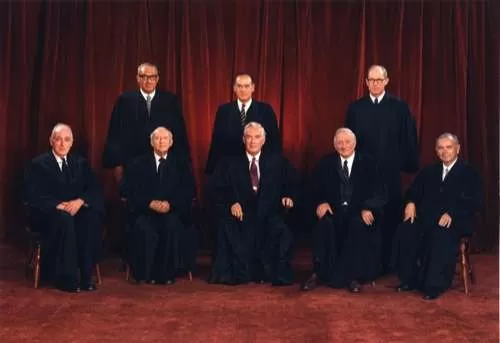
On April 7, 1969, the United States Supreme Court made a landmark decision in the case of Stanley v. Georgia. This ruling not only secured a fundamental right for American citizens, but also sparked a larger conversation about personal freedom and privacy. Today, we look back on this historic day in our nation’s history and reflect on the impact of this important decision.
The case of Stanley v. Georgia involved Robert Eli Stanley, a resident of Atlanta, Georgia who was convicted of possession of obscene materials in violation of state law. The state law in question prohibited the possession of obscene materials, regardless of whether or not they were intended for distribution or personal use. Stanley was found to have multiple reels of film depicting adult content in his home, and was subsequently arrested and charged.
Stanley’s lawyers argued that the state’s law violated his right to privacy, as protected by the First, Fourth, Fifth, and Fourteenth Amendments of the United States Constitution. They argued that the government had no right to dictate what an individual could or could not view in the privacy of their own home. The case eventually made its way to the Supreme Court, where the nine justices were tasked with determining whether or not the state’s law was in fact a violation of the Constitution.
In a unanimous decision, the Court ruled that the state’s law was indeed a violation of the Constitution. In the majority opinion, Justice Thurgood Marshall wrote, “If the First Amendment means anything, it means that the state has no business telling a man, sitting alone in his own house, what books he may read or what films he may watch.” This decision was a resounding victory for personal freedom and privacy, and set an important precedent for future cases involving obscenity laws.
The ruling in Stanley v. Georgia not only secured the right to privacy for individuals, but also sparked a larger conversation about the limits of government control and the importance of personal autonomy. The decision was hailed by civil liberties and free speech advocates, who saw it as a major step forward in protecting individual rights. It also sparked debate and discussion about the definition of obscenity and what constitutes a violation of community standards.
In the years following the Stanley v. Georgia decision, there have been numerous attempts to restrict or overturn the ruling. However, the Supreme Court’s decision has remained a steadfast protection of personal privacy and freedom of expression. This case serves as a reminder that the Constitution is a living document, constantly evolving to protect the rights and liberties of all individuals in our society.
Today, in a world where technology allows for constant surveillance and intrusion into our personal lives, the ruling in Stanley v. Georgia is more relevant than ever. The case stands as a reminder that the government has no place in dictating what individuals can or cannot do in the privacy of their own homes.
In conclusion, the decision in Stanley v. Georgia on April 7, 1969 was a monumental victory for personal freedom and privacy. It serves as a reminder of the importance of protecting individual rights, and continues to be a crucial foundation of our legal system. This landmark decision will forever be remembered as a pivotal moment in the fight for personal autonomy and the right to privacy.
