
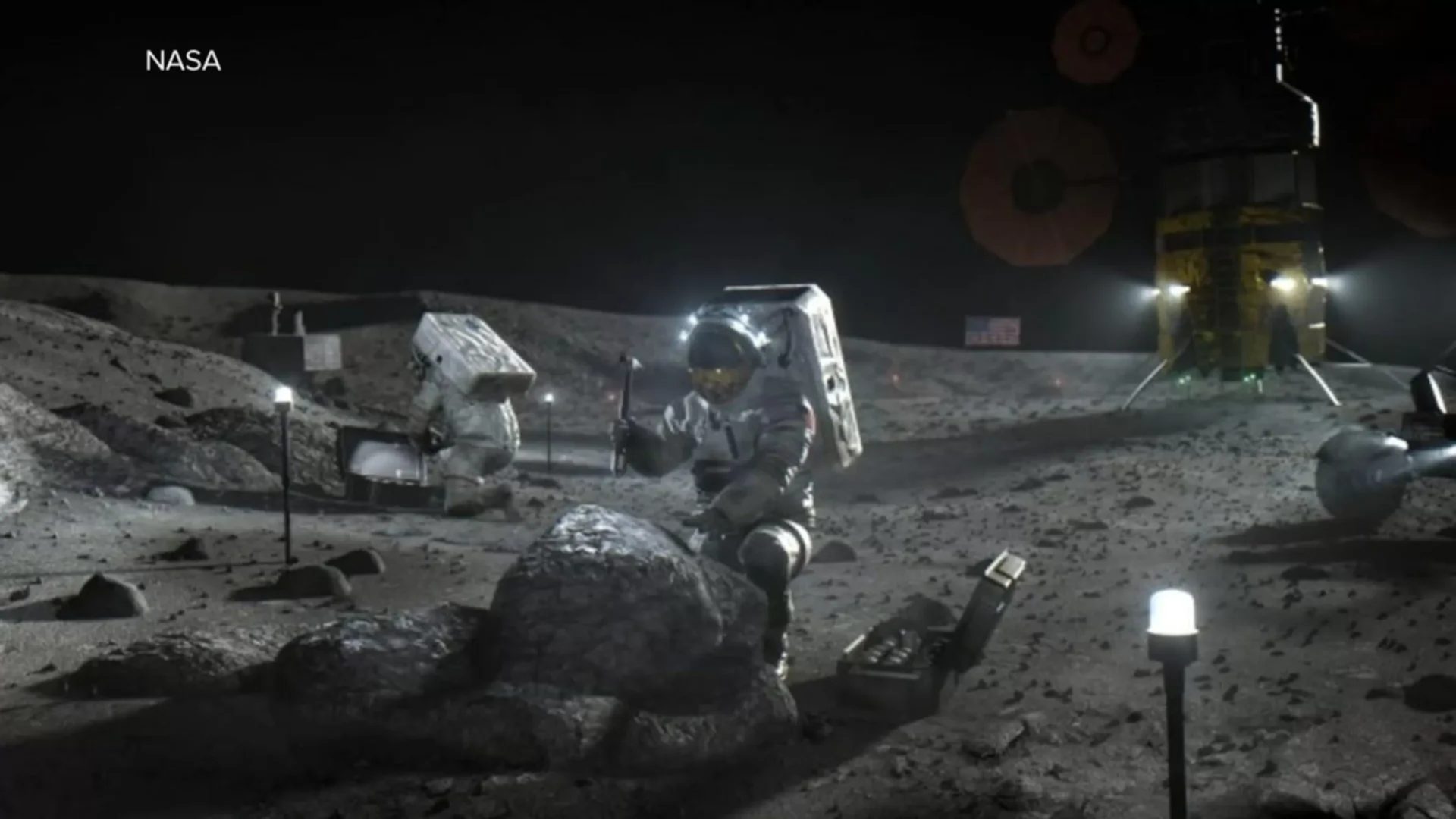
NASA has once again set its sights on the moon, with an ambitious $20 billion plan to establish a permanent base on its surface. The announcement was made by NASA Administrator Jared Isaacman on Tuesday, who declared that this time, the goal is to stay.
This new strategy marks a significant shift in NASA’s approach to the moon, as previous missions have focused on short-term visits and exploration. But now, the agency is determined to establish a sustainable presence on the lunar surface, paving the way for future missions to Mars and beyond.
The plan, known as the Artemis program, aims to land the first woman and the next man on the moon by 2024. This will be the first time humans have set foot on the moon since the Apollo missions ended in 1972. But this time, it will be different. Instead of just planting a flag and taking a few steps, NASA plans to build a permanent base, complete with living quarters, laboratories, and even a spaceport.
The base will be located near the moon’s south pole, where there is evidence of water ice in the permanently shadowed craters. This water can be extracted and used to sustain the astronauts living on the base, as well as for producing rocket fuel. This will significantly reduce the cost and complexity of future missions, as water is a crucial resource for space travel.
The Artemis program will also involve international partnerships, with NASA collaborating with other space agencies such as the European Space Agency, the Japan Aerospace Exploration Agency, and the Canadian Space Agency. This will not only bring together the best minds and resources from around the world but also foster cooperation and unity in the pursuit of a common goal.
But why is NASA so determined to establish a permanent presence on the moon? The answer lies in the potential benefits and opportunities that a moon base can provide. Firstly, it will serve as a testing ground for technologies and techniques that will be crucial for future missions to Mars. The moon’s proximity to Earth makes it an ideal location for conducting experiments and developing new technologies that can withstand the harsh conditions of space.
Secondly, a moon base will also serve as a launchpad for future missions to other destinations in the solar system. With the help of the moon’s lower gravity and lack of atmosphere, spacecraft can be launched more efficiently and with less fuel, making it a crucial stepping stone for deep space exploration.
Moreover, a permanent base on the moon will also open up new opportunities for scientific research. The moon’s unique environment, with its different geology and lack of atmosphere, can provide valuable insights into the history and formation of our solar system. It can also serve as a platform for studying the effects of long-term space travel on the human body, which is crucial for future missions to Mars.
But perhaps the most significant benefit of a moon base is the inspiration and motivation it will provide for future generations. The Apollo missions captured the world’s imagination and inspired a generation of scientists, engineers, and astronauts. A permanent base on the moon will continue this legacy and inspire the next generation to push the boundaries of human exploration even further.
Of course, such an ambitious plan comes with its challenges and risks. Building a moon base will require advanced technologies and significant funding. But NASA is confident that with the support of the government and private sector, this goal can be achieved. The agency has already made significant progress, with the successful testing of the Space Launch System (SLS) rocket and the Orion spacecraft, which will be used for the Artemis missions.
In conclusion, NASA’s $20 billion moon base strategy is a bold and exciting step towards a sustainable future in space. It represents a shift in the agency’s approach, from short-term visits to a long-term presence on the moon. With international partnerships, cutting-edge technologies, and the determination to stay, NASA is once again leading the way in human space exploration. As Administrator Jared Isaacman said, “This time, the goal is to stay,” and with the Artemis program, that goal is well within reach.
