
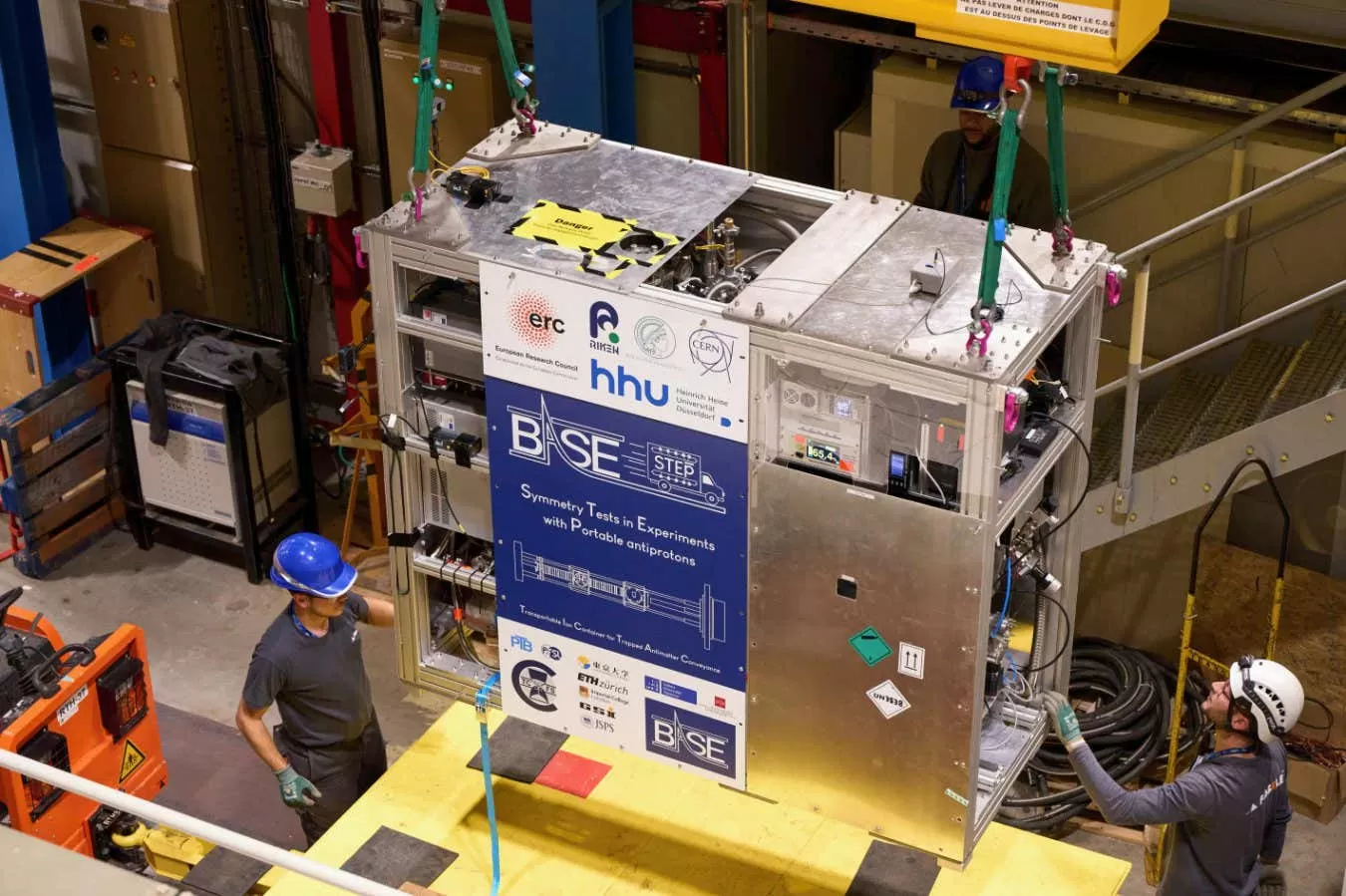
On Tuesday, history will be made as CERN, the European Organization for Nuclear Research, transports antiprotons on a truck for the first time. This groundbreaking event marks a major step forward in the field of antimatter research and has the potential to revolutionize the way we transport this elusive substance.
For those unfamiliar with the concept, antimatter is the opposite of normal matter, with particles having the same mass but opposite charge. It is a highly sought-after substance in the scientific community due to its potential applications in fields such as medicine, energy production, and space travel. However, the production and transportation of antimatter have always been a challenge due to its volatile nature.
CERN, located in Geneva, Switzerland, is home to the world’s largest particle accelerator, the Large Hadron Collider (LHC). This massive machine is used to accelerate particles to nearly the speed of light and collide them, allowing scientists to study the fundamental building blocks of the universe. In 2010, the LHC made headlines when it successfully produced and trapped antihydrogen atoms, a major breakthrough in antimatter research.
Now, CERN is taking another bold step by transporting antiprotons, a type of antimatter, on a truck for the first time. This is part of a larger plan to deliver antimatter by road to research labs across Europe. The idea is to use specially designed containers to safely transport the antiprotons, which will then be used for experiments and research at various facilities.
This plan has been in the works for several years, with CERN collaborating with several European research institutes and companies to develop the necessary technology. The containers, which are being referred to as “antimatter bottles,” have been rigorously tested to ensure they can withstand the extreme conditions of transportation. This includes being able to withstand high levels of radiation and magnetic fields, as well as maintaining a stable temperature to prevent the antiprotons from annihilating upon contact with normal matter.
The first test run will take place on Tuesday, with a truck carrying the antimatter bottles leaving CERN and traveling to the research facility at the University of Liverpool in the United Kingdom. This journey will cover a distance of over 1,000 kilometers, and the truck will be accompanied by a team of experts to monitor the containers and ensure their safe arrival.
This milestone achievement has the potential to open up new avenues for antimatter research. Currently, the only way to obtain antimatter is through particle accelerators, which are costly and time-consuming. By being able to transport it by road, scientists will have easier access to this valuable substance, allowing for more frequent and diverse experiments.
Furthermore, this development could also have practical applications in the future. Antimatter has been proposed as a potential source of energy, with the ability to produce more energy per unit mass than any known fuel. Being able to transport it by road could make it a viable option for energy production, especially in remote areas where traditional power sources are not available.
The success of this test run will also pave the way for future collaborations between CERN and other research institutes. The organization has already received requests from other facilities to transport antiprotons to their labs, and this could lead to even more groundbreaking discoveries in the field of antimatter research.
In conclusion, Tuesday’s transportation of antiprotons on a truck marks a significant achievement for CERN and the scientific community as a whole. It is a testament to the organization’s dedication and expertise in pushing the boundaries of scientific research. This development has the potential to revolutionize the way we transport and utilize antimatter, bringing us one step closer to unlocking its full potential. We eagerly await the results of this test run and the exciting possibilities it holds for the future.
