
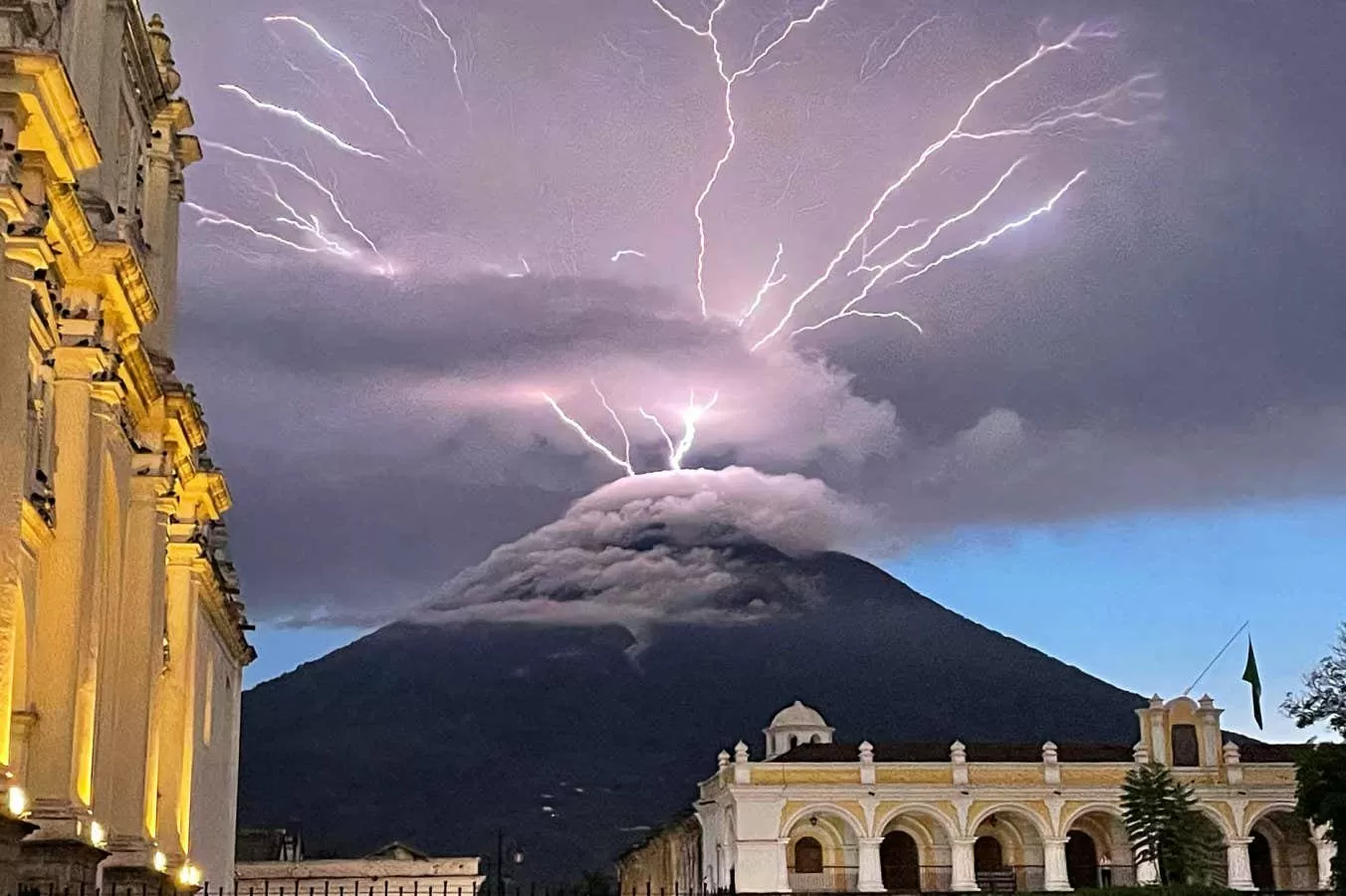
Volcanic eruptions are a powerful force of nature that can cause widespread devastation and chaos. But did you know that these eruptions also create something fascinating in the sky? Volcanic ash clouds are not just a mix of hot gases and debris, they also contain tiny particles that rub together and create an electrical charge. This phenomenon has puzzled scientists for years, but now, thanks to the hard work of physicists, we finally have an answer.
When a volcano erupts, it spews out a mixture of hot gases, rock fragments, and ash. The ash particles are tiny, ranging from the size of a grain of sand to the size of a pebble. As these particles are ejected into the atmosphere, they rub against each other, creating friction. This friction results in the particles gaining an electrical charge, with some becoming positively charged and others negatively charged.
For a long time, scientists were unable to explain how this process worked. But recently, a team of physicists from the University of Edinburgh in the UK and the University of Maryland in the US have made a breakthrough. They have discovered that the size and shape of the ash particles play a crucial role in determining their electrical charge.
The team conducted experiments in a laboratory, simulating the conditions of a volcanic ash cloud. They used particles of different sizes and shapes and observed how they interacted with each other. They found that the smaller particles, those less than 10 micrometers in diameter, were more likely to become positively charged, while the larger particles, over 10 micrometers, were more likely to become negatively charged.
But why does size matter? The answer lies in the surface area of the particles. Smaller particles have a larger surface area compared to their volume, which means they have more contact points with other particles. This increased contact leads to more friction and therefore, a higher chance of gaining a positive charge.
On the other hand, larger particles have a smaller surface area compared to their volume, resulting in less contact with other particles. This means there is less friction, and they are more likely to become negatively charged. The team also found that the shape of the particles also played a role, with elongated particles more likely to become positively charged.
This new understanding of how particles in volcanic ash clouds become charged is not only fascinating but also has practical implications. When a volcano erupts, the ash cloud can disrupt air travel, as the particles can damage aircraft engines. Understanding the electrical charge of these particles can help airlines and aviation authorities make better decisions on whether it is safe to fly or not.
But the implications of this research go beyond just volcanic eruptions. The phenomenon of particles rubbing together and creating an electrical charge is not unique to volcanic ash clouds. It also happens in dust storms, sandstorms, and even in everyday activities such as walking on a carpet. This research can help us better understand these natural phenomena and their potential impact on our lives.
The team’s findings have been published in the journal Physical Review Letters, and it has already received widespread recognition from the scientific community. Dr. David Bressloff, one of the lead researchers, said, “We are excited about our findings and hope that it will lead to further research in this area. Our ultimate goal is to improve our understanding of the world around us.”
This breakthrough in understanding the electrical charge of particles in volcanic ash clouds is a testament to the power of scientific research. It shows that with dedication and perseverance, we can unravel the mysteries of nature and gain a deeper understanding of our world. The team’s findings not only add to our knowledge but also have practical applications that can make a positive impact on our lives.
