
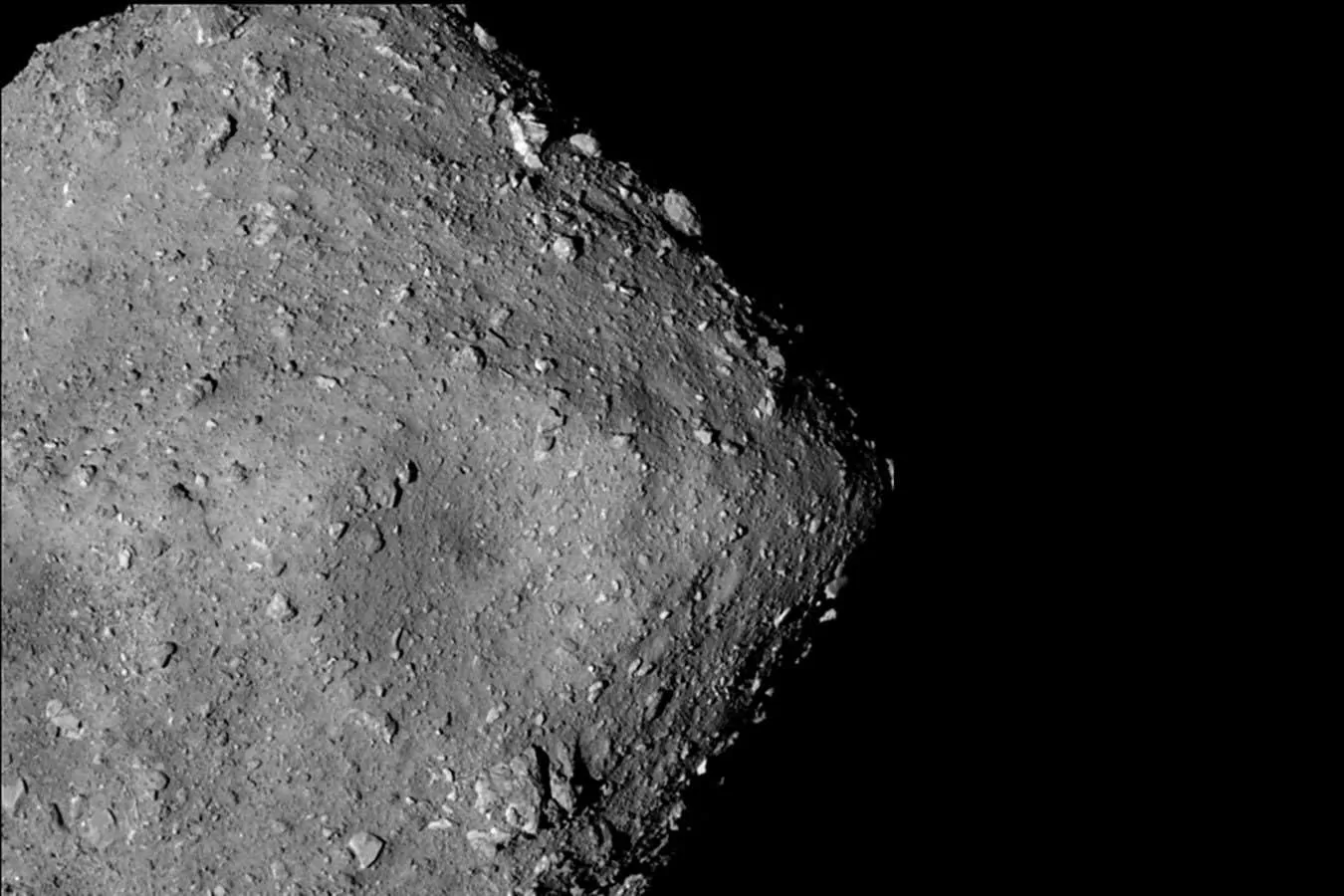
The search for extraterrestrial life has always been a subject of fascination for scientists and the general public alike. We have always wondered if we are truly alone in this vast universe or if there is life beyond our own planet. And the recent discovery of all five of the canonical nucleobases – the building blocks of DNA, RNA and life on Earth – in samples from the asteroid Ryugu has provided us with a glimmer of hope and excitement.
The asteroid Ryugu, named after a magical underwater dragon palace in Japanese folklore, is a small, rocky body orbiting between Earth and Mars. It is classified as a C-type asteroid, which means it contains high levels of carbon and water, making it a potential source for the ingredients necessary for life to form.
In 2018, the Japanese spacecraft Hayabusa2 successfully landed on Ryugu and collected samples from its surface and subsurface layers. The spacecraft then returned to Earth in December 2020, bringing with it precious samples that have been eagerly awaited by scientists.
Upon analyzing the samples, researchers from the University of Tokyo and Tohoku University in Japan made a groundbreaking discovery – all five of the canonical nucleobases, namely adenine, guanine, cytosine, thymine, and uracil, were present on the asteroid. The findings were published in the journal Science Advances on March 21, 2021.
This discovery is significant for several reasons. First and foremost, it supports the theory of panspermia, which suggests that the basic building blocks of life could have been transported to Earth from outer space. This theory was first proposed by the Greek philosopher Anaxagoras in the 5th century BC and has been a subject of debate among scientists ever since.
The presence of nucleobases on Ryugu also adds to the growing list of ingredients that have been found on comets and asteroids, further strengthening the argument for panspermia. Previous studies have shown that these celestial bodies also contain amino acids, the building blocks of proteins, and other organic compounds, all of which are essential for life to exist.
Secondly, the discovery of nucleobases on Ryugu provides insight into the chemical processes that may have occurred on the asteroid. The presence of all five nucleobases indicates that they were formed from the reaction of simple compounds such as ammonia, carbon dioxide, and hydrogen cyanide under high temperatures and pressures. This mirrors the conditions that were present on early Earth, suggesting that life on our planet may have originated in a similar way.
But perhaps the most exciting aspect of this discovery is the possibility of finding clues about the origins of life on Earth. The nucleobases found on Ryugu have a unique chemical signature that is different from those found on Earth. This could potentially give us a glimpse into the conditions that existed when life first emerged on our planet and provide us with a better understanding of how life evolved over time.
Moreover, the fact that these nucleobases were found on an asteroid opens up new possibilities for future space exploration. It shows that the building blocks of life can be found in other parts of the solar system, making it more likely that life could exist on other planets and moons.
This discovery also has implications for the search for life on other planets and exoplanets. By understanding the chemical processes that led to the formation of nucleobases on Ryugu, scientists can now use this knowledge to look for similar signatures in samples from other celestial bodies.
However, it is important to note that the presence of nucleobases on Ryugu does not necessarily mean that there is life on the asteroid. These building blocks are just one of the many ingredients needed for life to exist. Many other factors, such as a stable environment and a source of energy, are essential for life to thrive.
Nevertheless, this discovery is a significant step forward in our understanding of the origins of life and the potential for life beyond Earth. It reminds us of the vastness and complexity of the universe and the endless possibilities that lie beyond our own planet.
As we continue to explore the depths of space, who knows what other secrets and mysteries we will uncover. The discovery of nucleobases on Ryugu has given us a glimpse into the possibility of life existing on other celestial bodies, and it has reignited our curiosity and wonder about the universe. It is a reminder that we are part of something much bigger than ourselves, and the search for extraterrestrial life will continue to
