
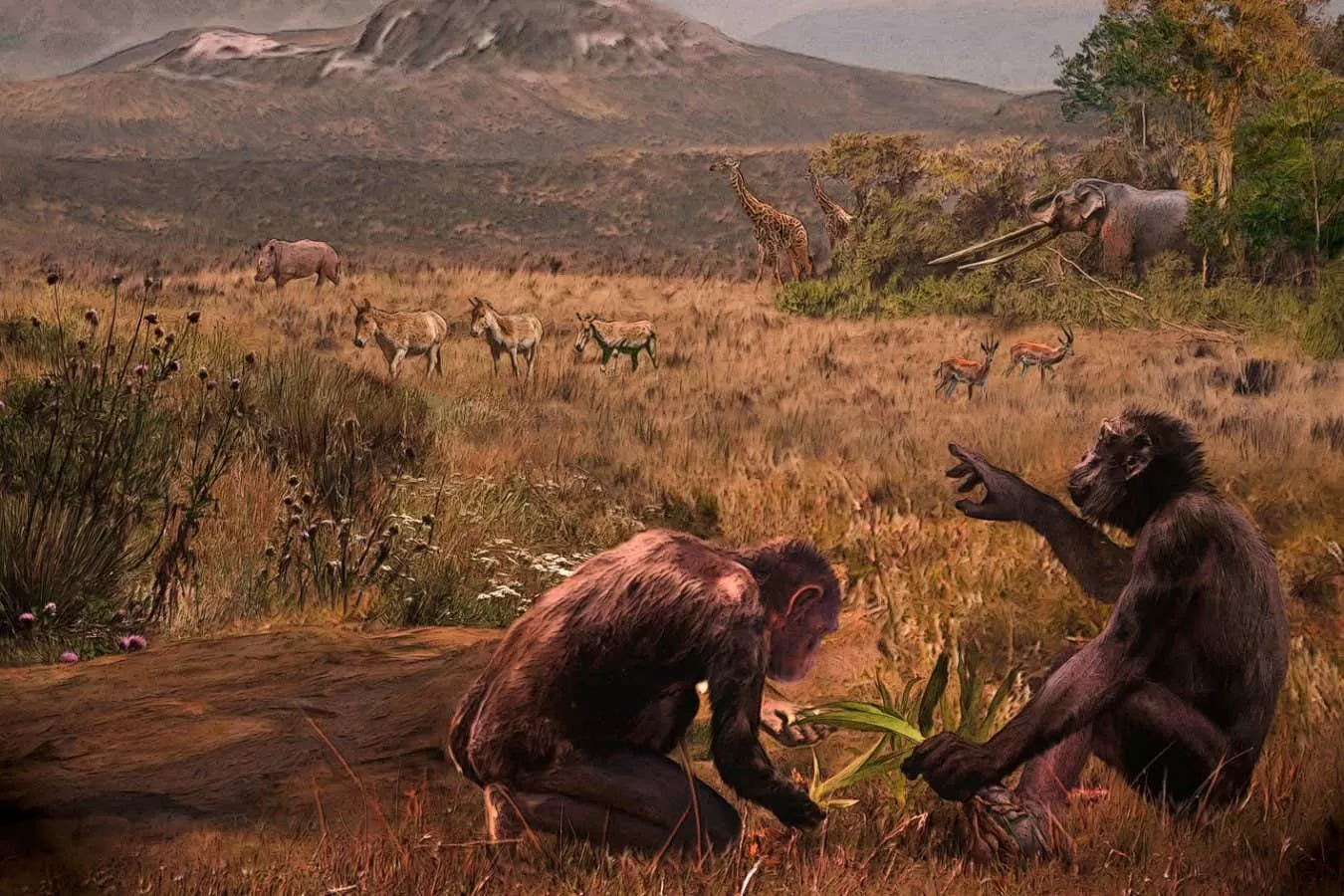
A recent discovery in Bulgaria has sparked a debate among scientists about the origins of bipedalism in early hominins. A single femur, or thigh bone, found in Bulgaria appears to represent an ape or early hominin that walked on two legs before any known African hominin. This finding challenges the long-held belief that bipedalism evolved in Africa, and raises questions about the early human migration patterns.
The femur, which is estimated to be about 7 million years old, was discovered in the Balkan Mountains by a team of Bulgarian researchers led by Nikolay Spassov from the Bulgarian Academy of Sciences. The bone was found alongside fossils of other animals, including rhinos, mastodons, and giant deer. However, it was the femur that caught the attention of the researchers due to its unique characteristics.
The femur, which belonged to a large-bodied primate, has a thick and robust shaft, similar to that of modern humans. This suggests that the creature was adapted for walking upright on two legs, rather than the knuckle-walking characteristic of apes. The femur also has a large attachment site for the gluteal muscles, which are important for maintaining balance while walking on two legs.
These characteristics have led scientists to believe that the femur belonged to a bipedal primate that lived in a forested environment. This is significant because it challenges the prevailing theory that bipedalism evolved in open savannahs in Africa. The discovery of the femur in a forested area of Europe suggests that bipedalism may have evolved in a variety of environments.
However, the evidence is far from conclusive and there are still many questions that need to be answered. One of the biggest challenges is identifying the species to which the femur belongs. The researchers have not been able to extract DNA from the bone, and it is not clear if the femur belongs to a previously known species or to a new one. Further analysis and comparison with other fossils will be necessary to determine the exact species.
Another challenge is the location of the discovery. The femur was found in Bulgaria, which is far from the African continent where early hominins are believed to have evolved. This raises questions about the migration patterns of early humans and how they spread to other parts of the world. It is possible that the bipedal primate in Bulgaria was a descendant of an early African hominin, but more evidence is needed to support this theory.
Despite these challenges, the discovery of the femur in Bulgaria is significant and has the potential to rewrite the narrative of human evolution. It opens up new possibilities and raises important questions about the origins of bipedalism. It also highlights the need for further research and exploration in other parts of the world, beyond Africa, to gain a better understanding of our evolutionary history.
The discovery of the femur in Bulgaria also demonstrates the importance of international collaboration and the sharing of knowledge and resources. The Bulgarian researchers worked closely with experts from other countries, including Germany, Canada, and Japan, to analyze and interpret the findings. This collaborative effort has resulted in a more comprehensive understanding of the femur and its significance.
In conclusion, the discovery of the femur in Bulgaria has opened up new avenues for research and has challenged long-held beliefs about human evolution. While the evidence is not yet conclusive, it has sparked a debate among scientists and has the potential to change our understanding of bipedalism. Further research and analysis will be necessary to fully understand the significance of this discovery, but it is a step towards unraveling the mysteries of our evolutionary past.
