
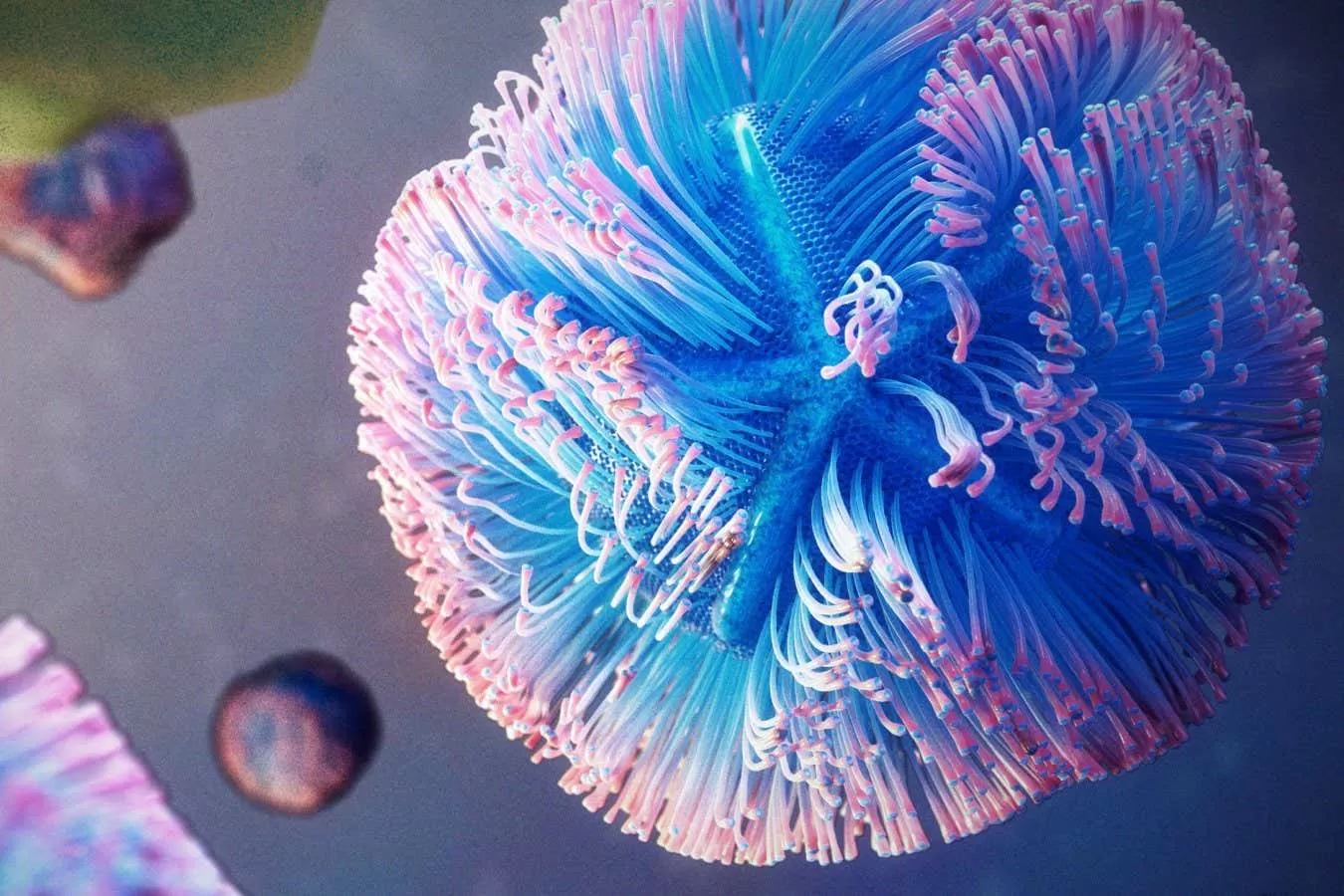
In recent years, scientists have made a groundbreaking discovery that has challenged our understanding of viruses and their relationship with living organisms. A team of researchers from the University of California, Berkeley and the US Department of Energy’s Lawrence Berkeley National Laboratory have uncovered a giant virus that possesses a part of the protein-making toolkit of cells, giving it a level of control over its host that was previously unheard of.
This discovery, published in the journal Nature, has sparked a new debate among scientists about how viruses evolved and how they should be categorized in the tree of life. The giant virus, named “Klosneuviruses”, is so large that it can be seen under an ordinary microscope, unlike most viruses that require an electron microscope for observation. It measures at 1.5 micrometers, making it larger than some bacteria.
What makes this virus particularly unique is its ability to encode a substantial portion of the protein-making machinery of its host, an amoeba called Acanthamoeba. This gives the virus unprecedented control over its host, leaving scientists wondering how such a complex organism could have evolved.
Viruses are known to be simple, infectious agents that cannot reproduce on their own and require a host cell to survive and replicate. They are often considered to be non-living entities due to their lack of essential characteristics of living organisms, such as the ability to metabolize and grow on their own. However, the discovery of Klosneuviruses is challenging this notion and raising questions about the classification of viruses.
One of the most intriguing questions posed by this discovery is how viruses could have acquired such a sophisticated ability to control their hosts. One theory suggests that viruses could have evolved from an ancient cell that gradually shed its cellular components until it became a fully functional virus. Another theory suggests that viruses could have evolved from self-replicating molecules that evolved independently from cells.
The team of researchers also found that Klosneuviruses have a large genome, containing approximately 1,500 genes, which is significantly larger than the average virus. This further supports the notion that viruses are more complex than previously thought and could potentially blur the line between living and non-living entities.
The discovery of Klosneuviruses has also raised questions about how we define life. With viruses possessing some characteristics of living organisms, such as the ability to evolve and adapt, it begs the question of whether viruses should be considered a form of life. This is a contentious issue that has divided scientists for decades and will continue to be a subject of debate in light of this new discovery.
Furthermore, the discovery of giant viruses like Klosneuviruses has far-reaching implications for our understanding of evolution. The fact that viruses can encode such a significant portion of the protein-making machinery of their host suggests that they may have played a crucial role in the evolution of cells and organisms.
While there is still much to be learned about the Klosneuviruses and their relationship with living organisms, one thing is certain – this discovery has opened up a whole new world of possibilities and has challenged our preconceived notions about viruses. It has also highlighted the importance of continuing to study and understand these tiny but complex entities that have such a significant impact on life on Earth.
In conclusion, the discovery of a giant virus that encodes part of the protein-making toolkit of cells has raised a plethora of questions about the origins and classification of viruses, as well as their role in the evolution of life. It is a testament to the ever-changing nature of science and the need to constantly challenge our understanding of the world around us. With further research, we may gain a deeper understanding of these fascinating creatures and how they fit into the grand scheme of life on our planet.
