
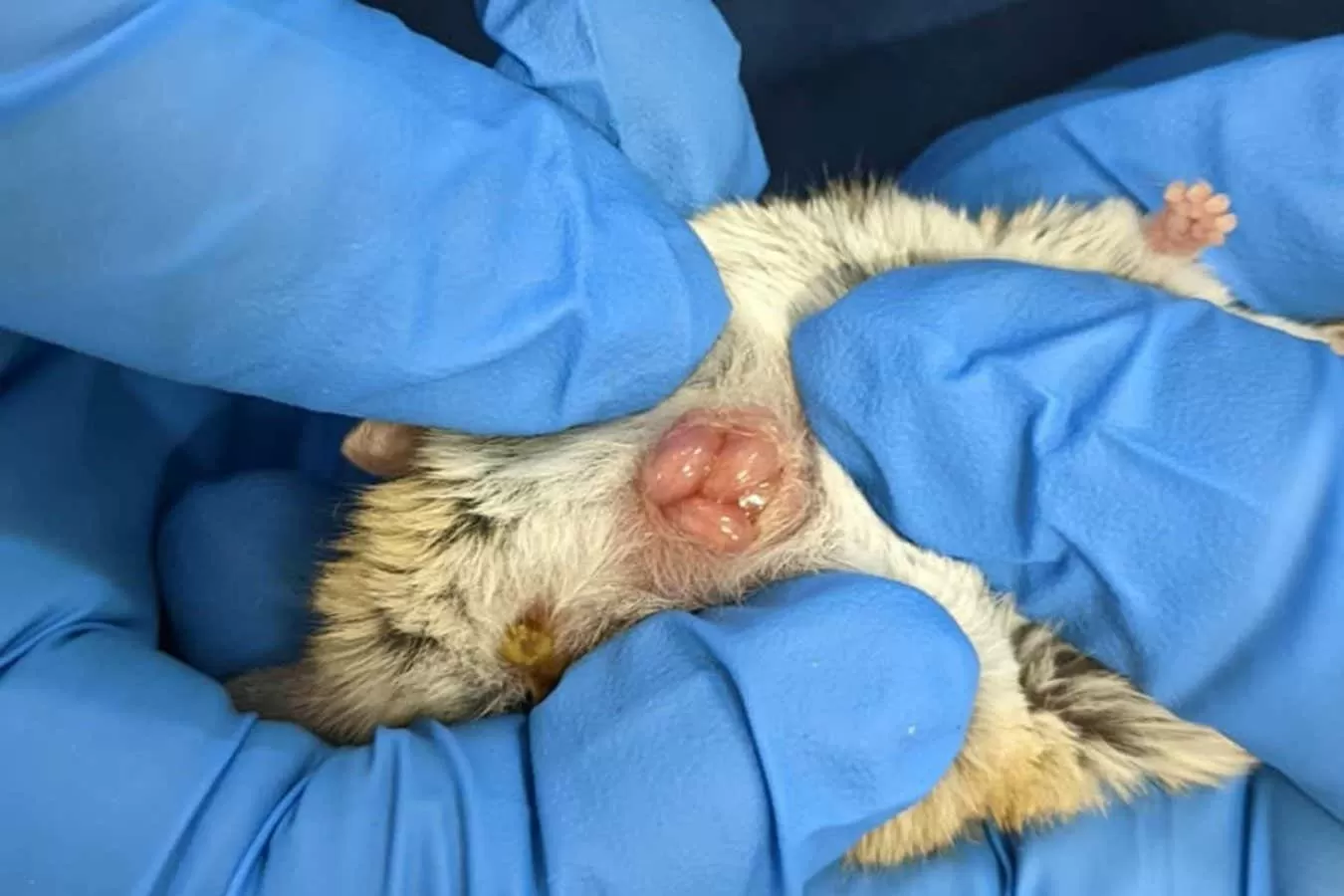
Scientists have recently captured breathtaking footage of the newborns of a tiny marsupial, known as the fat-tailed dunnart, as they journey to their mother’s pouch shortly after being born. This incredible discovery has shed new light on the early development and survival strategies of these small creatures.
The fat-tailed dunnart, also known as Sminthopsis crassicaudata, is a mouse-sized marsupial found in the arid regions of Australia. It is known for its distinctive fat tail, which it uses to store energy during times of food scarcity. These small mammals are nocturnal and solitary, making them difficult to study in the wild.
However, a team of researchers from the University of Sydney, led by Dr. Emily Roycroft, managed to capture rare footage of the newborn dunnarts in their natural habitat. The team used infrared cameras to observe the dunnart’s behavior without disturbing them.
The footage shows the tiny dunnarts, each weighing less than a gram, crawling out of their mother’s birth canal and making their way to her pouch. The mother dunnart has four teats in her pouch, and each of the newborns must find a teat to attach and suckle on. This process can take up to 10 minutes, and it is crucial for the newborns to reach the pouch quickly to ensure their survival.
Dr. Roycroft and her team were amazed by the agility and determination of the newborn dunnarts. The footage shows them using their strong forelimbs and sharp claws to navigate through the mother’s fur and reach the pouch. The mother dunnart also helps by licking and grooming her young to guide them to the pouch.
The researchers were also able to observe the dunnart’s unique survival strategy. The mother dunnart has the ability to enter a state of torpor, where her body temperature and metabolism decrease to conserve energy. This allows her to survive in the harsh and unpredictable arid environment, where food and water are scarce. The newborn dunnarts also have this ability, and they enter torpor while inside the pouch, conserving energy and reducing their dependence on their mother’s milk.
The footage of the newborn dunnarts has provided valuable insights into their early development and survival strategies. It has also raised questions about the role of the mother in guiding her young to the pouch and the importance of torpor in their survival.
Dr. Roycroft and her team are now planning to conduct further research on the dunnarts to better understand their behavior and survival strategies. They also hope to shed light on the impact of climate change on these small mammals and their habitat.
The discovery of the newborn dunnarts and their journey to their mother’s pouch is a remarkable feat in the world of science. It highlights the importance of studying and protecting these small and often overlooked creatures. The footage is a testament to the resilience and adaptability of these tiny marsupials, and it is a reminder that every living being, no matter how small, plays a crucial role in our ecosystem.
This discovery has also sparked excitement and interest among the general public, who have been captivated by the adorable and determined newborn dunnarts. The footage has been shared widely on social media, and people are in awe of these tiny creatures and the wonders of nature.
In conclusion, the footage of the newborn dunnarts making their way to their mother’s pouch is a groundbreaking discovery that has provided valuable insights into the early development and survival strategies of these small marsupials. It is a testament to the dedication and hard work of the researchers, and it has sparked curiosity and appreciation for the diverse and fascinating world of nature. Let us continue to marvel at and protect the wonders of our planet, no matter how big or small.
