
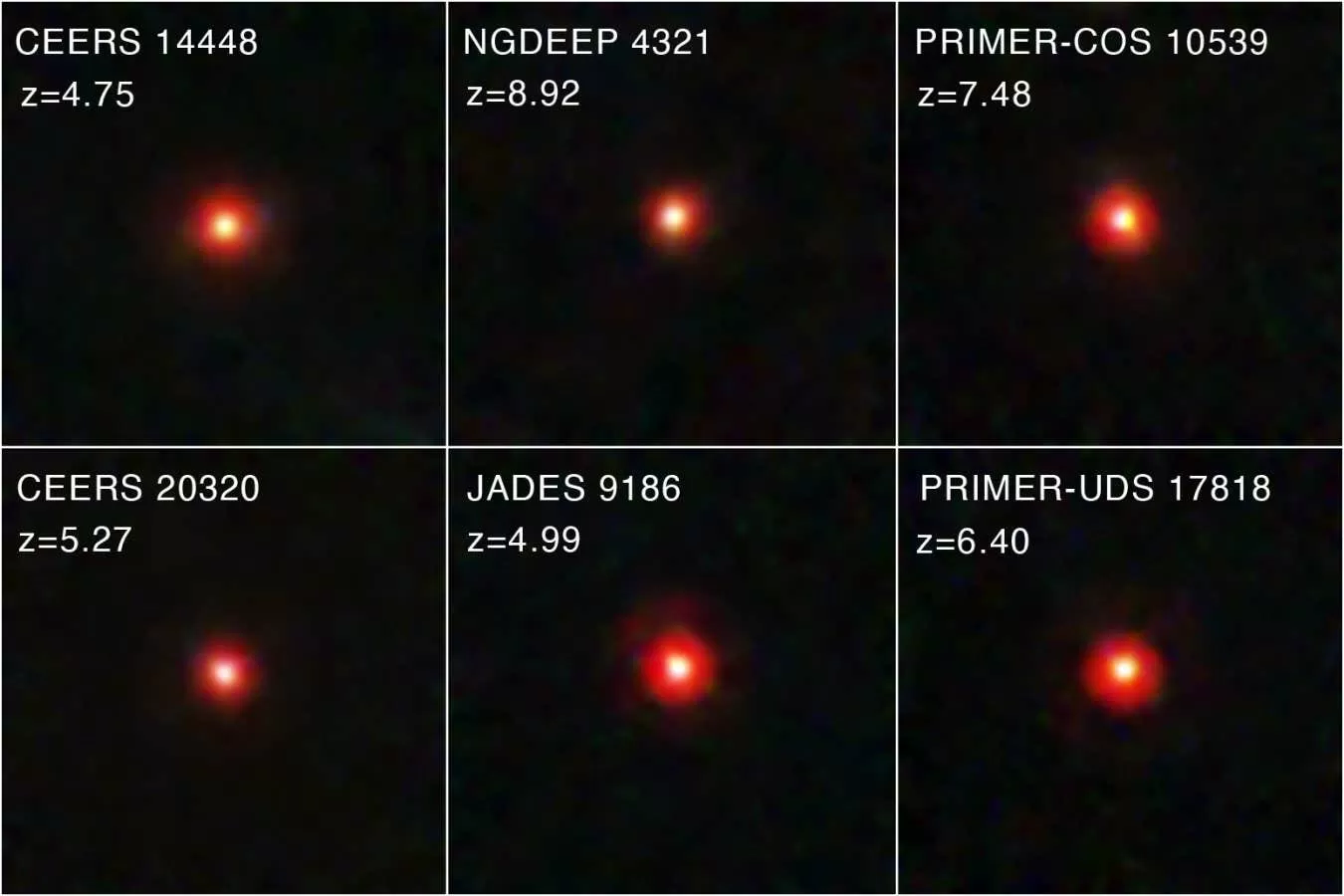
Since its launch in 2021, the James Webb Space Telescope (JWST) has been making groundbreaking discoveries in the vast expanse of our universe. One of its most recent findings has left scientists and astronomers in awe – the discovery of hundreds of distant and seemingly bright galaxies, aptly nicknamed “little red dots”. But what makes these galaxies even more intriguing is the possibility that each one of them may be carrying a baby black hole.
The JWST, a joint project between NASA, the European Space Agency, and the Canadian Space Agency, is the most powerful and advanced space telescope ever built. It is designed to observe the universe in infrared light, allowing it to peer deeper into space and time than ever before. And since its launch, it has been doing just that.
In a recent study published in The Astrophysical Journal, a team of astronomers used the JWST to observe a small patch of sky known as the Hubble Ultra Deep Field. This area has been extensively studied by the Hubble Space Telescope and has revealed some of the most distant and ancient galaxies in the universe. However, the JWST’s observations have taken this to a whole new level.
The team found that these “little red dots” are actually galaxies that are incredibly faint and distant, making them almost impossible to detect with previous telescopes. But with the JWST’s advanced technology, they were able to not only detect these galaxies but also study them in detail.
What makes these galaxies even more fascinating is the possibility that each one of them may be harboring a baby black hole. Black holes are one of the most mysterious and intriguing objects in the universe. They are regions in space where the gravitational pull is so strong that nothing, not even light, can escape. And while black holes are known to exist in the centers of most galaxies, the discovery of them in these “little red dots” is a first.
According to the study, these baby black holes are estimated to be about 100,000 times the mass of our sun. This may seem like a lot, but in the grand scheme of things, it is considered small for a black hole. It is believed that these black holes are still in their early stages of growth and will eventually merge with other black holes to form larger ones.
But why are these galaxies and their black holes so faint and distant? The answer lies in the age of the universe. The JWST’s observations have revealed that these galaxies and their black holes existed when the universe was only about 800 million years old. To put that into perspective, the universe is estimated to be around 13.8 billion years old. This means that these galaxies and their black holes are some of the oldest objects in the universe.
The discovery of these “little red dots” and their potential baby black holes has opened up a whole new realm of possibilities for astronomers. It not only sheds light on the early stages of galaxy and black hole formation but also provides valuable insights into the evolution of our universe.
Moreover, this discovery highlights the importance of the JWST and its capabilities. It has only been a few months since its launch, and it has already made groundbreaking discoveries that have changed our understanding of the universe. With its advanced technology and powerful instruments, we can only imagine what other mysteries it will uncover in the years to come.
The JWST is a testament to human ingenuity and our never-ending quest to explore and understand the universe. Its discoveries have the potential to revolutionize our understanding of the cosmos and inspire future generations of scientists and astronomers.
In conclusion, the discovery of hundreds of distant and seemingly bright galaxies, and the possibility of each one carrying a baby black hole, is a testament to the power and capabilities of the James Webb Space Telescope. It has once again proven that the universe is full of wonders waiting to be discovered, and with the JWST, the possibilities are endless. So let us continue to look up at the night sky with wonder and excitement, knowing that there is still so much more to be explored and understood.
