
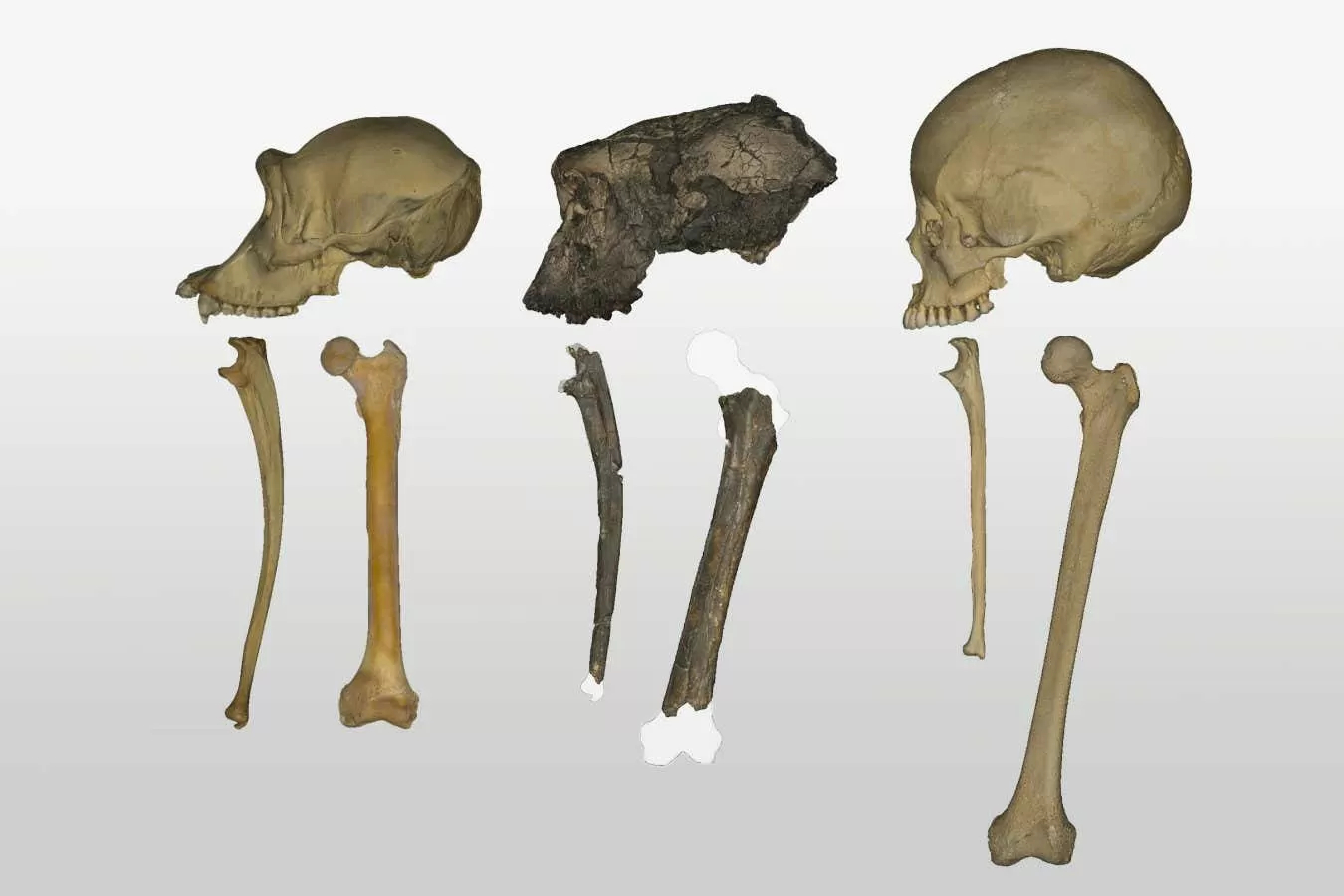
The discovery of Sahelanthropus tchadensis, a species of hominin that lived approximately 7 million years ago, has been a major breakthrough in the field of paleoanthropology. This ancient ancestor has sparked much debate and controversy among scientists, particularly when it comes to the question of whether it walked on two legs like modern humans. While the answer may seem simple, the truth is that it’s complicated.
Sahelanthropus was first discovered in 2001 in the Djurab desert of Chad by a team of paleontologists led by Michel Brunet. The fossil remains consisted of a nearly complete skull, along with some teeth and jaw fragments. This was a significant find, as it was the oldest and most complete hominin skull ever discovered at the time. However, it was only in 2005, after further analysis and research, that Sahelanthropus was officially classified as a new species.
The most striking feature of Sahelanthropus is its small brain size, estimated to be around 360-370 cc, which is comparable to that of a chimpanzee. This has led some scientists to believe that this ancient ancestor was more closely related to apes than to humans. However, other features of Sahelanthropus, such as the position of the foramen magnum (the opening at the base of the skull for the spinal cord), have raised questions about its mode of locomotion.
The foramen magnum of Sahelanthropus is located towards the center of the skull, which is a characteristic of bipedalism. This is in contrast to apes, whose foramen magnum is located towards the back of the skull, as they primarily move on all fours. This has led some scientists to argue that Sahelanthropus may have been an early bipedal hominin, similar to the famous Lucy (Australopithecus afarensis) who lived 3.2 million years ago.
However, there are also arguments against Sahelanthropus being a biped. The shape of the skull and the position of the spine suggest that it may have had a more horizontal posture, similar to that of apes. Additionally, the shape of the teeth and the wear patterns on them indicate a diet that consisted mainly of fruits and nuts, which is more typical of apes than bipeds.
So, did Sahelanthropus walk on two legs like modern humans? The truth is that we may never know for sure. The fossil evidence is limited, and there are different interpretations of the available data. Some scientists argue that Sahelanthropus may have been a transitional species, displaying both bipedal and quadrupedal characteristics. Others believe that it was a fully quadrupedal ape, with some features that may have evolved independently.
One thing is certain, though. The discovery of Sahelanthropus has shed light on the complex and gradual process of human evolution. It is a reminder that our ancestors were not static beings, but rather a diverse and evolving group of species. And while the debate about Sahelanthropus may continue, it has opened up new avenues of research and has challenged our understanding of human origins.
Moreover, the discovery of Sahelanthropus has also highlighted the importance of preserving and studying fossil remains. These ancient bones hold valuable information about our past and can help us unravel the mysteries of human evolution. It is crucial that we continue to support and fund scientific research in this field, as it not only expands our knowledge but also helps us better understand our place in the world.
In conclusion, the question of whether Sahelanthropus walked on two legs like modern humans is a complicated one. While the evidence may point towards bipedalism, there are also arguments against it. What is certain is that this ancient ancestor has played a significant role in shaping our understanding of human evolution. And as we continue to uncover more about our past, we must remember that the story of human evolution is a complex and ever-evolving one.
