
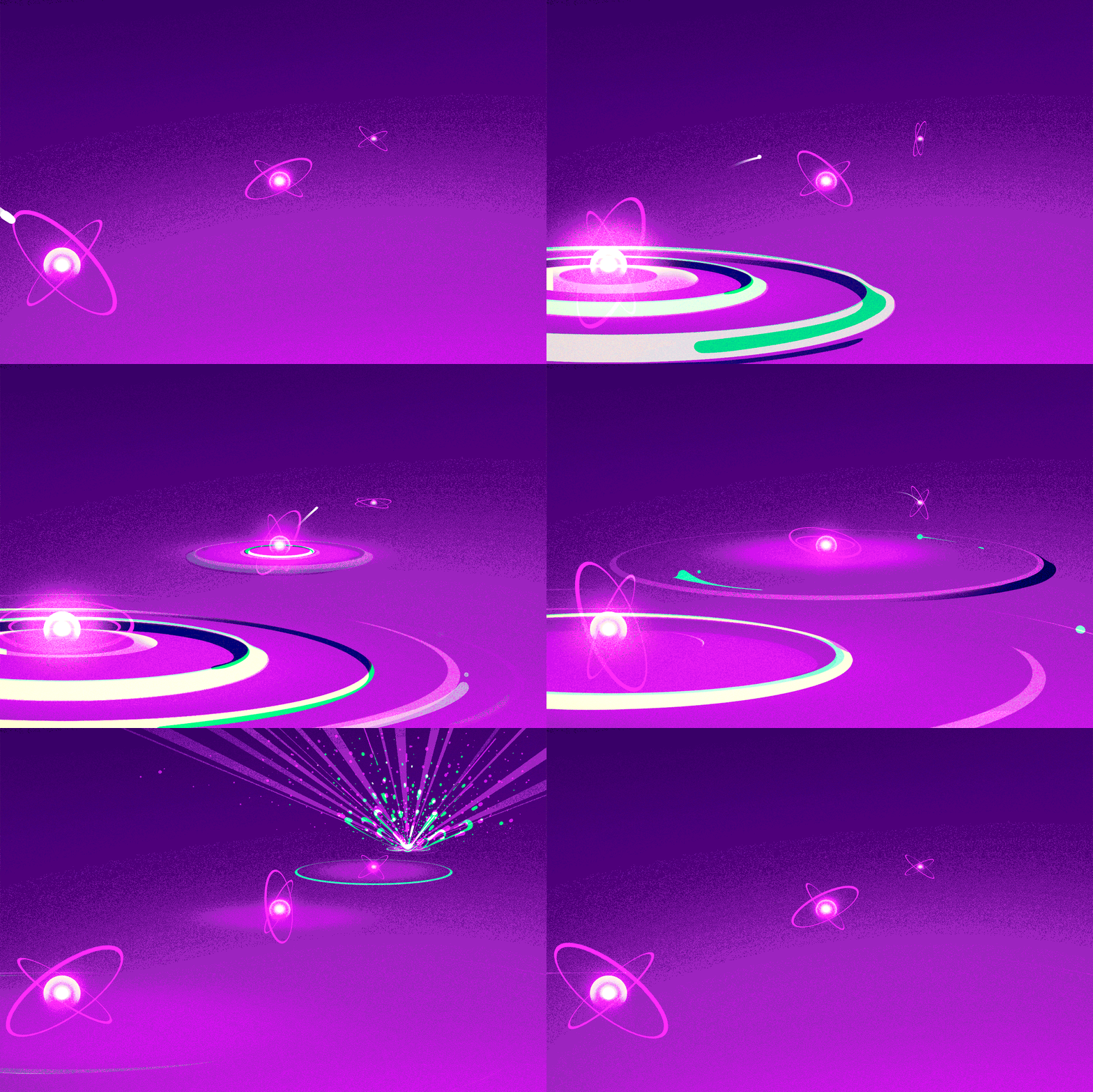
Quantum theory has revolutionized our understanding of the physical world, providing a framework for understanding the behavior of particles at the smallest scales. However, despite its success in predicting and explaining the behavior of these particles, quantum theory has yet to fully explain how the reality we experience emerges from the world of particles. This has been a longstanding mystery in the field of physics, but a new take on quantum cause and effect may hold the key to bridging this gap.
At the heart of quantum theory lies the principle of superposition, which states that particles can exist in multiple states simultaneously until they are observed or measured. This has been confirmed through numerous experiments, and it has led to the development of technologies such as quantum computers and cryptography. However, when it comes to explaining how this superposition of particles leads to the reality we experience, quantum theory falls short.
One of the main challenges in understanding the emergence of reality from the quantum world is the concept of causality. In classical physics, cause and effect are clearly defined and follow a predictable sequence. However, in the quantum world, the concept of causality becomes blurred. This is because particles can exist in multiple states at the same time, making it difficult to determine which state caused the observed outcome.
To address this issue, a team of physicists from the University of Vienna and the Austrian Academy of Sciences have proposed a new approach to quantum causality. Their theory, called “causal emergence,” suggests that the reality we experience is not a direct result of the behavior of particles, but rather emerges from the interactions and correlations between these particles.
In classical physics, causality is often described as a chain of events, where one event leads to another in a linear fashion. However, in the quantum world, this chain of events becomes more like a web, where particles can influence each other in non-linear ways. This means that the outcome of an experiment cannot be solely attributed to one particular cause, but rather to the collective behavior of all the particles involved.
The concept of causal emergence is not entirely new, as it has been explored in other fields such as neuroscience and complex systems. However, its application to quantum theory is a novel and promising approach. By considering the emergent nature of reality, this theory provides a new perspective on how the quantum world gives rise to the macroscopic world we experience.
One of the key implications of this theory is that it could potentially resolve the long-standing debate between the two main interpretations of quantum theory: the Copenhagen interpretation and the many-worlds interpretation. The Copenhagen interpretation suggests that particles exist in a state of superposition until they are observed, at which point they collapse into a single state. On the other hand, the many-worlds interpretation proposes that all possible outcomes of an experiment exist in parallel universes.
The concept of causal emergence offers a middle ground between these two interpretations. It suggests that while particles do exist in a state of superposition, the reality we experience is a result of the interactions and correlations between these particles. This means that both interpretations could be seen as valid, with the Copenhagen interpretation explaining the behavior of individual particles and the many-worlds interpretation explaining the emergence of reality from the quantum world.
The implications of this new approach to quantum causality are far-reaching. It not only has the potential to bridge the gap between quantum theory and our experience of reality, but it could also lead to new insights and advancements in fields such as quantum computing and quantum information processing.
In conclusion, while quantum theory has been incredibly successful in explaining the behavior of particles, it has yet to fully explain how the reality we experience emerges from the quantum world. The concept of causal emergence offers a new perspective on quantum causality and has the potential to bridge this gap. By considering the emergent nature of reality, this theory provides a promising avenue for further exploration and understanding of the quantum world.
