
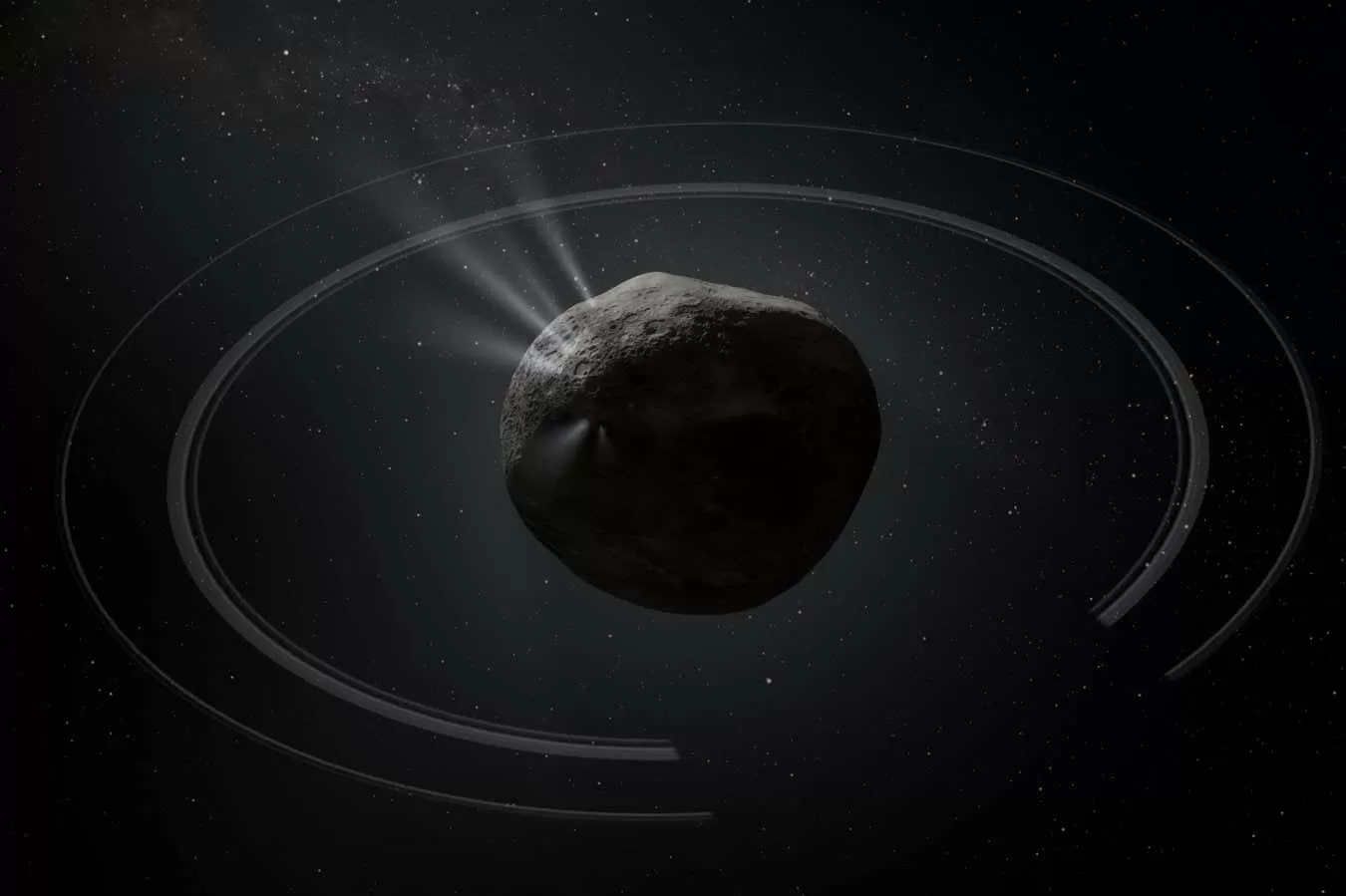
The universe is full of amazing and mysterious objects, and recently, one such object has caught the attention of scientists and astronomers alike. The comet-like object, Chiron, has been discovered to be in the process of forming new rings, a phenomenon that could provide valuable insights into the workings of these complex systems. This exciting discovery has left experts in awe and has opened up a whole new realm of possibilities for space exploration.
Chiron, also known as 2060 Chiron, is a minor planet located in the outer solar system, orbiting between Saturn and Uranus. It was first discovered in 1977 and was initially thought to be a comet due to its unusual orbit and characteristics. However, further studies revealed that it is a small, rocky object with a diameter of about 250 kilometers. Chiron is considered to be a member of the Centaur class of objects, a group of small bodies that orbit between the gas giants of our solar system.
Recently, a team of astronomers using the Atacama Large Millimeter/submillimeter Array (ALMA) telescope in Chile observed Chiron and noticed something extraordinary. They discovered that the object had a dusty debris disk around it, similar to the rings of Saturn. This is the first time that such a phenomenon has been observed in a small body like Chiron, and it has sparked a lot of excitement in the scientific community.
The new rings of Chiron are believed to be created by small particles of ice and dust that have been ejected from the surface of the object. These particles then form a disk around Chiron, similar to how planets and moons are formed in the early stages of a solar system. This process is known as accretion and is crucial in understanding how celestial bodies evolve.
One of the most interesting aspects of this discovery is that Chiron is not the only object of its kind to have rings. In fact, another Centaur object, Chariklo, was discovered to have a ring system in 2014. However, the rings of Chariklo are much more complex and dense compared to those of Chiron. This difference has raised questions about the formation and evolution of ring systems in small objects.
Scientists believe that the rings of Chiron and Chariklo could be remnants of a larger object that was destroyed in the early stages of our solar system’s formation. This theory is supported by the fact that both Chiron and Chariklo have a similar composition to that of comets and other small bodies in the outer solar system. Further studies of these rings could provide valuable insights into the early formation of our solar system and the role that these small objects played in its creation.
Apart from their scientific significance, the rings of Chiron and Chariklo also have aesthetic value. They add to the beauty and diversity of our solar system, showcasing the unique and complex nature of these celestial bodies. The discovery of the rings of Chiron has also sparked interest in studying other small objects in the outer solar system to see if they too have similar features.
The observation of the rings of Chiron is a testament to the advancements in technology and our understanding of the universe. With the help of powerful telescopes like ALMA, we are able to uncover new and exciting discoveries that were previously unknown to us. This discovery has opened up a whole new avenue of research and has the potential to reshape our understanding of small objects in the solar system.
In conclusion, the discovery of the rings of Chiron is a significant milestone in the field of astronomy and space exploration. It not only adds to our knowledge of the universe but also raises intriguing questions about the formation and evolution of celestial bodies. This discovery is a reminder that there is still so much to learn about our vast and mysterious universe, and we can only imagine what other wonders await us in the depths of space.
