
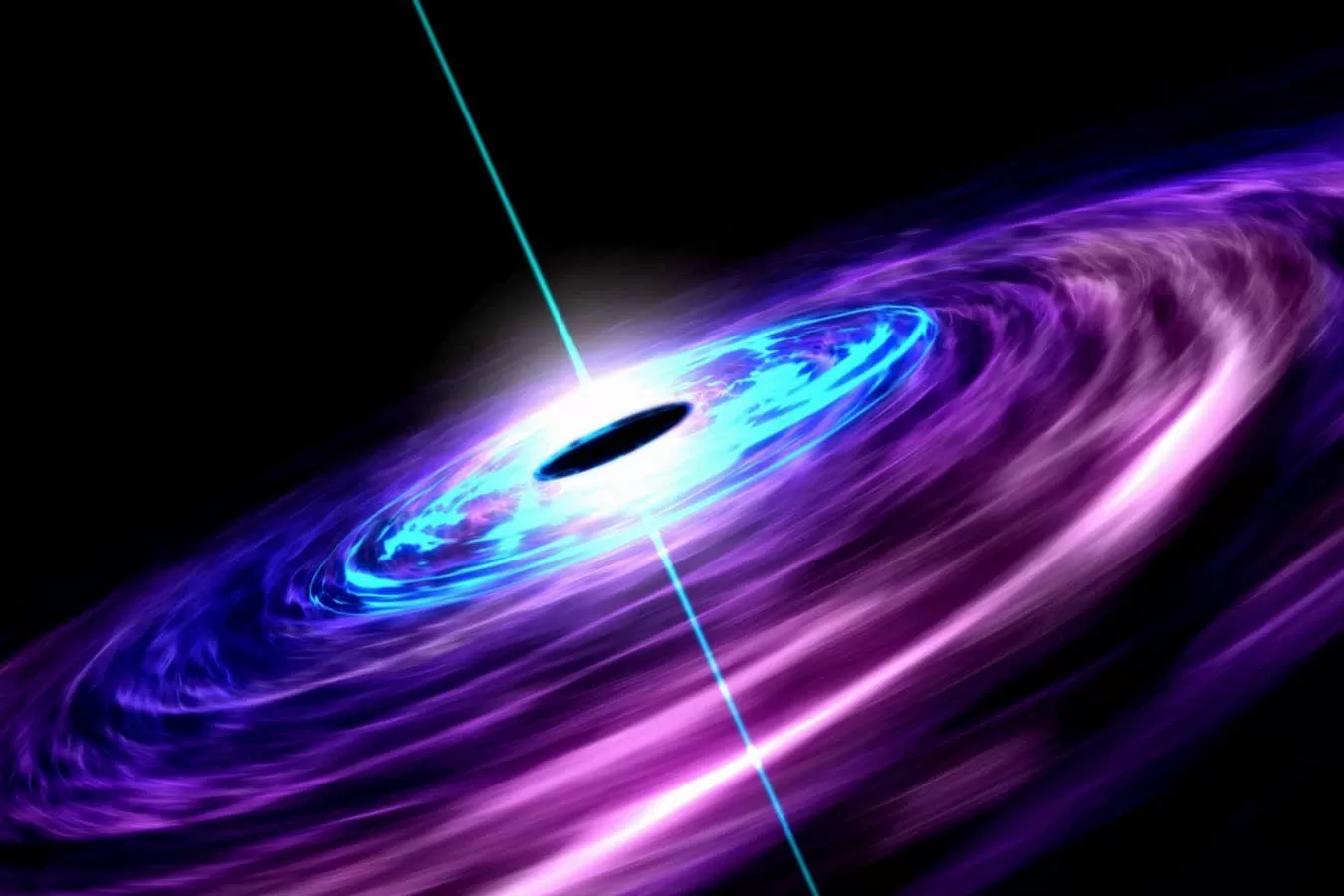
Black holes have long been a source of fascination and mystery for scientists and the general public alike. These cosmic behemoths, with their immense gravitational pull and ability to swallow everything in their path, have captured our imagination and sparked countless debates and theories about their nature and existence. But what if I told you that according to the equations that govern black holes, the entire universe could potentially be one giant black hole?
It may seem like a far-fetched idea, but let’s take a closer look at the science behind it. According to the theory of general relativity, the larger a black hole is, the lower its average density. This means that the more massive a black hole is, the more spread out its matter is. In other words, a black hole with the mass of our sun would be much more dense than a black hole with the mass of a galaxy.
Now, let’s consider the vastness of the universe. The observable universe is estimated to be around 93 billion light-years in diameter, and it is filled with countless galaxies, stars, and other celestial bodies. However, if we look at the universe on a larger scale, we can see that it is mostly made up of empty space. In fact, scientists estimate that only about 5% of the universe is made up of “ordinary” matter, while the remaining 95% is made up of dark matter and dark energy, both of which are still largely unknown to us.
So, if we apply the equation of black hole density to the universe, it seems that the universe could potentially have a very low average density, similar to that of a massive black hole. This raises the question – could the whole cosmos be a black hole?
The idea of the universe being a black hole is not a new one. In the 1970s, physicist Jacob Bekenstein proposed the idea that the universe could be a black hole in his work on the entropy of black holes. He suggested that the universe could be a black hole with a radius of about 10 billion light-years, which is consistent with the size of the observable universe.
Moreover, some scientists have suggested that the universe could be a type of black hole known as a “white hole.” Unlike a black hole, which sucks everything in, a white hole would be the opposite – it would be constantly spewing out matter and energy. This idea is based on the concept of a “wormhole,” a hypothetical tunnel through space-time that would allow for travel between two distant points in the universe. Some scientists believe that the universe could be a giant wormhole, with matter and energy constantly flowing in and out of it.
But before we start thinking about the universe as a giant wormhole or a white hole, it’s important to note that these theories are still highly speculative and have not been proven. In fact, there are many other theories about the nature of the universe, such as the “Big Bang” theory, which suggests that the universe began as a singularity and has been expanding ever since.
So, while the idea of the universe being a black hole is intriguing, it is still just a theory. We may never know for sure what the true nature of the universe is, but what we do know is that it is a vast and mysterious place that continues to inspire us to explore and discover more about it.
In conclusion, according to the equations that govern black holes, the universe could potentially have a very low average density, similar to that of a massive black hole. This has led some scientists to speculate that the whole cosmos could be a black hole, or even a white hole. However, these are still just theories and have not been proven. The true nature of the universe remains a mystery, and it is up to us to continue our quest for knowledge and understanding of our vast and wondrous universe.
