
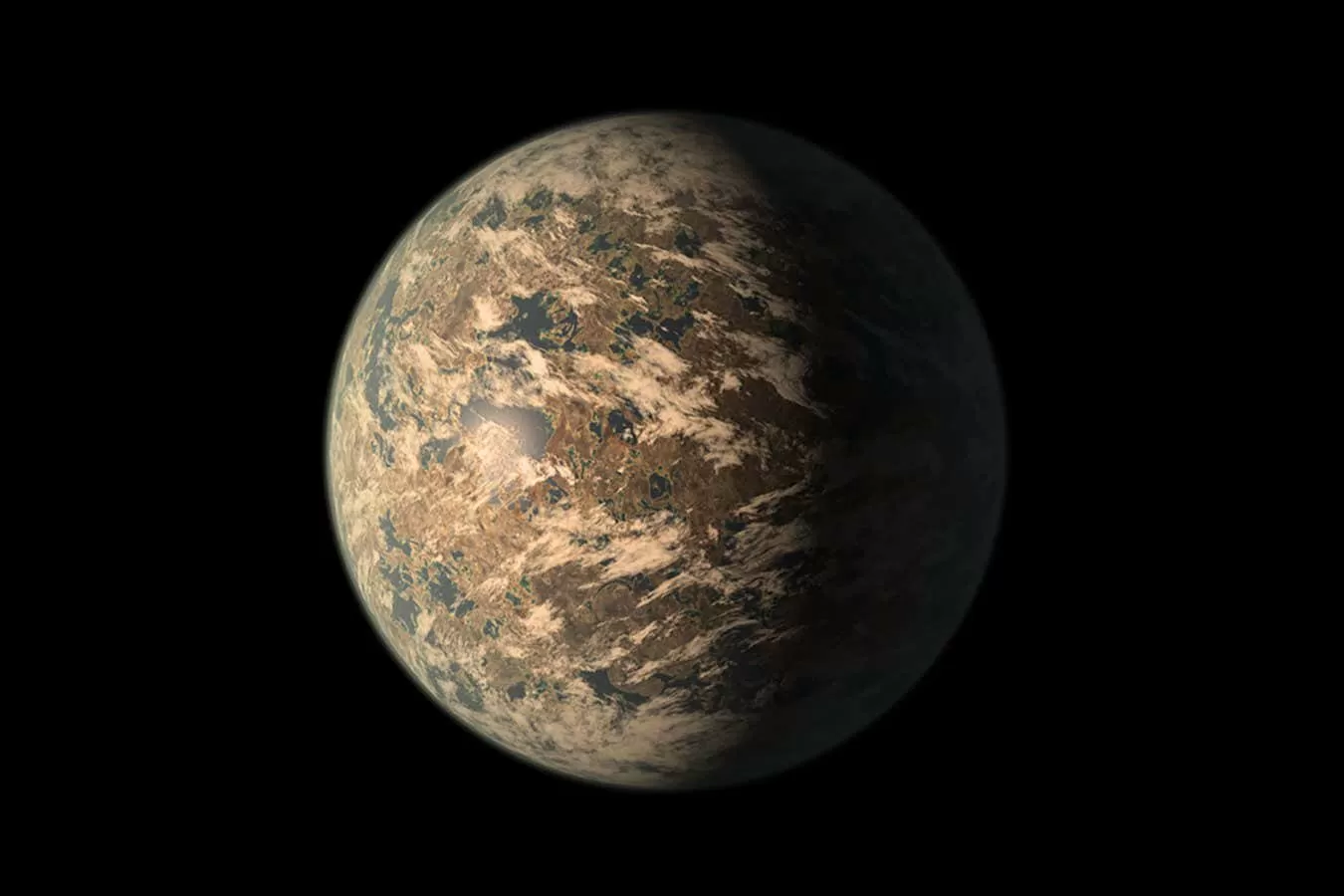
The search for habitable planets outside our solar system has been a topic of fascination for scientists and space enthusiasts alike. With the discovery of the TRAPPIST-1 system in 2016, the possibility of finding a planet that could potentially support life has become even more exciting. Among the seven planets orbiting the red dwarf star, TRAPPIST-1e has emerged as a prime candidate for hosting life due to its location in the star’s habitable zone and a recent analysis that suggests it may have a nitrogen-rich atmosphere similar to Earth’s.
TRAPPIST-1e is located approximately 40 light-years away from Earth in the constellation Aquarius. It is one of the seven planets orbiting the ultra-cool dwarf star, TRAPPIST-1, which is only slightly larger than Jupiter and much cooler than our sun. The discovery of this compact planetary system has sparked immense interest in the scientific community, as it presents a unique opportunity to study multiple planets in one system and potentially find one that could harbor life.
One of the key factors in determining a planet’s habitability is its location in the habitable zone of its star. The habitable zone, also known as the Goldilocks zone, refers to the region around a star where the temperature is just right for liquid water to exist on the planet’s surface. Too close to the star, and the planet becomes too hot, causing water to evaporate. Too far, and the planet becomes too cold, resulting in water freezing. TRAPPIST-1e is situated in the center of its star’s habitable zone, making it an ideal candidate for hosting liquid water.
Recently, a team of researchers led by Vincent Bourrier from the University of Geneva in Switzerland conducted a study to analyze the composition of TRAPPIST-1e’s atmosphere. The team used data from the Hubble Space Telescope to study the planet’s atmosphere as it passed in front of its star. This technique, known as transmission spectroscopy, allows scientists to detect the chemical fingerprints of different molecules in a planet’s atmosphere.
The results of the analysis were intriguing. The team found that TRAPPIST-1e’s atmosphere is likely to be dominated by nitrogen, with traces of other gases such as hydrogen, oxygen, and methane. This composition is strikingly similar to Earth’s atmosphere, which is primarily made up of nitrogen (78%) and oxygen (21%). The presence of nitrogen is crucial for the development of life as we know it. It is an essential element for building proteins and DNA, which are the building blocks of all living organisms.
The study also revealed that the atmosphere of TRAPPIST-1e is likely to be much denser than Earth’s, with a surface pressure estimated to be around 80 times that of our planet. This high pressure could lead to a greenhouse effect, trapping heat and making the planet warmer. This is significant because it could potentially allow liquid water to exist on the planet’s surface, even if it is further away from its star than Earth is from the sun.
The findings of this study have sparked excitement among scientists, as they provide further evidence that TRAPPIST-1e may be a habitable world. However, the presence of a nitrogen-rich atmosphere does not guarantee that the planet is indeed habitable. There are still many unknowns, such as the planet’s temperature, the presence of a magnetic field, and the potential for liquid water to exist on its surface. Further studies and observations are needed to confirm the habitability of TRAPPIST-1e.
Nevertheless, the discovery of a nitrogen-rich atmosphere on TRAPPIST-1e is a significant step towards understanding the potential habitability of planets outside our solar system. It also highlights the importance of studying exoplanets in detail to determine their suitability for life. The TRAPPIST-1 system has proven to be a treasure trove of information, and with the upcoming launch of the James Webb Space Telescope, scientists will have a powerful tool to study these planets in even more detail.
The possibility of finding a planet with a nitrogen-rich atmosphere like Earth’s is a testament to the vastness and diversity of our universe. It is a reminder that we are not alone and that there may be other worlds out there that could potentially support life. The discovery of TRAPPIST-1e and its potential habitability gives us hope and ignites our
