
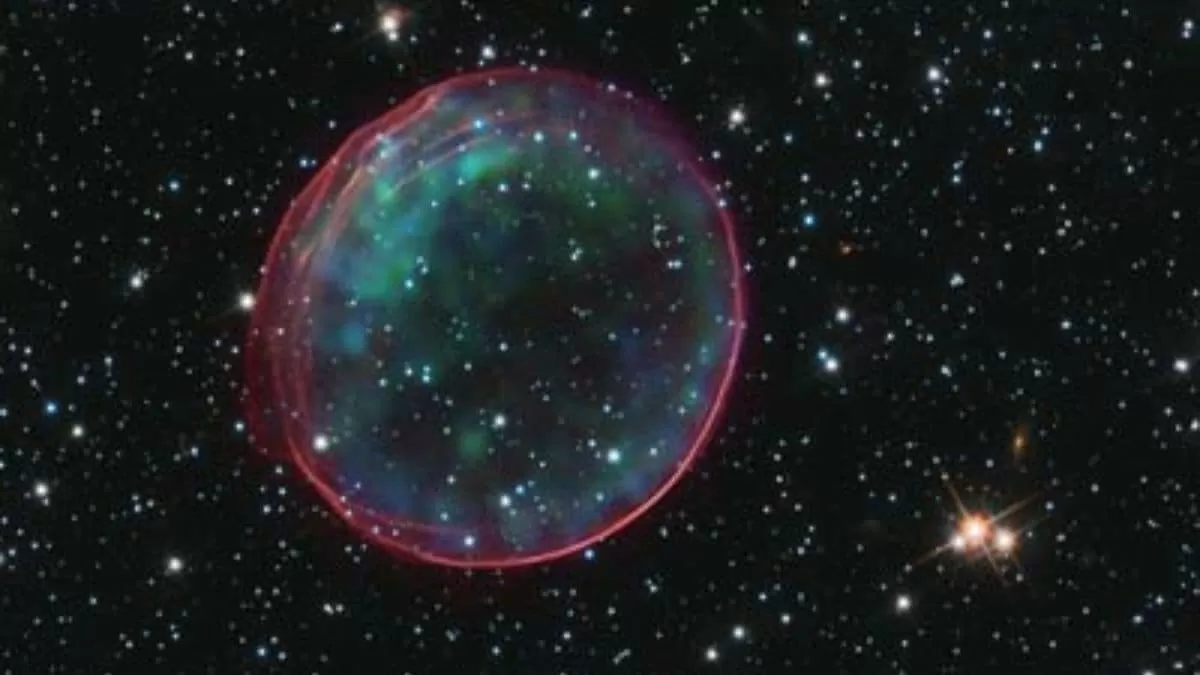
Veliki is a name that is quickly gaining recognition in the world of astronomy. This newly discovered supernova remnant, located in the Large Magellanic Cloud, has captured the attention of scientists and space enthusiasts alike. Through a global collaboration and the use of multiwavelength astronomy tools, Veliki has revealed itself to be a truly remarkable and complex celestial object.
Estimated to be 45,000 years old, Veliki is a remnant of a massive star that exploded in a spectacular supernova event. This explosion, which occurred thousands of years ago, has left behind a stunning display of shell structures and highly unusual radio properties. The discovery of Veliki has shed new light on the evolution of supernova remnants and has provided valuable insights into the processes that shape our universe.
The discovery of Veliki was made possible through the efforts of a global collaboration of scientists from various countries and institutions. This collaboration utilized a range of multiwavelength astronomy tools, including the Chandra X-ray Observatory, the Hubble Space Telescope, and the Australia Telescope Compact Array. By combining data from these different instruments, scientists were able to create a comprehensive and detailed picture of Veliki.
One of the most striking features of Veliki is its complex shell structures. These structures, which are made up of gas and dust, have been shaped by the powerful shock waves from the supernova explosion. The Chandra X-ray Observatory has captured stunning images of these structures, revealing intricate patterns and filaments that are a testament to the violent nature of the explosion.
In addition to its shell structures, Veliki also exhibits highly unusual radio properties. The Australia Telescope Compact Array has detected a strong radio emission from the remnant, which is not commonly seen in other supernova remnants. This emission is believed to be caused by the interaction between the shock waves and the surrounding interstellar medium. The unique radio properties of Veliki have sparked great interest among scientists and have raised new questions about the processes involved in the evolution of supernova remnants.
The discovery of Veliki has not only provided valuable insights into the evolution of supernova remnants, but it has also opened up new avenues for research. Scientists are now able to study the remnant in greater detail and gain a better understanding of the processes that govern the formation and evolution of celestial objects. This knowledge is crucial in our quest to unravel the mysteries of the universe and to further our understanding of the world we live in.
The discovery of Veliki is a testament to the power of collaboration and the advancements in technology that have allowed us to explore the depths of space. It is a reminder that there is still so much to discover and learn about our vast and complex universe. With each new discovery, we are one step closer to unlocking the secrets of our existence.
As we continue to study and observe Veliki, we can only imagine what other wonders and mysteries it holds. Its beauty and complexity serve as a reminder of the infinite possibilities that exist in our universe. The discovery of Veliki is a true testament to the wonders of science and the human spirit of exploration.
In conclusion, Veliki is a newly discovered, massive supernova remnant that has captured the attention of the global scientific community. Through a collaborative effort and the use of multiwavelength astronomy tools, this celestial object has revealed itself to be a complex and intriguing phenomenon. Its discovery has provided valuable insights into the evolution of supernova remnants and has opened up new avenues for research. Veliki is a shining example of the endless possibilities that exist in our universe and serves as a reminder of the power of human curiosity and determination.
