
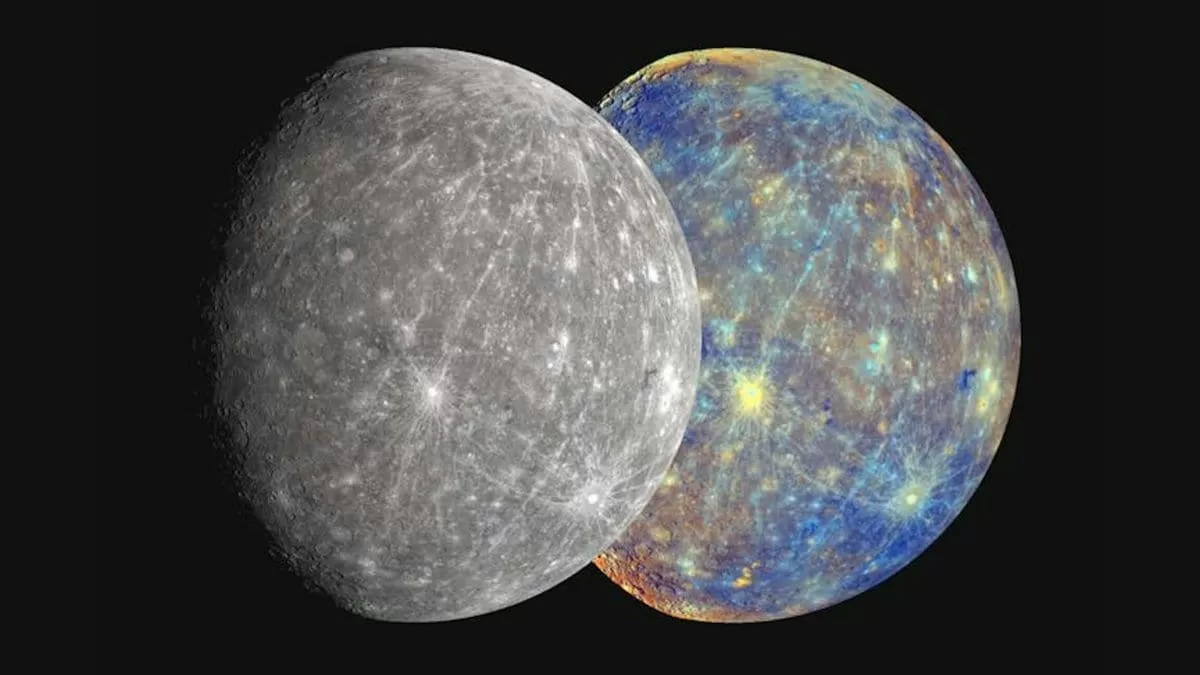
A groundbreaking new study has raised the possibility that two meteorites, known as Ksar Ghilane 022 and NWA 15915, may have originated from the planet Mercury. If proven true, this would be the first time that meteorites from Mercury have been discovered, providing valuable insights into the composition and history of our solar system.
The two meteorites were found in the deserts of North Africa and the Sahara, respectively, and have been the subject of intense research by a team of scientists led by Dr. Anthony Irving from the University of Washington. The team’s findings, published in the journal Meteoritics & Planetary Science, suggest that these meteorites share notable similarities with the surface minerals of Mercury, but also present some differences that complicate a clear link.
Mercury, the smallest and innermost planet in our solar system, has long been a mystery to scientists due to its proximity to the sun and its extreme temperatures. The planet’s surface is covered in a thick layer of dust and has been heavily bombarded by meteorites, making it difficult to study. However, the discovery of these two meteorites may provide a rare opportunity to gain a deeper understanding of Mercury’s composition and geological history.
Ksar Ghilane 022 and NWA 15915 were both classified as achondrites, a type of meteorite that is believed to originate from the inner rocky planets of our solar system. This classification, along with their unique chemical and mineral composition, led the team to suspect that these meteorites may have come from Mercury.
One of the key similarities between the meteorites and Mercury’s surface is the presence of a mineral called feldspar. This mineral is abundant on Mercury and is also found in both Ksar Ghilane 022 and NWA 15915. Additionally, the meteorites contain a high concentration of magnesium, which is also a characteristic of Mercury’s surface.
However, the team also found some differences between the meteorites and Mercury’s surface. For example, the meteorites contain a higher concentration of iron and a lower concentration of sulfur compared to Mercury. This suggests that the meteorites may have originated from a different region of Mercury or from a different time in the planet’s history.
Dr. Irving and his team are now working to further analyze the meteorites in order to confirm their origin. This will involve studying the isotopic composition of the meteorites, which can provide valuable information about the age and location of their formation. If the results confirm their suspicions, it would be a groundbreaking discovery that could change our understanding of Mercury and the early stages of our solar system.
The discovery of these potential Mercury meteorites is a testament to the power of scientific research and the endless possibilities that lie within our universe. It also highlights the importance of continued exploration and study of our solar system, as there is still so much we have yet to discover.
In addition to shedding light on Mercury’s composition, these meteorites could also provide insights into the formation and evolution of other rocky planets, including Earth. By studying the similarities and differences between these meteorites and Mercury’s surface, scientists may be able to piece together a more complete picture of our solar system’s history.
The possibility of these meteorites originating from Mercury is an exciting prospect that has the scientific community buzzing with anticipation. It is a reminder that there is still so much to learn about our universe and that the answers to some of our biggest questions may be waiting to be discovered in the most unexpected places.
As Dr. Irving and his team continue their research, we eagerly await their findings and the potential confirmation of these meteorites’ origin. This discovery could open up a whole new realm of possibilities and pave the way for future studies and missions to Mercury.
In conclusion, the discovery of two potential Mercury meteorites, Ksar Ghilane 022 and NWA 15915, is a groundbreaking development that has the potential to revolutionize our understanding of our solar system. While further research is needed to confirm their origin, the similarities between these meteorites and Mercury’s surface minerals are a promising indication that we may have finally found pieces of the elusive planet. This discovery is a testament to the power of scientific exploration and serves as a reminder that there is still so much we have yet to discover about our vast and mysterious universe.
