
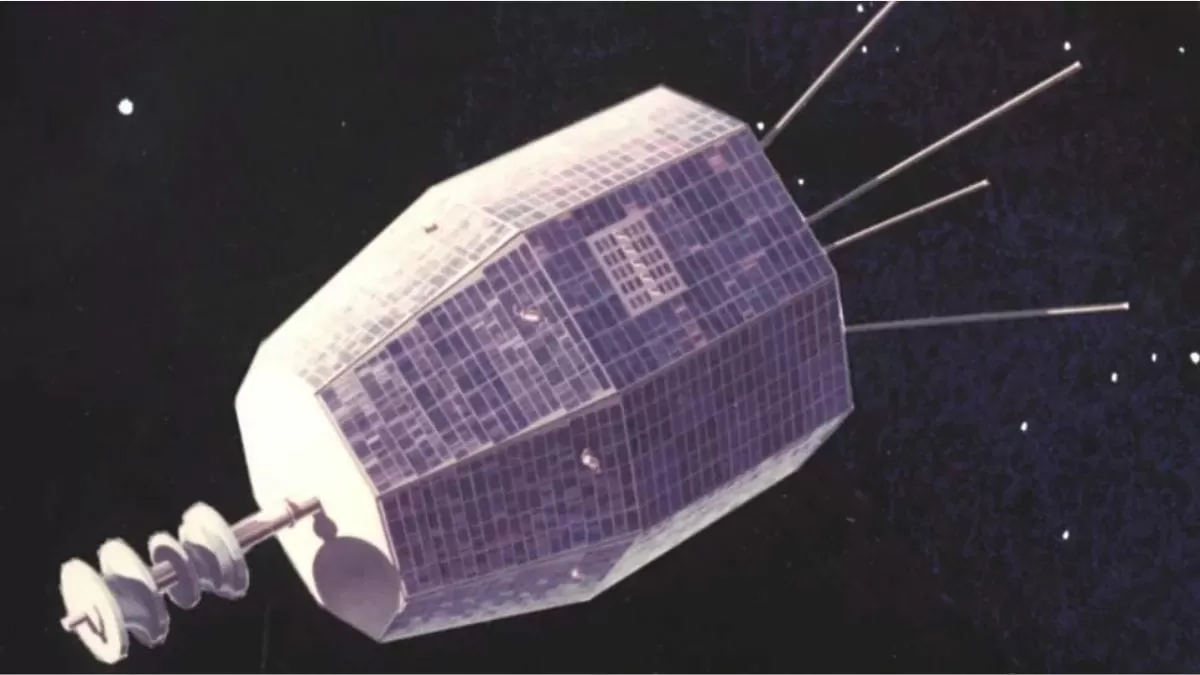
In June 2024, the scientific community was left scratching their heads when a mysterious 30-nanosecond radio burst was detected. For months, scientists were baffled by the source of the signal, until they made a shocking discovery – it was coming from a NASA satellite that had been offline since 1967.
The satellite in question, Relay 2, was launched in 1964 as part of the NASA’s first successful communication satellite program. It was designed to relay communication between Earth and spacecrafts in orbit. However, in 1967, the satellite suddenly went offline and was never heard from again. Its sudden disappearance was a mystery that remained unsolved for over half a century.
But now, in 2024, scientists have finally solved the puzzle. In a new preprint study, researchers have revealed that the signal detected in June was coming from Relay 2. The discovery has sent shockwaves through the scientific community and has shed new light on the capabilities of defunct satellites.
The study, led by a team of researchers from the California Institute of Technology, details how the signal from Relay 2 could have been triggered by either a micrometeorite impact or an electrostatic discharge. Both of these events are common in space and could have caused the satellite’s electronics to briefly come back to life.
This groundbreaking discovery has opened up a whole new realm of possibilities for scientists. Until now, defunct satellites were seen as nothing more than space junk, taking up valuable space and posing a potential threat to active satellites. But this new finding has shown that even after decades of being offline, these satellites can still hold valuable information.
The fact that a satellite that has been offline for over 50 years could still emit a signal strong enough to be detected by Earth-based telescopes is truly remarkable. It highlights the resilience and durability of these man-made objects, and how they can continue to surprise us even after all this time.
Moreover, this discovery has also highlighted the importance of continuously monitoring the skies for any signals or anomalies. With the advancement of technology, scientists now have the ability to detect and analyze signals from far-off objects in space, even those that were previously thought to be dormant.
The study of defunct satellites has now become an area of interest for scientists. They believe that there could be many more satellites out there, waiting to be discovered and studied. These satellites could provide us with valuable information about the history and evolution of our space technology.
The discovery of the signal from Relay 2 has also sparked a debate among scientists about the potential uses of defunct satellites. Some have suggested that these satellites could be repurposed for new missions, while others believe that they should be left alone as a part of our space history.
Regardless of the future use of defunct satellites, this discovery has shown that there is still so much to learn and explore in space. It has reignited the curiosity and passion of scientists and has motivated them to continue pushing the boundaries of our knowledge.
The fact that a signal from a satellite that was launched over half a century ago could still be detected is a testament to the incredible achievements of NASA and the advancements in space technology. It is a reminder that even when we think we have uncovered all there is to know about the universe, there is always something new and unexpected waiting to be discovered.
In conclusion, the discovery of the signal from Relay 2 has left scientists in awe and has opened up a new chapter in the study of defunct satellites. It has highlighted the resilience and capabilities of these man-made objects and has shown that even after decades of being offline, they can still surprise us with their secrets. This discovery serves as a reminder to never stop exploring and to always keep our eyes open to the wonders of the universe.
